The sanctuary of Poseidon at Samikon had been the object of archaeological search for over a century. The ancient geographer Strabo describes in his Geographika (Book 8) a famous sanctuary of Poseidon in Triphylia (Elis), which served as the central cult centre of the Triphylian cities and was administered by Makistos. His account locates the sanctuary on the west coast of the Peloponnese, at the foot of Mount Lapithos. Topographical landmarks such as the prominently visible fortress of Samikon and the nearby Grotto of the Nymphs with its warm sulphurous springs – most likely identical with the cave and hot springs of Kaiafa – support this localisation.
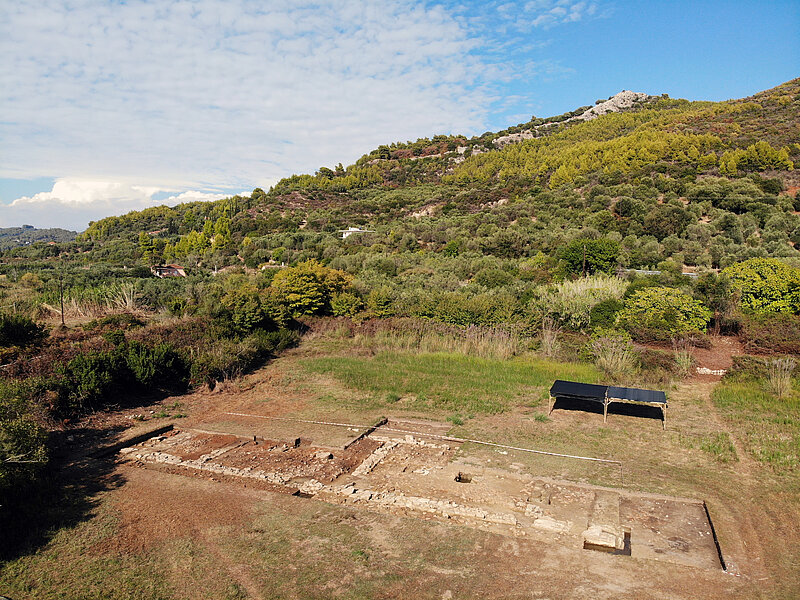
Based on Strabo’s description, the sanctuary was assumed to be situated in the area of the Kleidi hills below the ancient fortress of Samikon. However, the swampy terrain between the lagoons of Kaiafa and Agoulenitsa long hindered systematic exploration, leaving the sanctuary undiscovered.
Since 2017, the Austrian Archaeological Institute (OeAI) and the Ephorate of Antiquities of Elis, in collaboration with the universities of Mainz and Kiel, have been conducting geoarchaeological and geophysical surveys. Geomagnetic prospection in 2021 revealed the outline of a building that could be identified as a temple. Excavations of this monumental structure have been carried out since 2022 under the direction of Birgitta Eder (OeAI Athens) and Erofili-Iris Kolia (Ephorate of Elis) (Fig. 1).
The results obtained so far (as of 2025) allow the following reconstruction: the elongated rectangular building (9.44 × 27.88 m) comprises two large halls with axial interior supports and two symmetrically arranged porches to the southeast and northwest. Both façades feature two columns in antis and a pitched roof with Laconian tiles. The temple was probably constructed in the 6th century BC and went out of use in the early 3rd century BC. (Fig. 2)
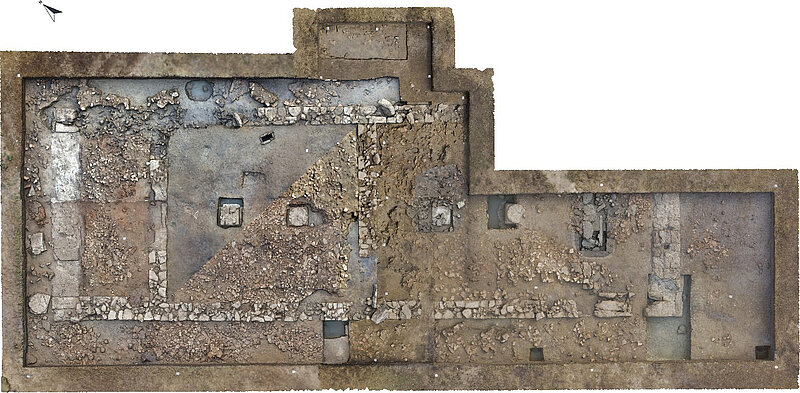
A dense layer of roof tiles covered the entire temple area, evidently representing the collapse of the roof after a fire, as indicated by charcoal concentrations and fragments of secondarily fired mudbrick. A few pottery sherds – mainly from drinking vessels – date this context to around 300 BC.
Of particular importance is a large bronze tablet (40.5 × 27.5 cm) found in the north-western hall. The inscription, dated to the 4th century BC, explicitly mentions the dedication of the tablet in the sanctuary of Poseidon Samios, thereby confirming the identification of the long-sought site. The edition of the inscription is being prepared by Sophia Zoumbaki (Athens) and Hans-Joachim Gehrke (Freiburg).
Also, from the same hall comes a large marble perirrhanterion (ritual cleansing basin) with elaborately shaped handles imitating bronze prototypes of Archaic date. Ancient repairs on the vessel attest to its prolonged use.
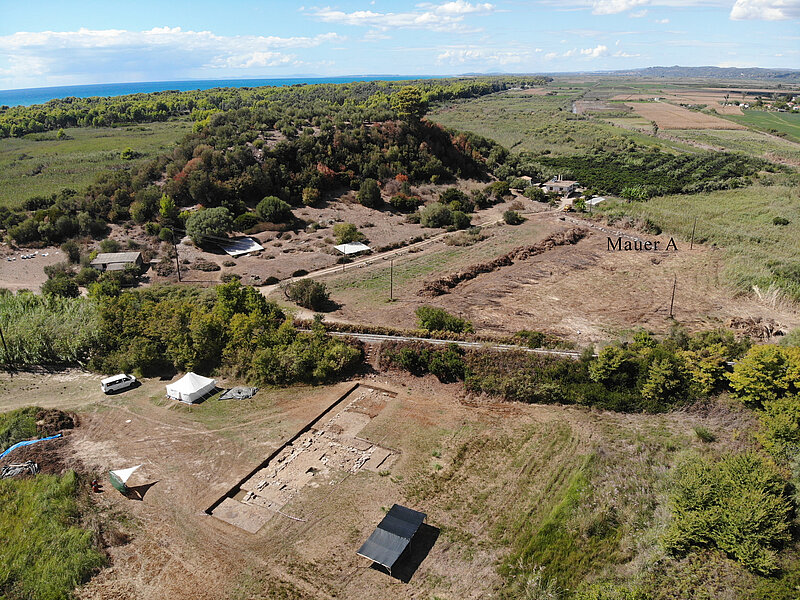
In parallel with the excavation of the temple, the wider sanctuary area is being investigated (Fig. 3). A massive double-faced wall to the north of the site, already noted by Wilhelm Dörpfeld, may, according to current research, have formed part of a dam construction protecting the sanctuary from the lagoon waters to the north.
Documentary film by the Gerda Henkel Foundation (6 episodes)
until 12/2027