In most cases, only traces of the original polychromy of ancient sculptures survive, and analyses are limited to qualitative descriptions. Pigment provenance analysis by mass spectrometry requires sample material. However, it is unclear how small the sample quantity can be for reliable geochemical results.
This pilot project investigates the following questions: Can samples of ancient polychromy taken with cotton swabs be sufficient for reliable provenance analysis? How small can the samples be to cause as little damage as possible to the ancient polychromy while also enabling reliable geochemical analyses?

Cotton swabs previously soaked in weak nitric acid were carefully moved across the surface of previously analyzed objects. This allowed minimal samples to be taken without causing significant damage to the ancient polychromy.
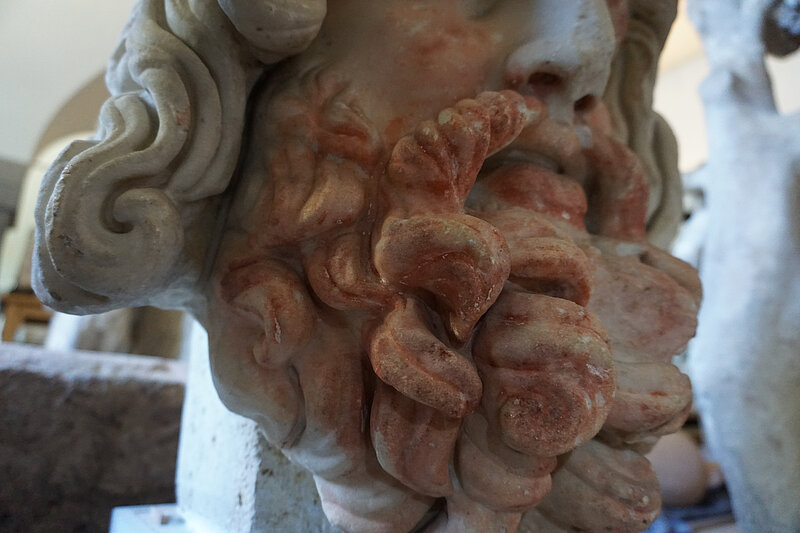
The sampled objects are a conglomerate of several Egyptian blue pellets (Fig. 1) from an Egyptian blue production workshop in Memphis, Egypt, that was active between the 3rd century BC and the 3rd century AD. This object was dated to the 1st century BC. The second object is a marble head of Zeus with red paint (Fig. 2) from Lazio, Italy, dating to the 1st century BC. Here, samples were taken from the beard.
The samples were then analyzed for their trace element and lead isotope composition. The results could be compared with previous lead isotope analyses, which showed that the sampling and quantity were largely sufficient to reproduce the results.
The pigment raw materials, especially copper for Egyptian blue production in Memphis, likely came from Greece, while the raw materials for the red pigment used for the Zeus marble sculpture probably came from Spain or Sardinia. Although such geochemical results can provide insight into trade connections, the various stages along the path from raw material sources to works of art remain uncertain.