Hundreds of thousands of papyri have survived from the ancient Mediterranean, but only 6% of this material has been deciphered, due to the difficult and time-consuming nature of this task. This project aims to channel the power of advanced AI to accelerate the decipherment of ancient documents and unlock vast historical archives from antiquity.
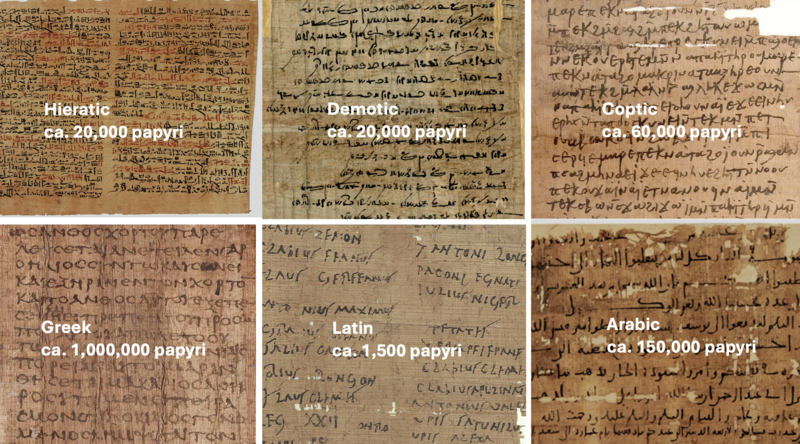
For decades, knowledge of ancient documents has been fragmented and not easily accessible due to physical and human limitations. Dry regions around the Mediterranean have preserved hundreds of thousands of documents on organic materials, including as many as 1 million papyri in Ancient Greek from the Hellenistic, Roman, Byzantine and early Islamic world (ca. 300 BCE–800 CE). After ca. 140 years of papyrological scholarship, barely 6% percent of this material has been published, which reflects the difficulty of this task and the limited supply of papyrological experts. At the current rate of publication, it would require more than 2 millennia to publish all surviving papyri.
Any single papyrus may contain historically significant and potentially groundbreaking insights, such as the stunning Greek record of a criminal trial for tax evasion on the eve of a cataclysmic rebellion in the Roman Near East (https://www.nytimes.com/2025/04/14/science/archaeology–papyrus–tax–fraud–trial.html) or the sensational discovery of excerpts from two new plays of Euripides (https://www.lrb.co.uk/the–paper/v46/n18/robert–cioffi/euripides–unbound). And yet, most of these documents remain hidden in papyrus collections without any means of acquiring even an approximate sense of the content of unpublished material.
In partnership with leading AI developers Mistral AI and SAIL Reply, this project aims to build cutting-edge multimodal Large Language Models (LLMs) for ancient languages and LLM-powered Vision-Language Models to propel the decipherment of ancient documents. We have started with Greek and created Apollo, the first LLM for Ancient Greek, trained on 600 million words of historical Greek sources and optimized for text restoration. The next step will be to train a Vision-Language model to transcribe masses of unread Greek papyri, of which the Austrian National Library holds one of the world's largest collections. We further intend to develop advanced AI systems for Latin and other ancient languages.
10/2025–10/2028