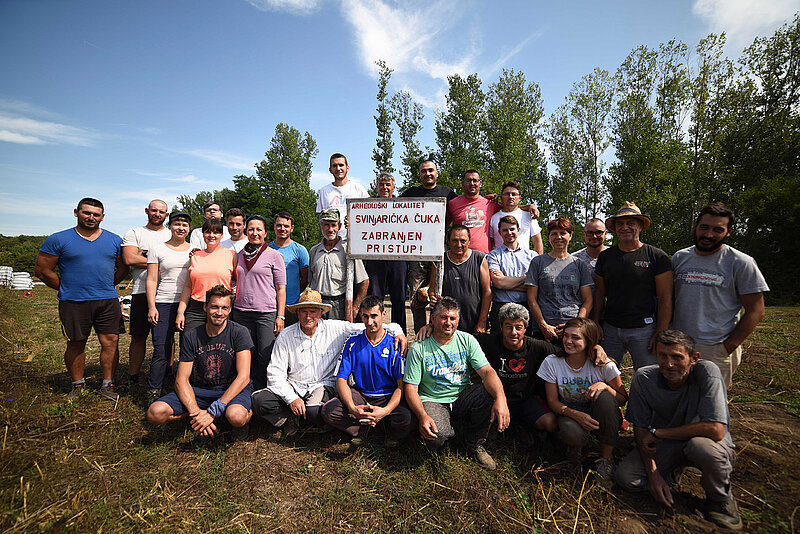
The NEOTECH project aims to shed new light on the Neolithisation process in the central Balkans. Excavations were conducted at the site of Svinjarička Čuka, during which remains of the Neolithic and the Metal Ages could be identified. This data will be contextualised along the Axios-Vardar-Morava River system, one of the main communication routes between the Aegean and the Danube.

The »Pusta Reka Research Collaboration« was initiated in 2017 between the former OREA Institute of the Austrian Academy of Sciences (Barbara Horejs) and the Archaeological Institute in Belgrade (Aleksandar Bulatović). The regional focus of this collaboration lays in the Leskovac Basin with an area of ca. 1,600 km² and its first permanent settling in Neolithic times, where we are cooperating with the Archaeological Museum of Leskovac. The development of the landscape and usage of the environment through prehistory forms an additional aspect of our investigations, including changes from the Early Neolithic until the end of the Bronze Ages. The first systematic survey campaign took place in 2017 and provided new data regarding the prehistory in the region and a first insight into the landscape and the environmental conditions as well as in the potential raw material sources. Extensive and intensive archaeological surveys formed the basis for geophysical surveys and corings in the selected areas. GIS analyses, material studies and radiocarbon dating of core samples have been conducted. Of altogether 20 detected and surveyed prehistoric sites at least five of them revealed results indicating their use in early to middle Neolithic period. The results of the surveys and geological studies have been published already (Brandl – Hautzenberger 2018; Horejs et al. 2018).
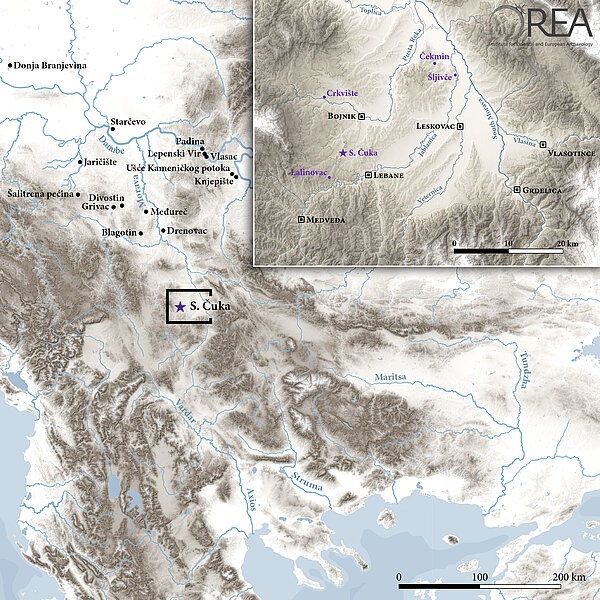
The collaborative studies have been awarded with funding by the Austrian Science Fund (FWF project »NEOTECH«) and the Innovation Fund of the Austrian Academy of Sciences (»Visualising the Unknown Balkans« project). The NEOTECH project aims to shed new light on the Neolithisation process in the central Balkans by analysing the built environment in combination with the potential impact of new social and cultural technologies. The adoption of the two crucial aspects in the region are key – living in house-based communities and integrating new technologies for production of material culture, especially in lithic and ceramic technologies. New primary data from state-of-the-art excavations are planned to be contextualized in the Neolithisation process along one of the main communication routes between the Aegean and the Danube by the Axios-Vardar-Morava River system.
The newly detected site Svinjarička Čuka was selected for the first systematic excavations in the project, where remains of the Starčevo Neolithic and the Metal Ages could have been identified during the surveys. The site is situated on the small-elevated Svinjarička River terrace northeast of the famous Caričin Grad in the Lebane district. The preliminary results demonstrate the occupation of the river terrace in Early to Middle Neolithic period (Starčevo), in the Late Copper Age, in middle to Late Bronze Age as well as in the Iron Age and perhaps the Byzantine period. Additionally, some finds from the Palaeolithic could be identified, indicating at least the presence of hunter-gatherers in the area:
The Iron and Bronze Age structures are being investigated by our partners at the Archaeological Institute in Belgrade. First results suggest extensive trade relations towards the Aegean, especially during the earlier periods.
With regard to the Neolithic period, six settlement phases could be identified so far, within which numerous usage horizons have been uncovered. The focus of the excavations in recent years lied upon investigating the earliest settlement layers. Of particular interest herein are the remains of a burnt-down rectangular house structure, which has been dated to around 6200-6000 cal. BC. Further built structures from later periods were identified in other areas of the site and are currently under investigation.
Another key area of the excavations at Svinjarička Čuka is an extensive sampling strategy, encompassing – among others – the fields of archaeobotany, archaeozoology, aDNA, 14C, soilphosphates, mikromorpholgy, trace elements and raw materials.
The excavation results are regularly presented to a broader public at a Media Days during both, the museum campaigns at the National Museum of Leskovac and during the excavations Consequently, various reports appeared in print media and TV. Additional information is constantly provided via OeAI's social media platforms.
During the state visit of the Austrian President A. Van der Bellen in the Republic of Serbia in October 2018, a network for scientists meeting took place in the Austrian Embassy in Belgrade in the course of the visit. The potential of Austrian-Serbian collaborations in archaeology was recorded and led to a new initiative of the Austrian Embassy dedicated to archaeology and history. A new lecture series about »Archaeology in Modern Era« has been initiated by the ambassador in collaboration with the Austrian Academy of Sciences and various Serbian scientists. The lecture series started successfully in September 2019 and is planned for a year with regular lectures by Serbian and Austrian archaeologists, anthropologists and historians for a broader public.
In August of 2025 a newly curated permanent exhibition about the site and its history, together with a new book, will be presented at the National Museum of Leskovac. During the 2024 campaign, the »Artist in Archaeology« Initiative took place at the site. Elham Hadian, a Vienna-based artist, joined the excavations to search for an inspiration for her next art project. This was successfully concluded with the »Exposed Layers« artistic installation in June-July 2025 at the Barvinskyi Galery in Vienna.
The interdisciplinary team managed by B. Horejs (OeAI) and A. Bulatović (Institute of Archaeology in Belgrade) includes postdoctoral experts for raw materials (M. Brandl, OeAI), lithics (B. Milić, OeAI), ceramics (M. Svilar, C. Burke, OeAI), archaeobotany (D. Filipović, Kiel University), archaeozoology (D. Grujić, Institute of Archaeology in Belgrade, J. Bulatović, University of Belgrade, M. Blanz, University of Oxford, E. Vegh, University of Vienna, N. Radovanović), micromorphology (L. Webster, OeAI), geophysics (C. Meyer, Berlin) and geography (St. Schneider, Osnabrück University). Excavation engineers, technicians and photographers are providing their expertise in fieldwork and material studies (M. Börner, D. Blattner, F. Ostmann, OeAI). The excavation serves as a field school for the Institute of Prehistoric and Hstorical Archaeology of the University of Vienna. Additionally, PhD (A. Papadogianni, University of Vienna) and MA and PhD students (E. Weissensteiner, S. Pail, M. Luger, K. Krupa, J. Valci, all University of Vienna, S. Wernado, University of Tübingen) are integrated in the project”, and should be corrected to “The excavation serves as a field school for the Institute of Prehistoric and Hstorical Archaeology of the University of Vienna. Additionally, PhD (A. Papadogianni, University of Vienna) and MA students (E. Weissensteiner, S. Pail, M. Luger, K. Krupa, J. Valcčić, all University of Vienna, S. Wernado, University of Tübingen) are integrated in the project.