Urban research in Ephesos is understood as an interdisciplinary field that encompasses topics such as urbanization, spatial organization, architecture, infrastructure, social and economic dynamics, as well as environmental aspects. Field studies are being conducted at several critical points in Ephesos to analyze urban processes in their full complexity.
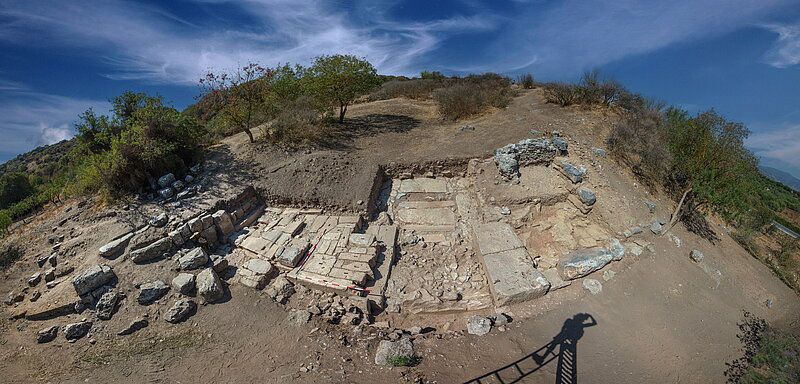
Since 2024, the Austrian Archaeological Institute has been researching a gate complex located between the Stadium and the terrace east of the Vedius Gymnasium. The monument, which can probably be identified as the so-called Coressian Gate, occupies a key position within the urban fabric. Together with the harbor gates that mark the city’s entrance from the sea and the city entrances in the west (below the so-called St. Paul’s Prison) as well as in the southeast (the Magnesian Gate), the Coressian Gate forms an important junction in the topography of Ephesos. Although it is not the largest known city gate, it is situated where major roads lead into the city. The significant role of the Coressian Gate is evidenced by the Salutaris inscription (IvE 27) from AD 104 . This inscription provides a precise description of the foundation by Gaius Vibius Salutaris, which included, among other things, a recurring procession and celebrations in honor of the goddess Artemis. The procession culminated impressively at the Coressian Gate.
The current research addresses not only chronological and architectural questions, but also focuses on the multifaceted role of the city gate in urban planning and usage, as well as its function as a transitional space between the city and its hinterland.
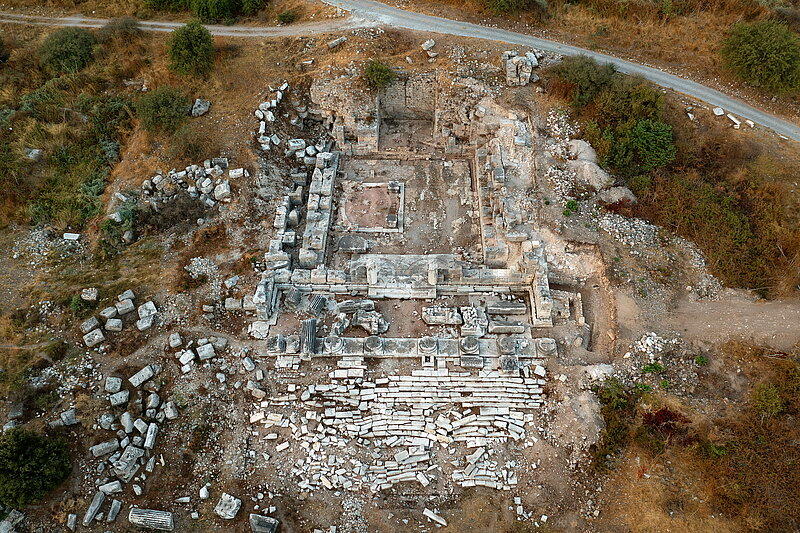
The Serapeion at the foot of Bülbüldağ in Ephesos is one of the most impressive and enigmatic monuments of the ancient city. Built before the mid-2nd century AD, the structure—being the largest monolithic temple in Asia Minor—represents not only an architectural high point of the Roman Imperial period but also raises a series of questions that have puzzled researchers for more than a century: Why was this magnificent temple built? Which deity was worshipped there? And what was the temple’s significance in the urban landscape of Ephesos? Our investigations approach these questions with an interdisciplinary methodology that combines archaeological, architectural-historical, and historical methods.