During the later Middle Bronze Age (15th and 14th centuries BCE) people in Sicily maintained relationships with many other societies in the Bronze Age world, as can be seen from Maltese, Aegean, Cypriot and Near Eastern artefacts found especially in SE Sicily. The project centers on a necropolis at Syracuse and its wider region. With the intend to analyze both the local society as well as its external relationships, the scholars involved investigate burial habits, nutrition, mobility, living conditions, social structure, and economy.
The Sicilian Middle Bronze Age
Thapsos in southeastern Sicily is the eponymous site for an entire Middle Bronze Age (MBA) culture group (facies) spread across the island. Paolo Orsi’s excavations at Thapsos and other sites in the region during the late 19th and early 20th centuries provided the basic archaeological data that still shape our picture of the 15th/14th century BCE on the largest island of the Mediterranean. During the MBA the Sicilian populations maintained relationships with many other parts of the Bronze Age world, as Maltese, Aegean, Cypriot and Near Eastern artefacts in the cemeteries of the Thapsos facies testify. However, the documentation of closed burial assemblages through stratigraphic excavation and the archaeometric analysis of artifacts and human remains are huge desiderata for the MBA and later BA periods in Sicily.
The chamber tombs at Syracuse and Thapsos
The project focusses on a cemetery of MBA rock-cut chamber tombs inside the archaeological park at the ancient Neapolis of Syracuse and on the well-known coeval cemetery of Thapsos located on the coast 10 km to the north of Syracuse. Both cemeteries stand out in terms of eastern Mediterranean imports and a considerable variety of local grave goods. They offer the possibility to investigate burial contexts by archaeological excavation and study of assemblages excavated in the last decades, in order investigate burial habits, nutrition, living conditions, economy, and social structure.
Methodology
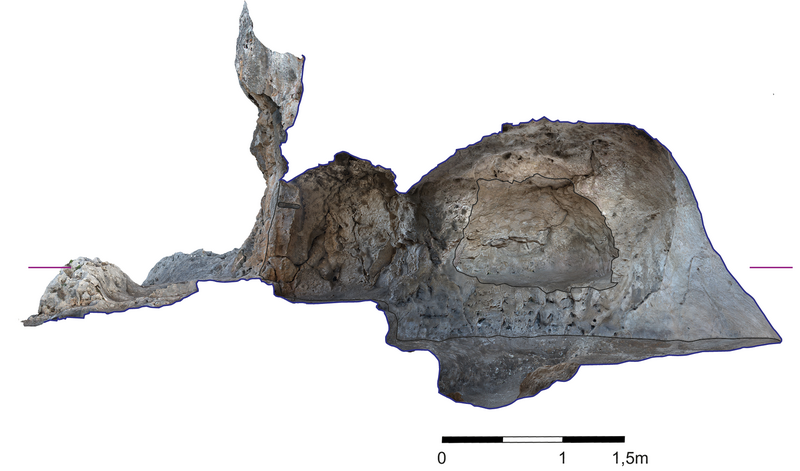
The architecture of the graves is measured and described in detail, photo-based 3D models are calculated, and the exact locations of the individual graves are plotted on topographical maps. Typological analyses of local ceramics, metal objects and Mycenaean imports serve to establish the historical-archaeological chronology, while 14C-dates provide an additional absolute time frame. The methods of physical anthropology in combination with proteomic sex identification, aDNA analyses, investigation of nutrition and mobility by stable isotope analyses (including laser ablation) reveal the biological characteristics of the buried individuals, while hypotheses on Bronze Age social kinship relations will be tested with the help of social anthropology. Archaeological, elementary, isotope and petrographic analyses of ceramics and metals will provide information on production and exchange practices. Furthermore, zooarchaeological investigation of animal bones, stable isotope analyses on animal teeth and organic residue analyses on pottery provide insight into subsistence economy and consumption practices.

07/2024–06/2027
FWF-Projekt PAT 1177724