During the past decade, the »ancient DNA revolution« has reopened key questions about prehistoric kinship that within archaeogenetics is narrowly viewed as genetic proximity. From a socio-cultural anthropological perspective, however, kinship is not only a biological but also a performative and imaginary principle for structuring and maintaining social relations. Frequently, it is not blood but houses that play a crucial role in forming kinship relations. Therefore, a unified study of dwelling spaces and biological markers of kinship is crucial to understanding kinship in prehistory.
• How can the material structures such as settlements, buildings, artifacts, and biological markers be read as ‘material codes’ of prehistoric kinship?
• How can ethnographic reports exemplify rather than verify variability in kinship during prehistory?
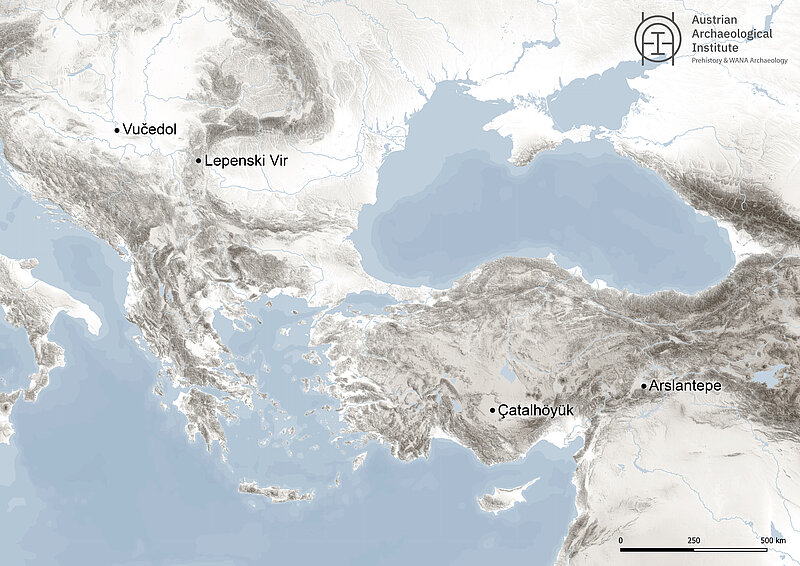
Four research sites in southeastern Europe and Anatolia: Çatalhöyük, Lepenski Vir, Arslantepe, and Vučedol.
X-KIN will align ethnographic reports with archaeological data to further contextualize houses and settlements as well as biological signatures of individuals to illuminate prehistoric kinship practices. This will be achieved through triangulation of analytical methods; by employing archaeology of kinship approaches based on cross-cultural anthropological insights, controlled comparison between ethnographic and archaeological material, and regional comparison between archaeological sites.
Several archaeologists have voiced the need for archaeologists to move beyond understanding kinship through biogenetic links but as a social practice instead – joining well-known insight from earlier socio-cultural anthropology. For the first time, kinship in prehistory will be addressed from an interdisciplinary perspective, including socio-cultural anthropology, bioarchaeology, and prehistoric archaeology, within a common analytical framework.
Special Issue
Cveček, Sabina, Maanasa Raghavan and Penny Bickle (Eds.) (2026) Kinship Trouble: Traversing Interdisciplinary Boundaries between Archaeology, Archaeogenetics, and Socio-cultural Anthropology. Cambridge Archaeological Journal.https://www.cambridge.org/core/journals/cambridge-archaeological-journal/issue/2189928F75F29A46CD24D5188C52421D
Journal Articles
Cveček, S., Timothy Earle, Carol R. Ember, Gary M. Feinman, William A. Parkinson, Funerary Placement in the Past and Present: Uses of Ethnographic Analogy for Archaeological Interpretation. American Antiquity. Published online 2026:1-20. https://doi.org/10.1017/aaq.2026.10208
Cveček, S., Maanasa Raghavan, and Penny Bickle (2026) Kinship Trouble: What, When, Where, Why, and How—and So What? Cambridge Archaeological Journal 36(2): 151-164. https://doi.org/10.1017/S0959774326100389
Cveček, S. and Andre Gingrich (2026)Kinship Analysis in Specified Contexts: When Interdisciplinary Collaboration is too Narrow, Results Tend to be Misleading. Cambridge Archaeological Journal 36(2): 238-246. https://doi.org/10.1017/S0959774326100390
Francois C. Romijn, Emma Kowal, Catherine J. Frieman, Sarah Abel, Anna Källén, Sarah Abel, Shumon Hussain, Sabina Cveček, and Francisco Vergara-Silva (2026) Engaging with Palaeogenomics beyond the Lab. Anthropology Today 42(3): 7-10. https://doi.org/10.1111/1467-8322.70072
Cveček S., Rana Özbal, Fokke Gerritsen, Sofija Stefanović, Yılmaz Selim Erdal, Meliha Melis Koruyucu Şimşek, and Ayça Aydoğan (2025) Cradled by Architecture: Infancy and Delayed Personhood in Neolithic Anatolia and the Balkans. World Archaeology. 1–22. https://doi.org/10.1080/00438243.2025.2596697
Cveček, S., Ana Herrero-Corral, Katharina Rebay-Salisbury, Eszter Banffy, Maxime Brami, Raphaëlle Chaix, Václav Hrnčíř, Kent Johnson, David F. Lancy, Mélie Le Roy, Ruth Mace, Peter Schweitzer, Rebecca Sear, Andaine Seguin-Orlando, David Shankland, Mehmet Somel, Stella Souvatzi, Peter Whiteley, and Aleksandra Žegarac (2025) Beyond Genetics: Exploring Aspects of Non-Biological Kinship in Prehistoric Times. Nature Anthropology 3(4), 10016. https://doi.org/10.70322/natanthropol.2025.10016
Cveček, S. (2025) Enthrone, Dethrone, Rethrone? The Multiple Lives of Matrilineal Kinship in Aegean Prehistory, Archaeological Dialogues 30: 102–122. https://doi.org/10.1017/S1380203824000059
Cveček, S. (2025) Fostering Interdisciplinary Dialogues, Archaeological Dialogues 30: 30, 132–136 https://doi.org/10.1017/S1380203824000096
Cveček, S. (2024) Why Kinship Still Needs Anthropologists in the 21st century, Anthropology Today 40(1): 3-6. https://doi.org/10.1111/1467-8322.12861


10/2023—09/2026