This project seeks to explore and analyze the karst caves containing evidence of human activity during the Bronze Age (2nd millennium BC). The collaboration between geologists, speleologists, and archaeologists will provide fresh insights into the morphology and formation of karst caves in the Dinaric Alps and shed light on their use as underground spaces.
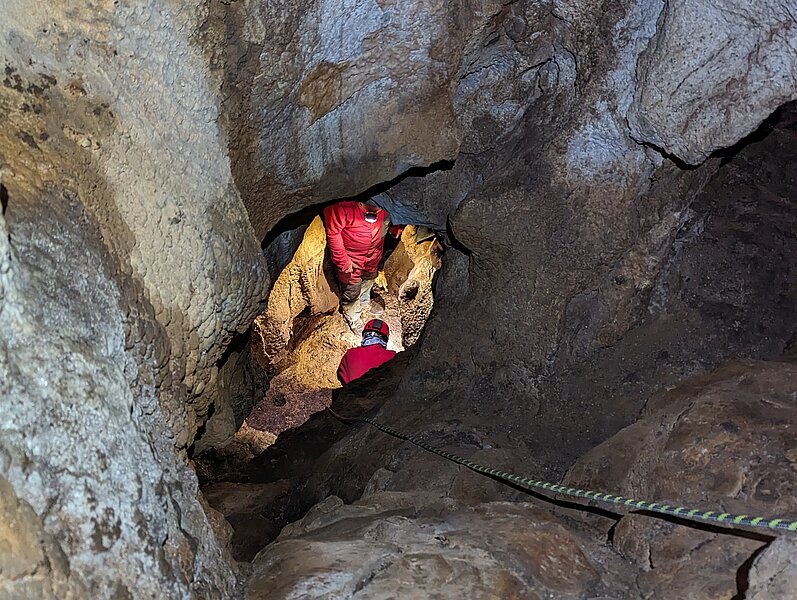

A defining characteristic of the Lika region and the surrounding landscapes of the Dinaric Mountains is the abundance of limestone caves formed through the chemical erosion of water. These caves, often distinguished by their considerable depth and complex, labyrinthine structure ˗ comprising passages, shafts, and chambers ˗ form a sophisticated underground drainage system. Their unique configurations, resembling a veritable underworld, create an ideal setting for hosting a wide range of ritual activities, necessitating a thorough and systematic analysis.
The investigations, which focus on around ten cavities in the Lika region (specifically the area between Otočac and Gospić), place particular emphasis on the Bobinac-Kozerina Cave (Sinac), a site of exceptional significance for the Bronze Age of the region. Discovered by chance in 2013 and excavated between 2014 and 2019 by members of the Speleological Club Ursus Spelaeus, the cave yielded numerous traces dating to the 2nd millennium BC, including complete vessels of various shapes, burnt layers, a woodpile, a wooden object of unknown function, and a stone platform in one of the chambers. Based on the cave’s configuration and the nature of the finds, it is highly likely that it was used as a sanctuary or a space for ritual practices.
The geological and speleological investigations aim to address a range of questions, such as distinguishing between natural and artificial structures and exploring the potential existence of additional entrances and passages that have yet to be identified. The chronology of human activities within the cave will be established through the typological and chronological analysis of the finds, supplemented by radiocarbon dating and uranium-thorium dating of speleothem fragments.
In addition to the geological, speleological, and archaeological assessments, the project will employ organic residue analysis on selected vessels. This method aims to extract valuable information regarding the rituals performed within the cave, providing insights into the resources involved in ritual offerings and/or feasting practices.

2024–2025
Emil Suess-Erbschaft