In October 2025, the project »Unveiling Neolithic Identities in the Balkans: Multiproxy Anthropological Insights from the Immature Remains from Svinjarička Čuka, Serbia« (PI: C. Partiot) was awarded an HEAS Seed Grant. Its aim is to carry out a multiproxy study of an immature mandible from the site excavated by B. Horej. Within the ÖAI, the project involves the Archscience unit, the RG Prehistoric Phenomena, and the Digital Archaeology and Classics (DAC) unit. It is conducted in collaboration with the University of Vienna, the CNRS UMR 7269 LAMPEA (Aix-en-Provence, France), the CNRS UMR 5199 PACEA (Bordeaux, France), the Faculty of Dentistry of Montrouge (France), and the CNRS UMR 7206 Ecoanthropology (Paris, France).
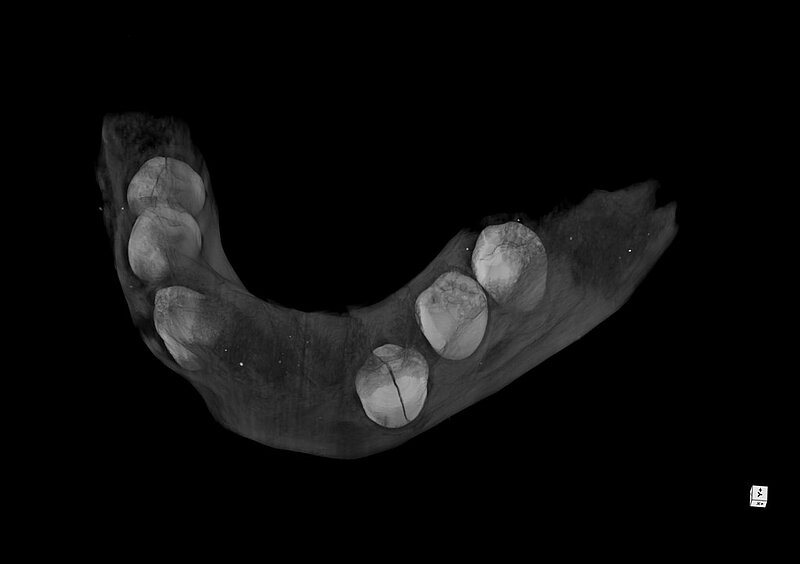
The project focuses on a mandible discovered in 2022 and belonging to a child who likely died at around ten years of age, currently representing almost the only human skeletal element from the Neolithic sequence. The rarity of human bone remains at the site gives it crucial importance, and the study of immature individuals also represents an exceptional opportunity to learn more about the life and environment of the group itself, due to the developmental plasticity of their organisms.
The objective of the project is to provide the first bioanthropological insights into questions of biological identity, life course and population affinities at the site of Svinjarička Čuka through multiproxy analyses of this remain, structured around three main research axes.
i) In-depth characterization of the biological profile of the individual, including a precise estimation of age at death and the assessment of genetic sex.
ii) Investigation of the individual’s life course through the study of osteological stress markers, mobility, and dietary reconstruction.
iii) Investigation of the individual’s population affinities, using dental and biochemical evidence. This approach will be based on the collaborative, interdisciplinary and innovative development of a multi-analytical sampling protocol designed to optimize invasive analyses while minimizing alterations to the remains.