The Long 13th Century in the Countries of Eastern Central Europe: Politics, Culture, and Identity
The research project is based on the view of Eastern Central Europe as a region with a common, specific past, something that may sound obvious to historians of the early modern period because a large part of the region formed a political unit. However, well-coordinated research into the history of the same region up to the middle of the 16th century is anything but self-evident. On the one hand, the research project focuses on Christianization and acculturation processes in the region towards the west in the 8th-11th centuries, and on the other hand on the political and economic transformations of the 13th century, which affected all relevant political entities in the region to the same extent – the Bohemian and Austrian lands, the Kingdom of Hungary, the Silesian principalities, and the Kingdom of Poland, including the territories of present-day Ukraine and Belarus. Another specific East Central European phenomenon is the cultural dynamics associated with the founding of late medieval transalpine universities, which led, among other things, to a significant increase in Latin and vernacular writing, as well as a fundamentally political redefinition of pastoral care as an emancipatory offering to non-privileged sections of the population.
The project focuses on cross-border research into the sources relating to these phenomena and also complements the research carried out at the participating institutes of the two academies. As such, the cooperation project aims to contribute to increased inter-academic cooperation in the field of historical research. The pilot project of inter-academic cooperation is dedicated to the chronicle of Přibík Pulkava of Radenín, which is preserved in the relevant languages of the region, Latin, German, and Czech, and whose research is one of the great desiderata of Middle Eastern European late medieval history. The edition of the chronicle and its research will make generous use of the dynamically developing methods of digital humanities, and the joint training of young scientists from both academies is one of the program's long-term priorities.
Winterschools of HTR
Kooperationsprojekte
Die Wirkung des Wortes in der mittelalterlichen bohemikalen Literatur
(Institut für tschechische Literatur, Akademie der Wissenschaften der Tschechischen Republik)
Projektworkshops 3/2023, 4/2024
Projekt ELITES: Legitimization of the Elites in Poland and Norway, c. 1000-1300
Forschungsaufenthalte der Kooperationspartner
2023
2024
2025
2023
The Idea of Empire and the Slavs, 860-1989
From a Western European perspective, the role of the Slavs in the history of Eurasia often stands in the shadow of the dominant narratives of the past. ‘Western’ ignorance and disinterest, or superficial appropriation of ‘Eastern’ research-results based on slightly ‘colonial’ attitudes go along with uncritical ‘Eastern’ reception of concepts developed in ‘Western’ scholarly discourses. The East-West divide somehow corresponds to the North–South cline, both producing similar although not identical dichotomies of self-description of individual societies and their humanities: Civilised – primitive, democratic – autocratic, rich – poor, rational – emotional, modern - backward etc. These dichotomies were integral to most Slavic identity constructions of the past and are virulent till today. This case study focuses on concepts of a hypothetical Slavonic empire traceable in the sources in various forms from the Early Middle Ages till today. Eventually, Russia became ‘the’ Slavic empire, and as such encountered ambivalent reactions from other Slavic peoples. Since the Slavs and their identity concepts have had an enormous impact on many Eurasian societies, this study will develop various synergies with other nodes and transversal themes in the COE, especially with identity-focused research in Node 3. Activities and deliverables: series of workshops on a) Strategies of identification and the idea of empire in the narrative sources produced in the given area of interest from 10th till 16th century, b) Migrations and the diffusion of ideas of empire from the 16th till 20th century, c) modern historiographical narratives on the Slavs; cooperation with stakeholders mediating historical and identity narratives in the area of interest; summer schools, joint seminars and short-term missions of students, individual training units.
Multilingualism and Cultural Translation in Central and Eastern Europe 1300-1700
In this study the spread of vernacular literacy and its social impact will be explored, especially concerning the empowerment of the laity in matters of Christian religion in the area of interest. Research concentrates on texts with broad and/or prominent social impact, transmitted in more than one language relevant in the local, regional and/or transregional social context. These texts will be analysed on several levels, at first critically edited if necessary, as texts existing in more than one medieval language usually do not have any satisfying modern editorial history. The editorial effort, a core activity in this case study, also allows for an application of HTR tools, with the aim of expanding the applicability of text recognition software (see TWG 5 ‘Manuscript Studies in a Eurasian Context’). Other types of multilingual texts in focus were almost entirely neglected to this day. In the area of interest, mostly collections of sermons are relevant, which very often display a great variety in the way in which they blended two or even three languages, and therefore represent important sources mirroring the social reality of multilingual discursive practices. Synergies: TWG 2; sub-node 2C, case study 4. Resources: Academy scientist with digital skills (AAS commitment recent money)
Activities and deliverables: Workshop on the multilingual narratives of the past
The True Believer – Dynamics of Religious Identification in Central/Eastern Europe, 14th-18th century
In the 14th century, an ambitious religious and theological education originating in the Western and Southern European centres gradually spread in Eastern Central Europe. The ambitious policies of Luxembourg princes, who in the middle of the 14th century created their new power base in Bohemia, used exclusive forms of religious education as a means to enhance their prestige and to ingratiate the elites of the respective region to the new rulers. In the long term, paradoxically, the effect rather was to destabilise the secular and ecclesiastical institutions, and religious unity and religious identities began to disintegrate, for instance, in the Hussite conflict in the 15th century. Attempts to create a new stability revolved around the question of defining the true believer(s). The efforts to re-form the Church and to return to the Apostolic principles were thus framed as a question of true Christian identity. This resulted in a competition of different strategies of identification which gradually made the previous forms of negotiation increasingly difficult. The German Reformation may be regarded as one of the milestones on the way to an ever more rigid understanding of religious identities which, projected into the past, tend to obscure our understanding of the character of the late medieval/early modern transformation of religious identities till today. The close collaboration within this COE represents a unique opportunity to see these very important developments in a broader context. Its genealogy is not simply Western-European. The Reformation, understood here as a petrification of competitive religious identities, started in Eastern Central Europe, a region in which the ideas of Greek and Slavic orthodoxy met Latin theology in a rather unique way. In the comparative setting of this Node, a new understanding of this process can be explored.
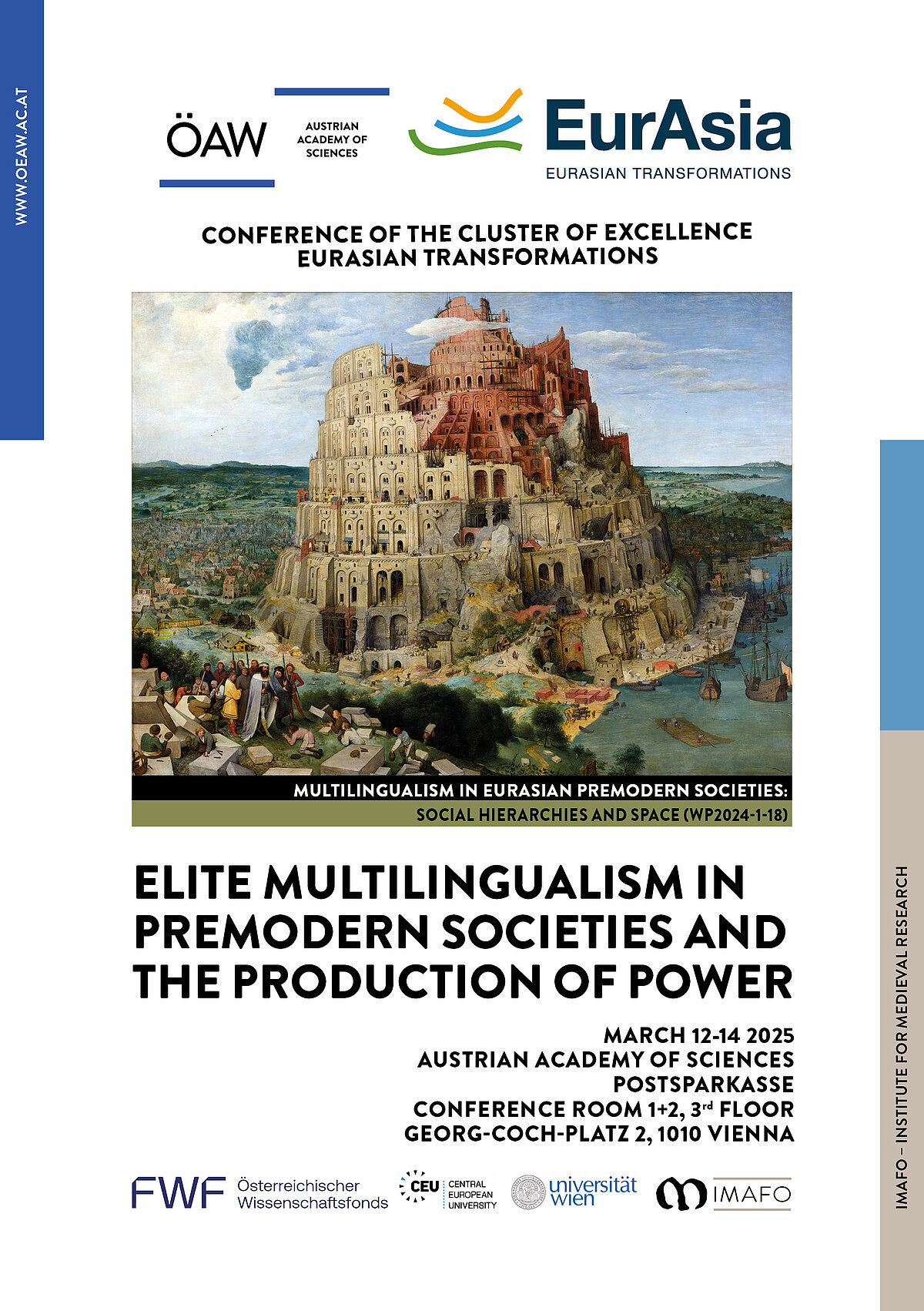
Elite Multilingualism
Pavlína Rychterová
The work package “Elite Multilingualism” explores the social role and dynamics of multilingualism in ancient and medieval contexts in Eurasia in 2024–2025. The focus is on theoretical and methodological questions concerning linguistic hierarchization and the functions that languages fulfilled in administration, religion, trade, and education. The aim is to highlight forms of multilingualism as instruments of social differentiation, status markers, and means of exercising power.
Activities include international workshops, a conference, a summer school, and a joint BA seminar. Topics include the languages of administrative centers, religious spaces, and urban markets. Special attention will be paid to the interfaces between written and oral communication, as well as to the spaces in which multilingualism meant conflict or opportunity. Research examples range from Egypt in Roman, Byzantine, and Arab times to Central Asia in the Mongol Empire to the contact zones between Byzantium and the Holy Roman Empire.
The events bring together historians, philologists, archaeologists, social scientists, and linguists from Europe and beyond. Promoting young talent is a central focus: students are to be introduced directly to research and methodology through summer schools and seminars. In this way, the work package contributes to networking the interdisciplinary work of the cluster and opening up new perspectives on the interrelationship between language, space, and power in pre-modern societies.