In the year 70 CE, the two Roman emperors Titus and Vespasian crushed a Jewish revolt by conquering Jerusalem and destroying the Jewish Temple. This event, however, would only unfold its full potential with hindsight, since Christian observers appropriated it for the matters of Salvation History, that is, the idea of how the divine will guides and structures the course of humankind. The Gospels were all written in the shadow of this event and allude to it on several occasions, just as it was understood early on as God’s punishment on the Jews for the crucifixion of Christ. The event featured thus as a key narrative in Christianity’s origins and self-understanding, wherefore it is not surprising that it appears in literally thousands of medieval texts. This project is devoted to offering a first broad examination of its use in the medieval period, considering Latin texts between c.600 and c.1200, from the post-Roman world and the early monastic exegetes to the crusade movement and the university of Paris. This includes moving beyond a reception history of Flavius Josephus (the main historiographical source on the event), given that there are numerous occurrences that do not (directly) relate to this source. The project’s scope becomes possible thanks to the full text databases nowadays available; these permit to capture quickly where, when, and how the conquest appears. These surveys have the goal to create eventually an own database about the reception of the Roman conquest, which catalogues its occurrences throughout the centuries, alongside further useful information. The materials recorded therein will be complemented by extensive work with unpublished manuscript materials. Roughly 100 occurrences have already been unearthed in unpublished texts (state June 2024). The database project is set up in cooperation with the Austrian Centre for Digital Humanities, which assists me with its technical dimensions. Making this dataset eventually available open access as well as in a user-friendly manner will create a valuable and multi-facetted tool that can serve in investigating many pertinent questions of modern scholarship.
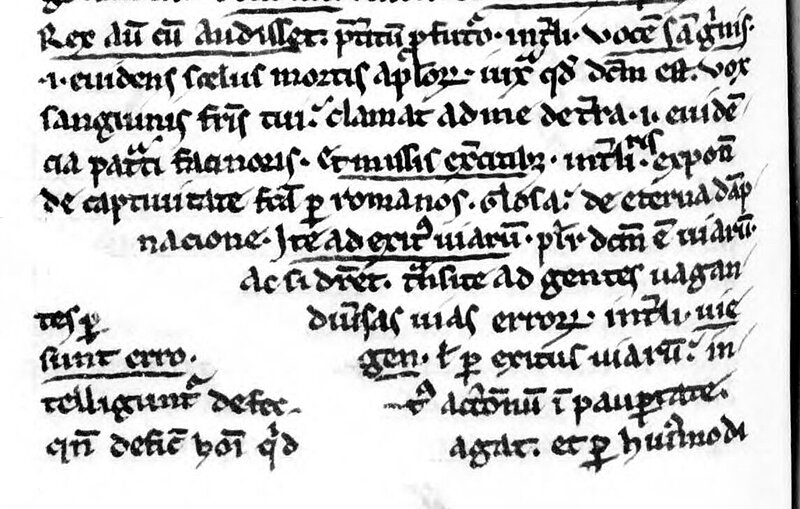
Deploying the Roman conquest in medieval texts is far more than an act of commemoration; the event blends with a number of crucial concerns, just as it delivers lenses for perceiving and rationalizing contemporary phenomena. Case studies will therefore examine how the event is used in particular contexts and what meaning it unfolds therein. Its purposes can be divided into two large categories, that is, (a) constructing Christian identity and demarcating it to other groups, especially the Jews, and (b) using the event as a resource for understanding and framing contemporary phenomena, in particular contemporary conquests of Jerusalem, but also, for example, anti-Jewish politics or eschatological beliefs (the Apocalypse was likewise supposed to happen in Jerusalem). For instance, as I discuss in a recent article, the crusade preacher Martin of León (c.1130-1203) implemented it for explaining the holy city’s loss in 1187, the trigger for the massive expedition of the Third Crusade (1187-92). Using it in the form of a sermon, he suggested to his audience that they suffered now a similar divine punishment as the Jews in 70 CE, that is, a potential loss of their status as God’s chosen people. He does so by calling his doubtlessly Christian audience repeatedly ‘Jews’ (in a pejorative sense), while including multiple times the Roman conquest as a point of reference. Using this in a sermon, which most likely originated on the eve of the Third Crusade, this aimed at prompting his audience to depart for the Holy Land, and to prevent thus that they would turn into the new Jews. This delivers a powerful example of how this past event could be deployed for current concerns, including meaningful historical dimensions. In other words, deploying this event is far more than an intellectual exercise in the medieval period.
The project investigates consequently why the conquest was used in so many medieval texts, probably more than any other historical event. This straddles a large variety of intellectual and historical contexts – but also different genres. Besides chronicles and anti-Jewish treatises, the project explores especially biblical commentaries and sermon collections. These rich and often unpublished sources – hitherto barely considered by historians – hold much innovative potential for enhancing our understanding of several historical phenomena. Similarly, they have survived in enormous numbers and provide, therefore, an unusually broad empirical basis for the medieval period. Sermons are such a valuable source because they can deliver insights beyond the clerical sphere: they were often meant for popular audiences (and this already before the advent of the Friars). Commentaries, even though these remain within the clerical register, complement the perspective, since these rich sources served in perceiving and making sense of phenomena in the wider world. Their discussions are often simply much more elaborate than those found in other sources. Furthermore, the project is unique in bridging sermon materials in-between the early Middle Ages on the one hand and the central and late Middle Ages on the other, a bridge that hardly any other scholar has built so far. This will shed new light on the role of preaching in the early medieval centuries, just as it will enable to review the large established narratives about medieval preaching (which are very much shaped by the dominant scholarship on the Franciscans and Dominicans). This endeavor will benefit from having Max Diesenberger, deputy director of the IMAFO and head of the Historical Identity Research department, as a mentor to this project, since he is a distinguished expert for Carolingian sermon material. Addressing all these rich dimensions, the project will elucidate various larger issues such as the tenacity and forms of anti-Semitism, or the question of why Jerusalem remained such a contested ground throughout the centuries, or the quite arbitrary use and abuse of history.