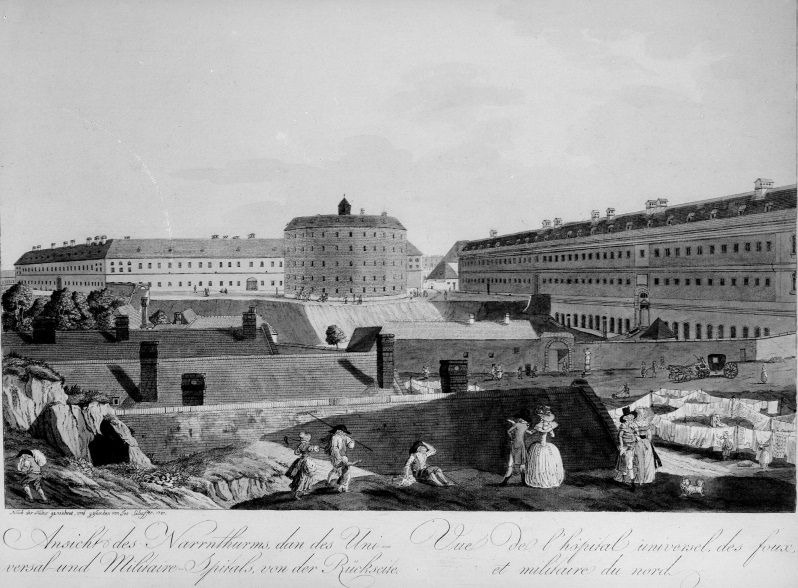
The project aims to make a long-overdue cultural-historical contribution to understanding the significance of music in medicine and psychiatric institutions in Vienna in the late eighteenth and first half of the nineteenth centuries. Considering international trends (such as psychiatric reforms in France, Germany, and England) and national developments (e.g. the establishment of so-called lunatic asylums in the Habsburg/Austrian Empire), the project focuses in particular on those psychiatric institutions where music was used as treatment—among them the Viennese Imperial and Royal Lunatic Asylum (“Narrenturm”) and Dr. Goergen's Private Asylum for Mental Illnesses. Literary primary sources are supplemented by research in, among other places, the Vienna City and State Archive and the archival holdings of the Josephinum.
The project provides a synopsis of the cultural, socio-political, medical, and psychiatric conditions that significantly influenced ideas around the “therapeutic” use of music in Vienna: neo-humanistic ideals, Enlightenment principles, the reforms of Joseph II, the beginning of “modern” psychiatry, medical-historical theories on “mental, emotional, and nervous illnesses,” as well as explanatory models on music’s effects on the body and on the “soul” and “spirit,” among others. In this context, the ranges of meaning of the following terms are explored within the history of thought and music: “resonance” (as both “acoustic resonance” and “emotional movement”), “mood” (as musical tuning and “emotional state”), and “sympathy” (as “resonance” and “empathy”). Based on historical musicology, these terms are further related to aesthetic discourse.
The project delves into the “Viennese history of music therapy” (in the broadest sense), which has been conspicuously neglected by both historical and music-therapeutic disciplines, with few exceptions. In this respect, it addresses an initial historical gap (from ca. 1780–1850) between early ideas of using music specifically for “mental and emotional disorders” in Vienna and the beginnings of modern “Viennese music therapy” in 1958. This project thereby lays the foundation for further research in the historical exploration of “music therapeutic” approaches in Vienna and in Western music therapy more broadly. Furthermore, the project holds significance for Austrian intellectual and cultural history at the intersections of music, medicine, and psychiatry.
The research findings will be published in articles on selected thematic areas and in the form of a book. In transdisciplinary exchange with international and national collaborators, the project seeks to foster a dialogue between historical musicology, the history of medicine and psychiatry, and music therapy—a dialogue that has thus far largely been absent.

Korenjak, A. (Speaker)
Korenjak, A. (Speaker)
Korenjak, A. (Speaker)
Korenjak, A. (Speaker)
Korenjak, A. (Speaker)
Korenjak, A. (Speaker)
Korenjak, A. (Speaker)
Korenjak, A. (Speaker) & Allesch, C. (Contributor)
Korenjak, A. (Speaker)
Andrea Korenjak
Hubert Reitterer
07/2014–08/2017
FWF 10.55776/P27287
Center for the History of the Emotions, Queen Mary University of London
Thomas Dixon
Penelope Gouk
Peregrine Horden
Manuela Schwartz
Christian Allesch
Thomas Stegemann