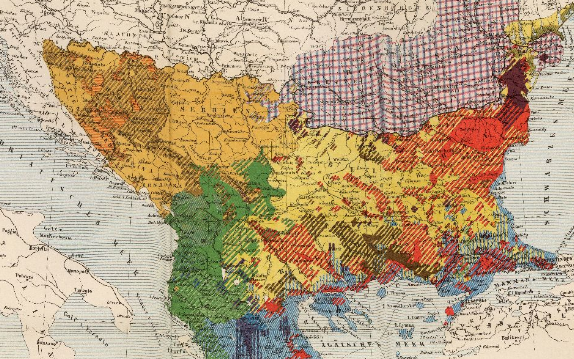
This project is about imperial, meta-national, and national discourses on music at the southern military border of the Habsburg Monarchy. The specially protected border space along the lower Danube region, where the Slavonian (1745–1881) and the Banat (1751–1873) Military Frontiers were established to protect the Empire from the Ottoman military operations, allowed for a multi-layered cultural transfer which involved the remote capital (Vienna), the free royal cities in Pannonia as local centers, and the main towns within the border space, as well as the Ottoman Empire beyond the border.
My analysis is based on writings on music, mainly the musical and cultural life, concert and theater guest performances, published in the newspapers in German ("Esseker Lokalblatt und Landbote", "Slawonische Presse" in Slavonia; "Groß-Becskereker Wochenblatt", "Banater Post" in the Banat), in Serbian ("Glas", "Pančevac"), in Croatian ("Virovitičanin", "Sriemski Hrvat") and in Hungarian ("Torontál"), but also in periodicals, anniversary publications of choral societies and theatres, the program notes of music performances, books and later established professional music journals, as well as publications by the first professional musicologists (e.g. Franjo Kuhač). Within the complex pluricultural, i.e. multiethnic, multilingual, and multireligious (Christian – Catholic, Orthodox, and Protestant; Jewish; Muslim heritage) border region, writings on music convey the full panorama of cosmopolitan, imperial, Pan-Slavic, and (meta-)national narratives of different social groups, emerging from the complex network of cultural and administrative institutions within the imperial context (Germans and Croats lived in the Habsburg Monarchy), including the diaspora (Serbs were divided between the Habsburg and Ottoman Empires), also considering a phase of Pan-Slavism (Austroslavism) and general social and sociological aspects.
The project’s theoretical framework is related to the structures of power and the construction of vernacular languages, challenging the concept of identity to provide more profound insights into cultural and social practices. The deeply-rooted nationalist attitude will be counterbalanced by elucidating the multifaceted variety of the – ultimately overlapping – imperial and national perspectives. These served as a basis for various self-representations even among the same national and religious communities and numerous minorities. The cultural and musical activities of settlers in the area between the two empires, including the Slavs (Serbs, Croats, Slovaks), Hungarians, Germans, Romanians, and Jews are also considered.




This article examines the “Lives in Musicology” column in Acta Musicologica (introduced in 2017 by Federico Celestini and Philip V. Bohlman) as a lens for reflecting on the discipline of musicology. Eight renowned scholars – including pioneers in musicology, ethnomusicology, and music theory – from the United States, Europe, East Asia, Africa, and Australia – revisited their careers, revealing the construction and trajectory of the field. Their autobiographical accounts, analyzed through the theory of autobiography by Jaume Aurell, trace the discipline’s expansion from the Western canon to diverse research areas, the establishment of new concepts, and the radical shift in Acta Musicologica editorial policy from conservative positivism focused on the Germanic canon toward a pluricultural and multilingual global musicology.
After the pandemic break (2020–2021) the journal TheMA continues with the presentation of research results relating to the cultures, literature, theater, music, and arts of and on southeast Europe. Furthermore, the next three volumes will be dedicated to herstory in the mesoregion, with the focus on women’s studies. Starting with this volume, female cultural enterpreneurs, Maecenases, authors, artists, composers, and performing artists, as well as the characters in literary, dramatic, and musical works, will be presented in papers by international scholars.
In order to shed light on cultural exchange in a meta-national context, Michel Espagne coined the term ‘cultural transfer’ with respect to exchange between ‘cultural zones’. The migration of cultural objects and individuals, signified by their appropriation and transformation in new contexts, is a process of continuous reinterpretation of travelling ideas and concepts. Such transnational approach provided by cultural transfers assumes transdifference, cultural hybridization, and interpenetration of cultural zones beyond the traditional dichotomy of centre-periphery: the nodes of the formed networks are proliferated (in some cases, temporary) centres, including also certain mediatory points. Two case studies of Serbian, i.e., Yugoslav musicians – the violin player Dragomir Krančević (1847 – 1929) and especially the soprano Karola Jovanović (1879 – 1958) – will be explicated in this theoretical framework in relation to their positions at music theatres. Both were well-known artists and had successful careers in Vienna and other cities in the Habsburg Monarchy (Budapest, Olomouc, Graz) and its successor states, Krančević mainly as a soloist and Jovanović as an opera and concert singer. These two musicians are understood here as agents of cultural transfer and this paper will show how they were transformed by adjustment to their new environments, i.e., to the dominant cultural policy expressed through repertoire, gender policy, guest performances, and other aspects. By doing so, they contributed to network building networks all over Europe, beyond territorial or national borders.
Markovic, T. (Speaker)
Markovic, T. (Speaker)
Markovic, T. (Speaker) & Markovic, T. (Speaker)
Markovic, T. (Speaker)
Markovic, T. ((Co-)Author)
Markovic, T. ((Co-)Author)
Markovic, T. (Speaker)
Markovic, T. ((Co-)Author)
Markovic, T. (Speaker)
Markovic, T. ((Co-)Author)
Markovic, T. (Speaker)
Markovic, T. (Speaker)
Markovic, T. ((Co-)Author)
Markovic, T. (Speaker)
Markovic, T. (Speaker)
Markovic, T. (Speaker)
Markovic, T. (Speaker)
Markovic, T. (Speaker)
Markovic, T. (Speaker)
Markovic, T. (Speaker)
Rebeka Pál-Ádány (until 09/2024)
Austrian Science Fund (FWF) 10.55776/P32695
10/2019–08/2026
Hungarian Research Network | Research Centre for the Humanities, Institute of Musicology


