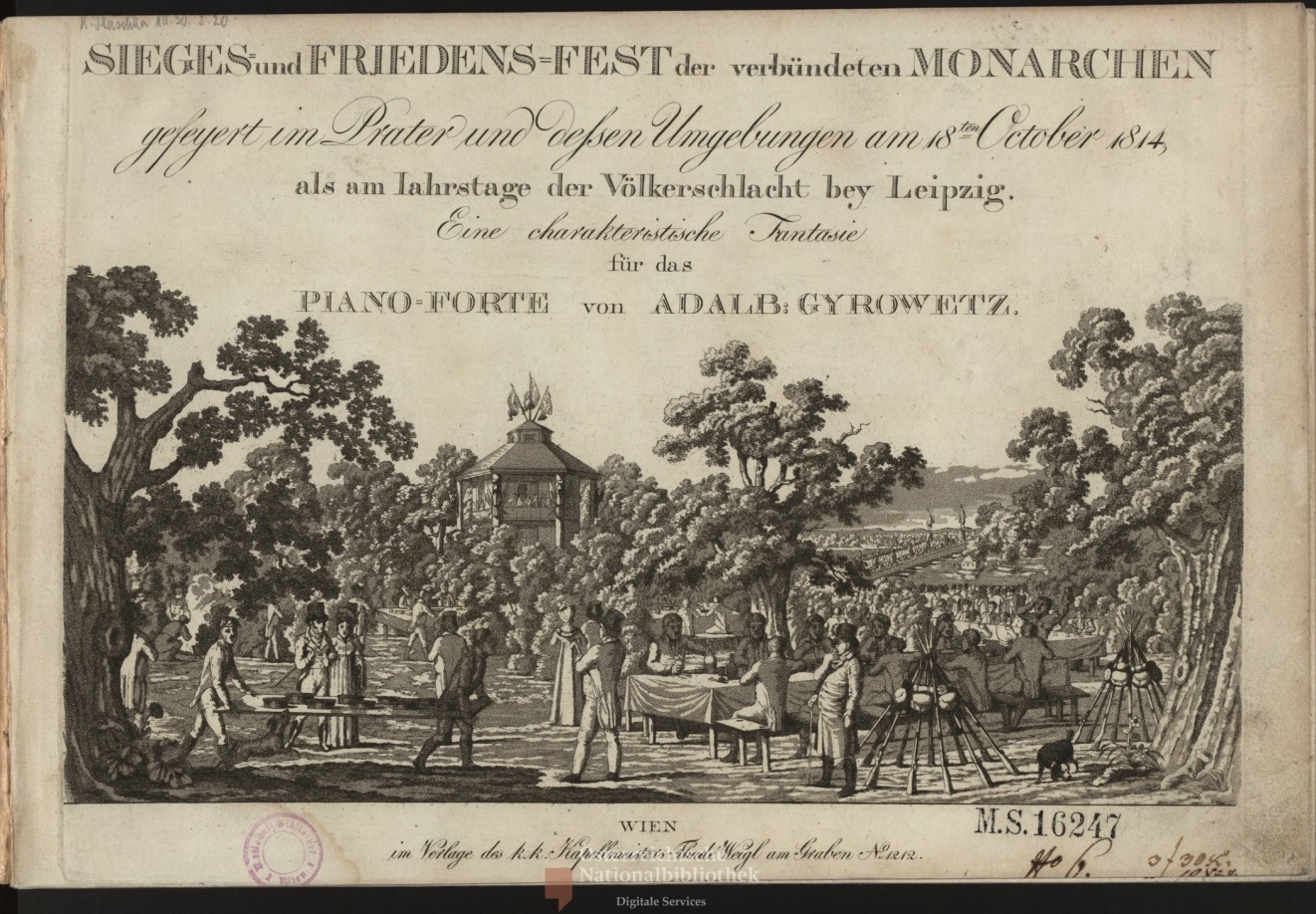
Between the end of September 1814 and early June 1815, Vienna, as the host of the Congress of Vienna, became the epicenter of global attention. Alongside the numerous negotiation rounds, committee meetings, and individual discussions aimed at reorganizing the European states in as stable a manner as possible after the turmoil of the Napoleonic Wars and the dissolution of the Holy Roman Empire, an extensive program of events unfolded. These festivities provided the dynasty and the imperial capital an opportunity to showcase themselves in a dazzling light.
However, to view these congress festivities merely as entertainment would be a significant oversimplification. The “courtly festivities,” in particular, were part of a highly sophisticated strategy of representation interwoven with negotiation practices typical of the Ancien Régime. Crucial negotiations rarely took place in large plenary sessions; instead, they occurred in the private salons of noble palaces during the renowned balls, dinners, and suppers, in the corridors and boxes of theaters, or amidst the grandeur of public festivals. Music and musical events served as a deliberate platform for skillfully staging political strategies and messages, with calculated political use of the public and selectively targeted audiences as integral elements of these orchestrations.
Vienna’s flourishing music publishing and printing industry skillfully capitalized on the demand among both local audiences and the numerous visitors to acquire musical mementos of the congress festivities. Numerous piano arrangements of marches (most notably Friedrich Starke’s Alexander March), dances, and “characteristic tone paintings” depicting the grand public celebrations—above all the one commemorating the anniversary of the Battle of Leipzig on October 18, 1814, in the Prater—stand as evidence of this. Even Ludwig van Beethoven, Vienna’s preeminent composer at the time, drew inspiration from the atmosphere surrounding the congress. His “patriotic composition,” the grand cantata “Der glorreiche Augenblick” (The Glorious Moment, op. 136), premiered to great acclaim on November 29, 1814, capturing the aspirations and emotions of his contemporaries in musical form.
This project pursues two primary objectives: first, to compile and classify the festivals, celebrations, and concerts held during the months of the Congress of Vienna as completely as possible; second, to explore the messages conveyed through music and the festivities in such a densely charged political atmosphere. How was music deployed as a tool of symbolic politics? How were ideals of unity and a “harmonious world” staged? And how did the “Holy Alliance” find not only a visual representation in the numerous engravings of the time but also a corresponding “musical language”?


