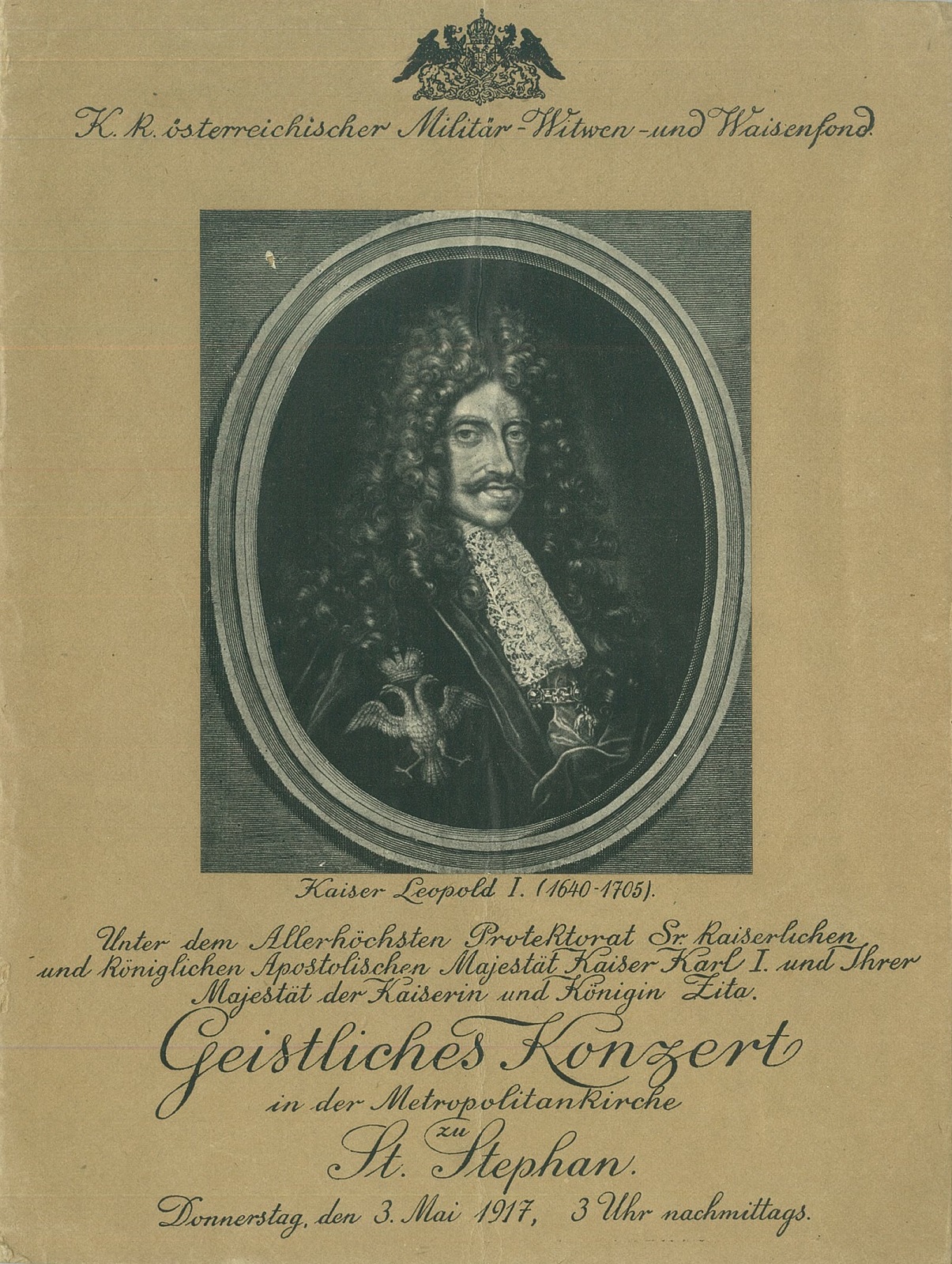
Music played an important role in the self-conception and representation of the Habsburg dynasty. The various court chapels, which already existed at the medieval courts, were centres for the cultivation of music. The earliest evidence of a choir dates back to 1296. In connection with a change in the self-image and representation at the beginning of the early modern period, the rulers’ public presence increased, hence the creation of works of art would secure the memory and fame of the dynasty and its members “for all time”. Music and a court music chapel (“Hofmusikkapelle”), which now increasingly performed on secular occasions, played a crucial role in these presentations.
Maximilian I was the first emperor to push these new opportunities, and accordingly he reorganised his court music. The continuity and constancy with which the Habsburgs expanded their court chapels in Vienna from Ferdinand I and Ferdinand II onwards, especially from 1619/20, and turned them into leading chapels in Europe, contributed to its nimbus of “uniqueness”. The extent to which myth, successful state or dynastic propaganda, and reality merged here must be scrutinised. Musicologists at the turn of the 19th and 20th centuries constructed a “heroic age” (“Heldenzeitalter”) of music, in which Prince Eugene was placed at the side of Johann Joseph Fux. Although the Habsburgs withdrew more and more from the public sphere in their artistic productions from the middle of the 18th century onwards, the imperial music chapels returned to their roots, the church service. Other forms of representation of dynasty, state, and power were developed. The imperial music chapels as well as the myth of the Habsburgs’ unique love of music and musical talent remained as part of Austrian identity even in the First and Second Republic.
The project is devoted to various aspects of the cultivation of music at the Austrian courts of the House of Habsburg and their interaction both with the noble courts within the Habsburg lands and with the network of European courts. Furthermore the relevance and ceremonial embedding of music at the courts is explored. In addition to issues of style and genre (such as the so-called “Imperialstil”), socio-historical aspects of the tasks and functions of musicians and artists as well as their embedding in the court are to be researched.
Hilscher, E. (Speaker)
Hilscher, E. (Speaker) & Gruber, R. H. ((Co-)Author)
Hilscher, E. (Speaker)
Hilscher, E. (Speaker)
Hilscher, E. (Speaker)
Hilscher, E. (Speaker)
Hilscher, E. (Speaker)
Hilscher, E. (Speaker)
Hilscher, E. (Speaker) & Hochradner, T. (Contributor)
Hilscher, E. (Speaker)
Hilscher, E. (Speaker)
Hilscher, E. (Speaker)
Hilscher, E. (Speaker)
Hilscher, E. (Speaker)
Hilscher, E. (Speaker)
Hilscher, E. (Speaker)
Hilscher, E. (Speaker)
Hilscher, E. (Speaker)
Hilscher, E. (Speaker)
Hilscher, E. (Speaker)
Hilscher, E. (Speaker)


