


Glottocode: sart1247, ISO 639-3: xal
Oirat; Kalmyk (KALM. ХАЛЬМГ КЕЛН)
A small ethnic community known as the Karakol Kalmyks, or Sart Kalmak, resides in the eastern part of Kyrgyzstan, along the river and town both called Karakol. Though this group is modest in number, it represents a unique cultural and linguistic enclave within the multi-ethnic fabric of the Issyk-Kul region. The majority of Karakol Kalmyks live in compact settlements in the villages of Börü-Bash, Burma-Suu, Tash-Kyya and Chelpek. Historically, Burma-Suu and Tash-Kyya were separate settlements; today, they are administratively incorporated into Chelpek village (ayyl). Small groups of Kalmyks also live in the villages of Sarykamysh, Cherik, Kerege-Tash, Jeti-Oguz and the city of Karakol (Menyaev, 2021: 23).
Language situation
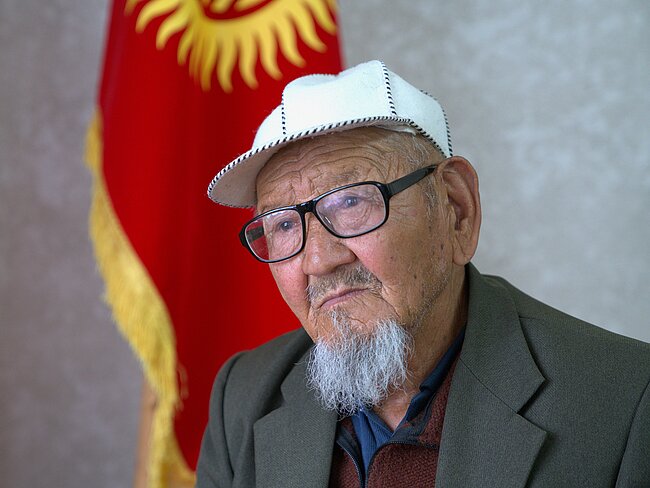
The current linguistic situation among the Karakol Kalmyks reflects processes of mother tongue loss and identity transformation. The absolute majority of the Kalmyks speak and use Kyrgyz as their first language. The communityʹs native language, a dialect of Oirat Mongolian, has been transmitted exclusively through oral means. Toktobek Zholdoshev and Duishokan Torbatova, two of the few remaining fluent speakers, recall learning the language from their parents and using it primarily at home until their elder relatives passed. Both informants state that their children's generation (aged 40–50) does not speak the Oirat language. As a result, the use of Oirat among the Karakol Kalmyks has virtually disappeared. While elderly Kalmyks (primarily those over the age of 70) still understand and speak the language to a reasonable degree, the younger generations only possess a limited vocabulary and are barely able to communicate in it.
Some members of the community express a strong desire for revitalisation efforts, such as language classes or cultural exchanges with Kalmykia and Xinjiang. However, the absence of institutional support and the very limited number of fluent speakers present significant challenges to the preservation of the language. Consequently, the Oirat language in Kyrgyzstan appears to be on the verge of complete extinction in the near future.
The Karakol Kalmyksʹ language represents a noteworthy dialect example of the Oirat Mongolian language. Given the Karakol Kalmyksʹ likely Ööld[1] ethnic origin, their vernacular is generally attributed to the Oirat-speaking population residing in the Ili region of Xinjiang (Borlykova, Menyaev, 2022). However, a distinctive phonetic feature – namely, the pronunciation of the phoneme /c/ as /ch/ – alongside other lexical and phonological divergences, led the phonetician Professor Dordzhi Pavlov to associate the Karakol Kalmyk language with the Tsaatan dialect of the Torguud people, who inhabit the south-eastern region of Kalmykia (Pavlov, 2012: 147). Furthermore, it is documented that this same phonetic substitution is observed in the speech of the Torguuds residing in the Khar Zo (lit. ʹBlack Ridgeʹ) area of Tekes County in the Ili Kazakh Autonomous Prefecture, as well as among the Tsaatan Torguud people of the Bayangol Mongolian Autonomous Prefecture in Xinjiang (Borlykova; Menyaev; Basanova, 2023: 93).
Collection content
This collection contains video and photographic materials from an ethnographic expedition to the Karakol Kalmyks residing in the Issyk-Kul region of Kyrgyzstan. The field research was conducted by VLACH associated researchers Prof Dr Thede Kahl and Chingis Azydov, MA in the autumn of 2023, with the primary aim of documenting the Oirat-Kalmyk language, folklore and traditions. The aforementioned researchers interviewed 10 people in the villages of Chelpek and Börü-Bash and the nearby area, as well as in the city of Bishkek. The materials collected represent interviews on history, language situation, traditional culture, music and cuisine narrated in the Oirat-Kalmyk and Russian languages.
[1] One of the main Oirat Mongolian subethnic groups
Settlements represented in our collection
read more...
Population and religion
The question of the population size of the Karakol Kalmyks is a complex one. According to oral accounts provided by informants from the village of Chelpek, there may be as many as 10,000 to 12,000 Kalmyks in the region. However, many members of this community reportedly identify as Kyrgyz in official documents, which complicates accurate demographic assessment.
Official statistical data available online offers a more conservative estimate. According to the 1999 census, the number of Kalmyks residing in Kyrgyzstanʹs Issyk-Kul Region was recorded as being 5,314 individuals. By the time of the 2009 census, that number had declined to 3,801 (Population census, 2022).
Karakol Kalmyks are Sunni Muslims. The exact date of their conversion to Islam is not known. Ethnographer Dr Badma Menyaev, referring to local historian from Chelpek Sultan Nasynbatov, reports that "the first Ölöts who arrived in 1863 in the Karakol River valley from among the Uyghurs of Xinjiang professed Islam and were referred to as khotn khäl'mg (Khoton Kalmyks)[1]" (2021: 17).
As Menyaev further reports: "In 1884 and 1894, the Karakol Khoton-Kalmyks were joined by the Tekes Kara-Kalmyks (Black Kalmyks; in Kalmyk: khar khäl'mg), who initially followed Buddhism. These newcomers eventually adopted Islam. According to the recollections of elderly informants, the newly arrived group differed from the Muslim Kalmyks in their funeral rites, which were conducted in accordance with Buddhist tradition" (2021: 18).
Ethnic origin and historical background
The ethnic composition of the Karakol Kalmyks (self-designated as khälmig; plural: khälmigmüs) appears to be heterogeneous, containing a significant Turkic component, as evidenced by the genealogical names of their clans. In their article Karakol Sart Kalmyks: Fieldwork Essays, Buryat historians Bair Nanzatov and Marina Sodnompilova provide a list of their "ethnic subdivisions, known in Kalmyk as yasun and in Kyrgyz as uruu. These include: Bayin-Bakha (Bayan-Bakha), Khar-Bator, Shonkur, Solto, Zhediger, Monkush, Khudan (Khodon), Kerem, Sarypaldy (Sarybaldy), Karakoz, Kuikun uulu (Küyküyünün), Orbendik (Orvondik), Zharin Orku, Chagan, Mool-Mamed (Mongolmamed), Zhyilmamed, Chimid (Chumot), Bezhinsharyp (Beyzhinsharyp), Chirick (Cherik), Mongoldor, Tavan-Talkha, and Tavan-Khar" (2012: 132–133). Hungarian ethnographer Dávid Somfai Kara, who visited the Kalmyks of Chelpek village in 1999, suggests that "they are most likely Khotons who accepted Islam in their former homeland in East Turkestan (Xinjiang, China)" (2012: 197).
In her article The Issyk-Kul Kalmaks (Sart Kalmaks), the historian and Mongolist Professor Natalia Zhukovskaya, characterises the Karakol Kalmyks "not as a distinct ethnic group, but rather as an ethnographic subgroup within the Kyrgyz people – one that does not noticeably set itself apart. Even when they refer to themselves as Kalmak, in keeping with historical tradition, they typically add that they see no difference between themselves and the Kyrgyz. And that this is not merely a modern narrative, but from the very beginning, they have had Kyrgyz blood" (1980: 164).
Russian Mongolist Aleksei Burdukov, who conducted fieldwork among the Karakol Kalmyks in the summer of 1929, collected a substantial corpus of folklore materials. His ethnographic documentation includes the epic Jangar, 60 songs, 120 proverbs and sayings, 50 riddles and a number of orally transmitted historical legends. In his article The Karakol Kalmyks (Sart-Kalmyks), Burdukov provides a detailed account of the historical origins of the Karakol Kalmyks, tracing their history from the collapse of the Dzungar Khanate to the founding of the villages Börü-Bash and Chelpek:
"According to the oral stories of the Karakol Kalmyks, their ancestors, the Ölöts (Oirat: Öölöd), used to live in the region of Tokmok along the Chü River (Oirat: Chö) before the disintegration of the Oirat state.
At that time, two Uzbek (Khoton) merchants named Bakkha and Oshur came from Namangan to the area along the Chü River, where the Ölöts lived. They settled there and married Ölöt women, with whom they established large families.
A time of turmoil followed (Burdukov here cites several legends concerning the fall of the Dzungar Khanate).
[…] The Oirats began to migrate in different directions. The Ölöts, Bakkha and Oshur migrated with their families to the Ili River region, where Bakkha became wealthy and was henceforth known as Bayin Bakkha (ʹRich Bakkhaʹ). They were accompanied by two Kyrgyz men, Teke and Tyugulbai, who also married Oirat women. These four men – Bakkha, Oshur, Teke and Tyugulbai – are regarded by the Karakol Kalmyks as their ancestral forefathers" (Burdukov, 1935: 48–49).
Following the Qing conquest of the Dzungar Khanate and the subsequent genocide of the Oirat-Mongol population, the surviving Oirats became subjects of the Qing Empire. In the 1860s, uprisings by Dungans (Hui Muslims), Taranchis (Uyghurs) and other ethnic groups in the western provinces of the Qing Empire triggered renewed instability. These events led to the migration of certain Oirat communities – specifically, six somons of Ölöts – into the territory of the Russian Empire, particularly to the Issyk-Kul region and the Almaty district, in 1865.
As Burdukov further recounts: "After the demarcation of the border between China and Russia in 1882, the nomadic pastures of the so-called Sart-Kalmyks along the Khabkhak and Naren-Gol rivers fell on the Russian side.
In response to inquiries by Russian officials as to whether they wished to remain in these territories or return to the Chinese side to rejoin their kin, the Sart-Kalmyks declared their desire to stay and remain the Russian subjects. At this time, during their official registration, the Russian authorities recorded them under the ethnonym ʹSart-Kalmyksʹ.
Prior to this, they were generally known as ʹKara-Kalmyksʹ, although they themselves had always referred to their community as ʹÖlötʹ" (Burdukov, 1935: 53–54).
This historical trajectory sheds light on the complex ethnogenesis of the Karakol Kalmyks, whose identity has been shaped by centuries of mobility, interethnic contact, imperial boundary-making and cultural continuity.
[1] Translations of this and the subsequent quoted texts originally in Russian are by C. Azydov.
Chingis Azydov, 2025
Bibliography
Sources:
- Kahl, Thede & Azydov, Chingis (2023): Field research video interviews with Karakol Kalmyks, Yssyk-Kul Region, Kyrgyzstan. Ethnographic expedition materials.
- National Statistical Committee of the Kyrgyz Republic (2022): Perepis naseleniya i zhilishchnogo fonda Kyrgyzskoj Respubliki 2022 goda. Issyk-Kulʹskaya oblastʹ [Population and Housing Census of the Kyrgyz Republic 2022. Issyk-Kul Region]. Bishkek. Available at: https://stat.gov.kg/media/publicationarchive/8b892242-eaa9-446d-94b2-7ba7aadcb340.pdf [Accessed 15 July 2025].
References:
- Borlykova, Boskha Kh.; Menyaev, Badma V.; Basanova, Tatyana V. (2023): O nauchnoj ekspeditsii k sart-kalmykam [On the scientific expedition to the Sart-Kalmyks]. In: Vostokovednye polevye issledovaniya. Materialy Vserossijskoj nauchnoj konferentsii (2021–2022 gg.), Vol. 2, Ed. Y. A. Pronina, Moscow, pp. 86–100.
- Burdukov, Aleksei. V. (1935): Karakolʹskie kalmyki (sart-kalmyki) [The Karakol Kalmyks (Sart-Kalmyks)]. In: Sovetskaya etnografiya, No. 6, pp. 47–79.
- Menyaev, Badma V. (2021): The Sart-Kalmyks of Kyrgyzstan: past and present. In: Nomadic Civilization: Historical Research, Vol. 1, No. 4, pp. 11–26. (In Russian). DOI: https://doi.org/10.53315/2782-3377-2021-14-30-40-11-26
- Nanzatov, Bair Z.; Sodnompilova, Marina M. (2012): Karakolʹskie Sart Kalmyki: Polevye ocherki [The Karakol Kalmyks: Fieldwork Notes]. In: Tartaria Magna, No. 2, pp. 128–151.
- Pavlov, Dordzhi A. (2012): Khar gholyn khalʹmgud boln tednä keln [The Karakol Kalmyks and their language]. In: Primer sluzheniya nauke i obrazovaniyu: k 100-letiyu professora D. A. Pavlova, Ed. B. K. Salaev et al., Elista: Kalmyk State University Press, pp. 102–158.
- Somfai Kara, Dávid (2012): Sart-Kalmyk — Kalmyks of Ysyk-Köl (Karakol, Kirghizstan). In: Oirad and Kalmyk Linguistic Essay, pp. 197–210.
- Zhukovskaya, Natalia. L. (1980): Issyk-Kulʹskie kalmaki (sart-kalmaki) [The Issyk-Kul Kalmaks (Sart-Kalmaks)]. In: Etnicheskie protsessy u natsionalʹnykh grupp Srednej Azii i Kazakhstana, Moscow: Nauka, pp. 157–166.
Video Collection
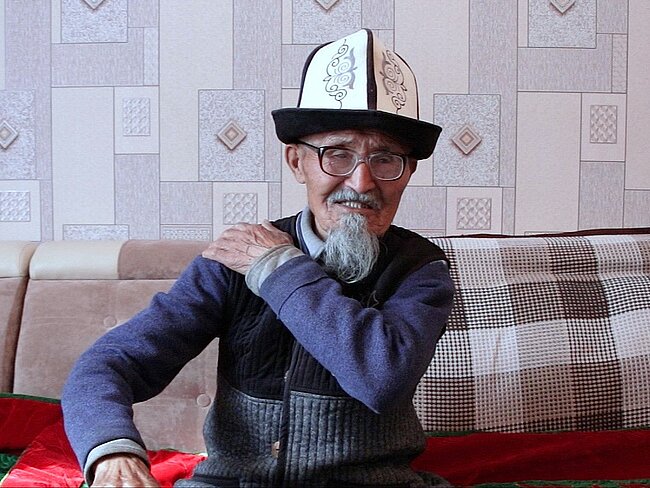
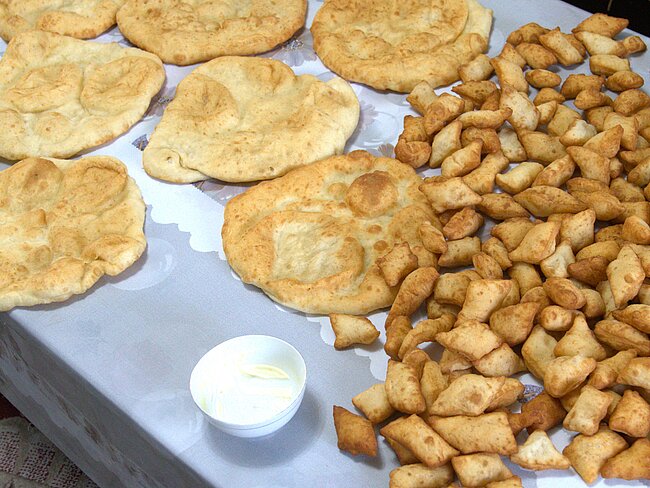
Photo Collection
Links
Special thanks
The Commission VLACH and the researchers involved wish to express their deep gratitude to Marsel Islamov, Salavat Kadaev and Israil Arpachiev for their help in the organisation of field work in Kyrgyzstan.