



Both projects have an envisioned starting date of beginning of 2027, and are fully funded for three years. The annual gross salary is about 39.900€ in accordance to the collective agreement of the respective institution (see application details).
The following PhD projects are available:
For details about how to apply for these positions, please go to YRP PhD Application 2026.
Project: Development of a High-frequency Electrostatic Gating System for a Next-Generation Ion Mass Spectrometer towards the Saturnian system
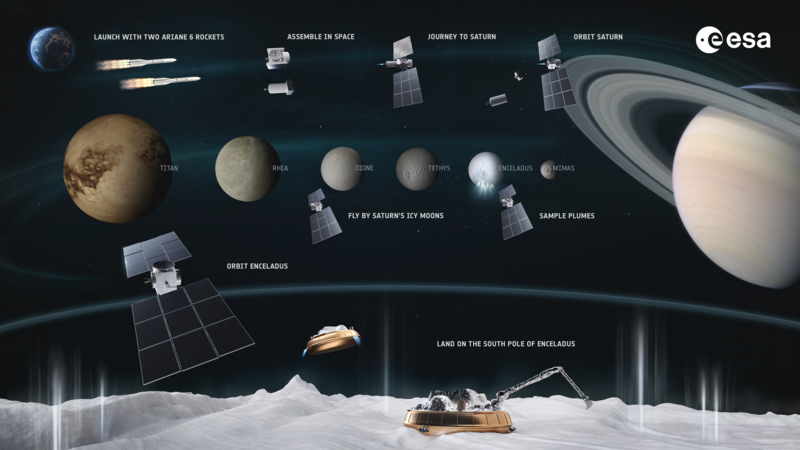
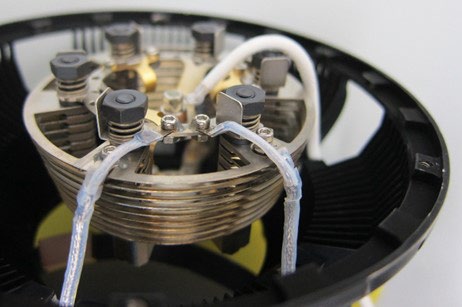
The PhD position focusses on the development of a crucial part of a next-generation ion mass spectrometer for a future ESA mission to Saturn's moon Enceladus. The goal is to improve upon an existing instrument design to achieve much faster and more precise measurements, enabling the high-resolution analysis of complex molecules in the moon's plume.
The successful candidate will be part of Dr. Gabriel Giono’s research group Onboard Computing in close collaboration with Dr. Ali Varsani at the IWF, and will be embedded in the Young Researcher Program for interdisciplinary Space Science and Planetary research YRP@Graz.
Keywords: Space Instrumentation, Analogue and Digital Electronics Design, Laboratory Experiment, Planetary science, Saturn, Enceladus, Ion Mass Spectrometer.
Figures: Upper panel: Enceladus mission concept (ESA), Lower panel: PICAM electrostatic gate system (IWF)
Research Group Environment in the Graz area: Onboard Computing / IWF (Dr. Gabriel Giono), Solar System Planetary Physics / IWF (Dr. Ali Varsani)
Abstract: The European Space Agency (ESA) has announced that the next large-class mission of the 2030-2040’s (L4) will focus on the science of the “Moons of the Giant Planets”. Saturn’s moon Enceladus is the favourite candidate, as it is considered to have a habitable environment, with a liquid water ocean; and it has all the bio-essential elements carbon, hydrogen, nitrogen, oxygen, phosphorus, and sulphur (CHNOPS) [1]. Enceladus also exhibits active water plumes at its south pole, potentially enabling the sampling of its sub-surface ocean from to space. In addition to neutrals, both positive and negative ions have been reported to be present in the plume. Negative ions (e.g., OH-, O-, H-) have been observed by Cassini mission, and thought to been produced from the neutral H2O in the plume of Enceladus, by dissociative electron attachment [2]. Other observations have shown positive ions such as H2+, and water group ions (O+, OH+, H2O+, and H3O+); with the charge exchange between magnetospheric ions and plume neutral molecules being the major sources [3][4]. However, in order to truly understand the chemistry of its environment, it is essential for the L4 orbiter spacecraft to have a particle detector capable of analysing the composition of the ions (negative and positive) with a high mass resolution and without breaking complex molecules apart.
The IWF has started the development of a next-generation ion mass spectrometer for this mission. The design is based on the Planetary Ion CAMera (PICAM), an ion mass spectrometer built and operated by IWF for the BepiColombo mission. The Enceladus design aims at using the same electrostatic gating method (Hadamard gating, [5][6]) as in PICAM. This technique is required to ensure impact-free time-of-flight measurements, enabling the measurements of complex molecules and icy nanograins which can be both positively and negatively charged. However, a much higher quality of the gating electrical signal is required to achieve high-mass resolution. In the case of PICAM, the gate driver electronics was able to switch every 6 ns but the gate impedance prevented the edge of the signal to be better than 10 ns.
The announced PhD project will focus on building upon the heritage of PICAM and focus on improving the design of the driver and gate design to achieve nanoseconds cycling with sub-nanosecond edges. This development will include aspects of (1) analogue and digital electronics design, as well as mechanical design for impedance control, (2) embedded software development for the gate driver itself and (3) laboratory testing of the prototype performances.
Tasks:
- Review the design of the PICAM electrostatic gate design and understand its limitation.
- Develop an ultra-fast electrostatic gate system, including theoretical analogue electronics calculation, mechanical consideration for impedance control, and simulation (e.g., LTSpice) to predicts the design’s performances.
- Develop the driver electronics (i.e., schematics, layout, firmware application), in collaboration with senior engineers of the research group.
- Prototyping and laboratory tests to evaluate the design performance.
- Publication in peer-reviewed journals, and presentation in national and international conferences.
Requirements:
The candidate is expected to have a Master degree in Electrical Engineering. Expertise in analogue and digital electronics are expected. Programming experience in C, Python, and/or other languages for embedded system are also recommended. Teamwork skills, a self- driven research attitude, and scientific curiosity are important.
References:
[1] Report of the Expert Committee for the Large-class mission in ESA’s Voyage 2050 plan covering the science theme “Moons of the Giant Planets”; https://www.cosmos.esa.int/documents/1866264/1866292/ESA_L4_Expert_Committee_report_Voyage_2050_Moons_of_the_Giant_Planets.pdf
[2] Coates, A. J., Jones, G. H., Lewis, G. R., Wellbrock, A. A., Young, D. T., Crary, F. J., Johnson, R. E., Cassidy, T. A., & Hill, T. W. (2010). Negative ions in the Enceladus plume. Icarus, 206(2), 618–622. doi: 10.1016/j.icarus.2009.07.013
[3] Tokar, R. L., R. E. Johnson, M. F. Thomsen, R. J. Wilson, D. T. Young, F. J. Crary, A. J. Coates, G. H. Jones, and C. S. Paty (2009), Cassini detection of Enceladus' cold water-group plume ionosphere, Geophys. Res. Lett., 36, L13203, doi: 10.1029/2009GL038923
[4] Haythornthwaite, R. P., Coates, A. J., Jones, G. H., & Waite, J. H. (2020). Fast and slow water ion populations in the Enceladus plume. Journal of Geophysical Research: Space Physics, 125, e2019JA027591. doi: 10.1029/2019JA027591
[5] Vaisberg, O., et al. (2016), The 2π charged particles analyzer: All-sky camera concept and development for space missions, J. Geophys. Res. Space Physics, 121, 11,750–11,765, doi: 10.1002/2016JA022568
[6] Orsini, S., Livi, S.A., Lichtenegger, H. et al. SERENA: Particle Instrument Suite for Determining the Sun-Mercury Interaction from BepiColombo. Space Sci Rev 217, 11 (2021). doi: 10.1007/s11214-020-00787-3
Project: Atmospheric modelling of N2-dominated atmospheres on rocky (exo)planets affected by high-energetic events
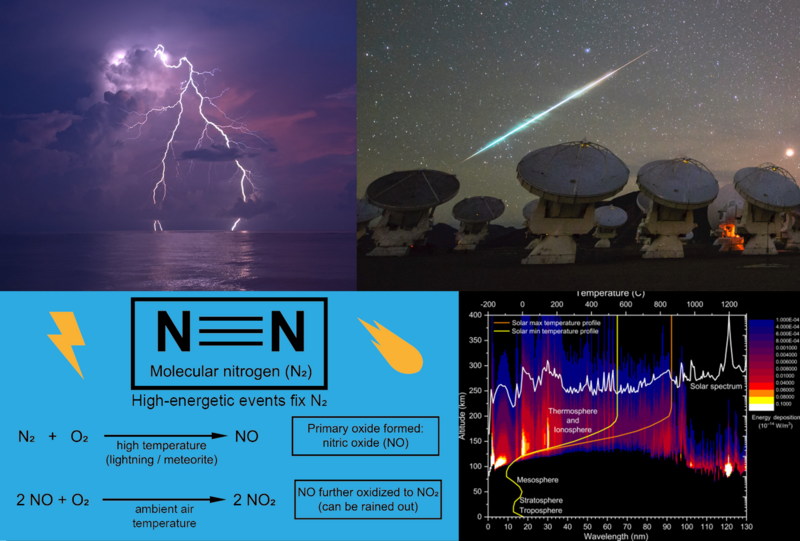
This project investigates the stability of nitrogen-dominated atmospheres on Earth-like exoplanets by combining laboratory experiments with advanced computer modeling to study how high-energy events cause atmospheric loss. The PhD student will specifically focus on the modeling aspect, using and adapting computational codes to simulate the impact of these processes on a planet's atmospheric evolution, stability, and detectability.
The successful candidate will be part of Doz. Dr. Peter Woitke’s research group Planet-Forming Disks and Astrochemistry and Doz. Dr. Helmut Lammer 's research group Solar System Planetary Physics at the IWF, and will be embedded in the Young Researcher Program for interdisciplinary Space Science and Planetary research YRP@Graz.
Keywords: Earth-like atmospheres, exoplanets, atmospheric escape, atmospheric evolution, photochemistry, high-energetic events, star-planet interaction, habitability, astrobiology.
Figures: Illustration of high-energy induced phenomena in planetary atmospheres that can remove nitrogen due to atmospheric escape caused by lightning in the lower atmosphere (upper left and bottom left), penetrating meteorites (upper right and bottom left) and by high XUV-fluxes absorbed in the thermosphere (bottom right). Image Credits. Upper left: „lightning“ by duane.schoon (CC BY-NC-SA 2.0); upper right: ESO/C. Malin (CC BY 2.0); bottom left: M. Scherf; bottom right: R. Vierer.
Research Group Environment in the Graz area: Planet-Forming Disks and Astrochemistry / IWF & TU Graz (Dr. Manuel Scherf & Doz. Dr. Peter Woitke), Solar System Planetary Physics / IWF & Uni Graz (Doz. Dr. Helmut Lammer)
Abstract:
Earth is the only known planet with an N2-O2-dominated atmosphere that supports complex aerobic life, but it remains unclear whether its evolutionary path is unique or whether similar conditions can also develop and persist on rocky planets beyond the Solar System [1,2]. In particular, the long-term stability of nitrogen-dominated atmospheres is a key open question for assessing the habitability of Earth-like exoplanets [2]. Although atmospheric N2 partial pressures are often regarded as stable over geological timescales, they can be strongly affected by high-energy processes such as stellar X-ray and extreme-ultraviolet radiation (XUV), lightning, and meteoritic impacts [3,4]. These processes can lead to atmospheric erosion [2,5] and the fixation of N2 into other molecules [3,4], thereby influencing atmospheric composition, pressure, and evolution, habitability, and the spectral fingerprints detectable by future telescopes such as LIFE and HWO [5].
For investigating the long-term stability, evolution, and spectroscopic detectability of these atmospheres, the bilateral project HESiOD (High-Energy Sinks of N2-Dominated Atmospheres), funded by the Austrian Science Fund FWF and the Czech Science Fund GACR, will combine large-scale laboratory simulations of high-energy plasma events with advanced modelling (e.g., ARGO [6], Kompot [5], Monte Carlo hot particle code [7,8]) of atmospheric escape processes driven by XUV radiation and photochemistry. The Austrian team (Manuel Scherf as Austrian Pi, Helmut Lammer as Co-PI) is responsible for the theoretical and modelling part of the project and works closely with the Czech project partners (Martin Ferus as Czech PI, Petr Kabath and Miroslav Krus as Co-PIs) who perform the laboratory plasma experiments. Together, we aim to better understand N2 loss pathways such as atmospheric escape and the formation of nitrogen-bearing species (e.g., NO, NO2, N2O) and their impact on the prevalence, evolution, and detectability of Earth-like atmospheres. The PhD project will be carried out within the frame of this project and offers the opportunity to work at the interface between astrophysics, planetary science, atmospheric chemistry, and astrobiology.
The PhD student will work on the modelling of high-energy atmospheric processes in N2-dominated atmospheres. A particular focus will be placed on the production of suprathermal nitrogen species (e.g., NO [7]) via processes such as dissociative recombination and particle precipitation under different atmospheric compositions, pressures, and solar/stellar plasma and irradiation conditions. This includes the application and adaptation of our in-house Monte Carlo hot particle code [8,9] to study the effect of suprathermal particle production on atmospheric escape, atmospheric thermal stability, and remote detectability on early Earth and exoplanets. The PhD student will further adopt and apply our atmospheric box model NDEV [4] to study the evolution of Earth-like atmospheres by implementing N2 fixation yields from the experiments and escape rates from our models. The work will be performed in close collaboration with the team in Graz, our colleagues in Prague, and (inter)national collaborators (e.g., K. Kislyakova, P. Rimmer), and provides connections to current and future exoplanet missions and concepts such as PLATO, LIFE, and HWO.
Tasks:
- Adaptation and application of our hot particle Monte Carlo code to early Earth and Earth-like exoplanets.
- Investigation of NOx formation driven by XUV radiation, suprathermal atoms, lightning, and impact-related processes.
- Integration of laboratory-derived and modelling-based N2 fixation and atmospheric loss rates into our atmospheric evolution model.
- Parameter studies covering different atmospheric compositions, pressures, stellar activity levels, and planetary conditions.
- Contribution to spectral/detectability studies of nitrogen-bearing molecules in rocky exoplanet atmospheres.
- Collaboration with in-house, national, and international project partners.
- Preparation of peer-reviewed scientific publications and presentation of results at national and international conferences.
Requirements:
The candidate is expected to have a master’s degree in physics, Astronomy, or Earth/Planetary Sciences. Programming experience in FORTRAN-90, Python, or other computer languages is recommended. Teamwork skills, a self- driven research attitude, and scientific curiosity are important.
References:
[1] Lammer, H., Scherf, M., and Sproß, L., Eta-Earth Revisited I: A Formula for Estimating the Maximum Number of Earth-Like Habitats, Astrobiology, 24, 10, 897, 2024, doi: 10.1089/ast.2023.0075.
[2] Scherf, M., Lammer, H., and Spross, L., Eta-Earth Revisited II: Deriving a Maximum Number of Earth-Like Habitats in the Galactic Disk, Astrobiology, 24, 10, e916, 2024, doi: 10.1089/ast.2023.0076.
[3] Stüeken, E. E., Kipp, M. A., Koehler, M. C., Schwieterman, E. W., Johnson, B., and Buick, R., Modeling pN2 through Geological Time: Implications for Planetary Climates and Atmospheric Biosignatures, Astrobiology, 16, 12, 949, 2016, doi: 10.1089/ast.2016.1537.
[4] Sproß, L., Scherf, M., Shematovich, V. I., Bisikalo, D. V., and Lammer, H., Life as the Only Reason for the Existence of N2-O2-Dominated Atmospheres, Astronomy Reports, 65, 4, 275, 2021, doi: 10.1134/S1063772921040077.
[5] Johnstone, C.P., Lammer, H., Kislyakova, K.G., Scherf, M., and Güdel, M., The young Sun's XUV-activity as a constraint for lower CO2-limits in the Earth's Archean atmosphere, Earth and Planetary Science Letters, 576, 117197, 2021, doi: 10.1016/j.epsl.2021.117197.
[6] Rimmer, P. B. and Helling, Ch, A Chemical Kinetics Network for Lightning and Life in Planetary Atmospheres, The Astrophysical Journal Supplement Series, 224, 1, 9, 2016, doi: 10.3847/0067-0049/224/1/9.
[7] Scherf, M., Krauss, S., Tsurikov, G., Strasser, A., Shematovich, V., Bisikalo, D., Lammer, H., Güdel, M., and Möstl, C., The impact of electron precipitation on Earth's thermospheric NO production and the drag of LEO satellites, Annales Geophysicae, 44, 1, 209, 2026, doi: 10.5194/angeo-44-209-2026.
[8] Gröller, H., Shematovich, V. I., Lichtenegger, H. I. M., Lammer, H., Pfleger, M., Kulikov, Yu. N., Macher, W., Amerstorfer, U. V., and Biernat, H. K., Venus' atomic hot oxygen environment, Journal of Geophysical Research (Planets), 115, E12017, 2010, doi: 10.1029/2010JE003697.
[9] Amerstorfer, U. V., Gröller, H., Lichtenegger, H., Lammer, H., Tian, F., Noack, L., Scherf, M., Johnstone, C., Tu, L., and Güdel, M., Escape and evolution of Mars's CO2 atmosphere: Influence of suprathermal atoms, Journal of Geophysical Research (Planets), 122, 6, 1321, 2017, doi:10.1002/2016JE005175.