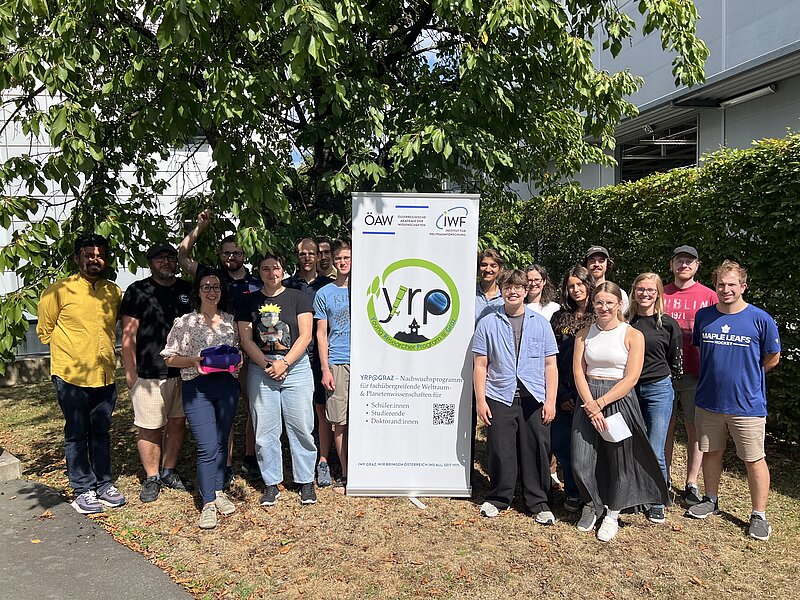

The summer internship positions 2026 will partly financed from the budget of the mayor of Graz, Elke Kahr, as well from the IWF budget.

Summer Internships for Bachelor- and Master-Students

In 2026, the IWF offers again positions for two-to-three-months summer internship for (under)graduate students (time period July-October 2026; for EU/EEA/Swiss nationals only). Payment is made according to the OeAW salary scheme, which is based on the applicant's level of training. Students can send their application via email to Dr. Ruth-Sophie Taubner (Deadline: April 21st, 2026, 23:59). The application (in English) should include the following information:

  • CV
  • Study (University, degree programme, estimated time of graduation)
  • Interested in which project(s)
  • Motivation (max. 500 words)


The following projects are offered in 2026:

Project: Cloud formation on Venus: A novel model approach to resolve the conundrum of the Venusian clouds

Supervisor: Dr. Manuel Scherf

Venus, the hellish twin of our home planet Earth, is covered by thick clouds mostly consisting of droplets that contain a mix of sulfuric acid, water and a wide, partially unknown component of dust particles that originate either from Venus’ surface, volcanic degassing or an influx of interplanetary dust particles and micrometeorites. The origin, physical and chemical behaviour of the clouds, however, are still mostly a conundrum and are accompanied by various unresolved scientific problems. Among others, these include (i) the disputed detection of phosphine, (ii) the unknown UV absorber in Venus’ clouds, (iii) a strong depletion of SO2 above the clouds, (iv) an unexpected increase in the deuterium to hydrogen ratio in the mesosphere, and (v) the composition and size-distribution of the cloud particles and aerosols themselves. This student internship aims at better understanding Venus’ clouds by investigating the origin, behaviour, distribution and chemical composition of aerosols in Venus’ atmosphere with DiffuDrift and GGchem, which will help in resolving above mentioned scientific conundrums.

Necessary knowledge: Master or Bachelor student in physics or space science; Interest in atmospheric physics and chemistry; Basic knowledge of Linux, Python (and interest in Fortran)

Recommended reading sources:

Project: MMS Data Exploration & Energy Budget Analysis

Supervisor: Dr. Aditi Upadhyay and Dr. Zoltán Vörös

Earth’s magnetosheath, the turbulent, shocked solar wind region bounded by the bow shock and the magnetopause, is a unique natural laboratory for studying collisionless plasma turbulence across a wide range of spatial and temporal scales. Understanding how energy cascades from large magnetohydrodynamic (MHD) scales down to electron kinetic scales, and how it is locally converted and transported by coherent structures, is a central open question in space plasma physics. NASA’s Magnetospheric Multiscale (MMS) mission, flying four identical spacecraft in a tunable tetrahedral formation, provides the highest-resolution plasma and electromagnetic field measurements ever made in this region. This project introduces the student to the MMS mission and its unique data products, develops the physical and mathematical tools needed to compute plasma moments and energy terms from particle distribution functions, and places these in the context of multi- versus single-spacecraft analysis. The culminating step is to apply the acquired skills to compute local energy proxy (LEP) terms and contribute processed, labelled data intervals to the FWF project’s growing magnetosheath database.

Necessary knowledge: 

  • Physics: Classical electrodynamics (Maxwell’s equations, Lorentz force); plasma physics fundamentals (frozen-in theorem, MHD); space physics context (magnetosphere structure, bow shock, magnetosheath) -- MSc level
  • Mathematics: Vector calculus (div, curl, gradient); linear algebra (tensors, eigenvalue decomposition for MVA) -- BSc/MSc level
  • Programming: Python (numpy, matplotlib, scipy); Jupyter notebooks -- MSc level
  • Data Handling: Multi-dimensional arrays; pyspedas library introduced during the project -- No prior experience required

Recommended reading sources:

Project: Magnetopause Response to Interplanetary Magnetic Field Orientation Changes

Supervisor: Dr. Adriana Settino and Dr. Daniel Schmid

The Earth's magnetopause is a dynamic boundary separating the shocked solar wind plasma from the magnetosphere. The dominant coupling processes at this boundary are strongly controlled by the interplanetary magnetic field (IMF) orientation. For instance, southward IMF drives dayside magnetic reconnection, while northward IMF favors the Kelvin–Helmholtz instability. Both processes facilitate solar wind plasma entry into the magnetosphere.
The solar wind magnetic field is, however, highly variable in both magnitude and orientation. Despite extensive study of magnetopause dynamics under prolonged periods of quasi-steady IMF conditions, the transitional periods — when the IMF changes orientation — remain comparatively poorly understood. This project addresses two fundamental questions regarding this transition:

  • How does the magnetopause respond to a IMF turning?
  • On what timescale does the magnetopause readjust to the new IMF configuration?

Answering these questions is essential for advancing our understanding of solar wind–magnetosphere coupling under realistic, time-varying solar wind conditions and critical to understand the energy input into the magnetosphere.

Necessary knowledge: Plasma Physics knowledge would be beneficial. Programming skills in Python or Matlab are required.

Recommended reading sources:

Project: Neural-RT: A Neural Emulator for Radiative Transfer for Exoplanet Atmospheres

Supervisor: Dr. Amit Reza

Present and future space missions enable comparative studies of the weather and climates of ensembles of exoplanets orbiting different stars within our galaxy, where the host-star population and the chemistry-determining element abundances change. Exoplanet atmospheres are complex physio-chemical systems where cloud and gas chemistry are in close feedback loops with the local thermo- and hydrodynamics, which in turn are affected by the external radiation field of the host star and the local galactic metallicity. Complex models have been developed that are highly computationally intensive, including three major components of exoplanet atmosphere characterization: the 3D Global Circulation Model (GCM), Cloud modeling, and Radiative Transfer. This work aims to develop a Machine Learning (ML)-driven data interpretation pipeline as a fast, robust, and reliable alternative to classical components, in particular to develop a neural network (NN) emulator to accelerate the radiative transfer (RT) component, integrating with 3D GCM and cloud modelling.

Necessary knowledge: Knowledge in one or more of the following topics will be helpful: Exoplanet Atmospheric Modelling, Astrophysics, Atmospheric Science, and Machine Learning.

Recommended reading sources:


Welcome Event for IWF Summer Interns
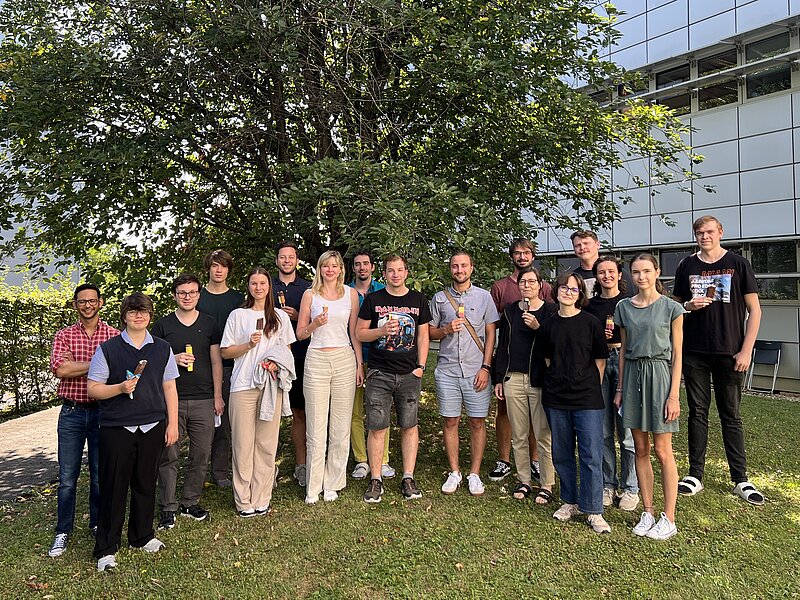
On 19 August 2025, we had the pleasure of inviting this year's summer interns to a joint welcome event. Before each intern was given the opportunity to briefly present their project, there were a few icebreaker games. The event was rounded off with a round of introductions by the various research groups at the IWF. Strengthened with ice cream and lots of new ideas, our interns were then able to take a look at the IWF Astrolab at the end.

We plan such a welcome event also for summer 2026.

Past Summer Internships

In 2023, the IWF was offering two summer internships for undergraduate students. The projects chosen in 2023 were "The habitability of nearby stellar systems: assembling a target list of stars that can host planets with Earth-like atmospheres" (supervisor: Dr. Manuel Scherf) and "Interplanetary Shocks and plasma turbulence Using Supercomputer Simulations" (supervisors: Dr. Luis Preisser and Dr. Cyril Laurent Simon-Wedlund).

Also in 2024, the IWF was offering two internships for undergraduate students. The projects chosen in 2024 are "Planetary atmospheres through time: evolution driven by atmospheric mass loss" (supervisor: Dr. Daria Kubyhkina) and "Ion trajectories simulation for the calibration of the PICAM instrument onboard ESA/BepiColombo mission" (supervisors: Dr. Gabriel Giono und Dr. Ali Varsani).

In the summer of 2025, four school pupils and students were able to complete an internship at the IMF. The six-week public outreach project "Bau und Programmierung eines PLATO-Modells" (supervisor: Dr. Manfred Steller) and the four-week IT project "Konfiguration und aktive Umsetzung eines Git/Wiki Systems zur Verwaltung der IT-Dokumentation und interner Software des Instituts" (supervisor: Mag. Wolfgang Voller) were successfully completed by two school pupils from Styria. The two 2-month projects "UV-driven chemistry in a shadowed protoplanetary disk" (supervisor: Dr. Sierk van Terwisga) and "Evaluating the Evolution of Systematic Noise in HST/STIS Exoplanet Transit Observations" (supervisor: Dr. Sreejith Aickara Gopinathan) lasted until October 2025.

    The Summer Internships 2023 and 2024 were entirely, and 2025 partly funded by the budget of the mayor of Graz, Elke Kahr.