Our group also studies the formation of exospheres on airless bodies that originate through the solar plasma and radiation environment (Lammer et al. 2022). Planet Mercury and low-mass objects like Earth’s Moon, asteroids, or the moons of the giant planets in the outer Solar System have no substantial atmosphere and are generally defined as airless bodies. Because the surface of these celestial bodies is directly exposed to the radiation, ions, and electrons of the ambient plasma flow from the Sun or, in the case of giant planets, from their magnetospheric plasma, to the solar radiation and meteoroid fluxes, the surface-interaction of these exogenic sources changes and modifies the surface environment. Several surface interaction processes, such as thermal release,
Photon-stimulated desorption, electron-stimulated desorption, surface particle sputtering, and micrometeorite impact evaporation modify the chemical and optical surface properties of these planetary bodies and produce collisionless gaseous envelopes, so-called exospheres, that consist of elements from the surface.
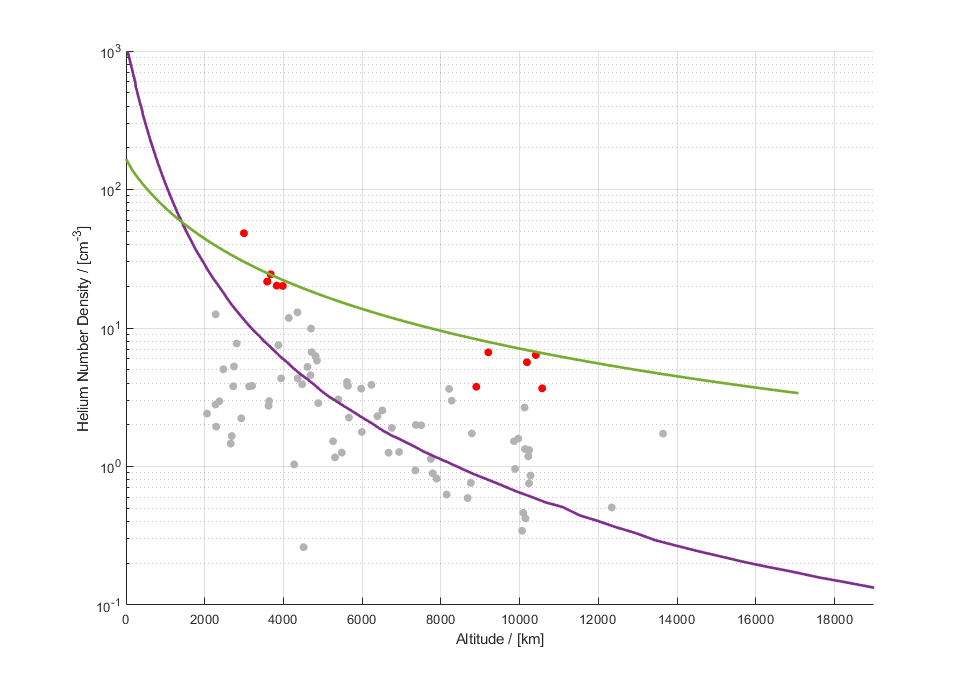
The exospheres of planets are usually observed by using transit spectroscopic methods, such as the Lyman-α line, particle detectors, flight mass spectrometers, and the analysis of so-called ion cyclotron waves (ICWs) using magnetometers and plasma instruments (Lammer et al. 2025, Schmid et al. 2025, Weichbold et al. 2025). The ICWs are produced by pick-up ions from exospheric neutral atoms over a large distance upstream of planetary bodies, where newborn exospheric ions generate an unstable secondary ion population in the solar wind plasma, where the interaction between these populations can produce plasma waves. The observed wave power can then be used to obtain the corresponding pick-up ion and related neutral particle densities, as shown for He densities in the above figure.
We study the formation and characterization of ionized and neutral exospheres by applying Direct Simulation Monte Carlo Models for the investigation of diffusion effects on solar wind surface interaction, and exosphere/plasma physics models in cooperation with the Space Plasma Physics Group at the IWF.
This research is carried out with the help of ESA's BepiColombo mission with its PICAM (Planetary Ion Camera) and SERENA (Search for Exospheric Refilling & Emitted Natural Abundances) instruments.
Within the FWF-WEAVE joint Czech-Austrian Venus science project VeReDo (Redox Disequilibrium in the Clouds of Venus – A Sign of Life?), where we study the escape of water from the Venus upper atmosphere. Earth's inner planetary neighbor has been explored by numerous spacecraft. Until now, its water inventory and implications for planetary evolution remain uncertain. To know the atmospheric deuterium-to-hydrogen (D/H) ratio of escaping particles in Venus' exosphere is necessary to understand the evolution of the planet's water inventory. Within this project, we reanalyze the Venus Express magnetic field data to investigate ion cyclotron waves (ICWs) generated by the pick-up ions of exospheric hydrogen isotopes.
We discovered ICWs that are generated by exospheric H+ and D+ pick-up ions (Weichbold et al. 2025). A reproduction of the exospheric H and D neutral density profiles results in D/H ratios that are in agreement with recent solar occultation observations by the SOIR instrument on board Venus Express (Mahieux et al. 2024) that found an unexpected increase from 0.025 at about 70 km to more than 0.25 at 108 km of the deuterium to hydrogen ratio above the Venus cloud deck. The derived escape rates that are constrained by the data challenge the existence of a late-stage ocean on Venus.
Another study addresses the discovery of compact dust clouds in the lunar exosphere (Khodachenko et al. 2025), which may be responsible for a high accident rate of spacecraft during approach to and/or landing on the lunar surface. The failure rate of robotic lunar landers and rovers was around 53% in the 1960s and 70s. Of 19 lunar landing and rover missions in the last five years (2019–2024), 11 (57%) were lost. Such incidents point to a previously overlooked technological risk factor.
We conducted a statistical analysis of the spatial and temporal features of long-lasting anomalous stellar occultations and discovered obscuring dust clouds resembling an impact cloud approximately 1 km in diameter, with the probability of anomalous occultations peaking during the Perseid meteor shower. Finally, rough estimates of the dust concentrations in the discovered compact, near-ground clouds and their braking effect on spacecraft show that even a single flyby of such dust formations can lead to a critical loss of altitude or technical malfunctions of near-ground spacecraft.

Within the study of exospheres, we further investigate similar processes at icy satellites and comets within ESA's Jupiter's Icy Moon Explorer and the Comet Interceptor mission.