The work performed in this research area aims at understanding fundamental physical processes related to the complex stellar-planetary interaction, which drives the continuous evolution of planets. Our key question to be addressed is:
Solar/stellar-planetary interaction processes are manifested in the nearby dynamical plasma environments of planets and their electromagnetic radiations, formed under the influence of the host stars and their activity factors, such as stellar winds, stellar radiation, and particle flows, which comprise the planetary space weather. Therefore, the problem of stellar-planetary interactions, including the impact of stellar activity on the evolution of planetary systems, calls for extensive study of the whole variety of stellar/solar activity phenomena and planetary environments (atmospheres, ionospheres, magnetospheres) in their mutual connection and influence. In this way, we implement a multidisciplinary approach to probe, characterize, and understand physical processes in the dynamical environments of (exo)planets, driven by complex stellar/solar-planetary interactions, including the factors of solar/stellar activity, plasma flows, and radiation.
Our research builds on the synergy of three major research methodologies:
The optical and spectral phenomena, measured during exoplanetary transits, as well as in situ data from space missions in the Solar System, provide valuable information for probing and characterizing planetary systems and their dynamical environments. We use this observational data for a consistent interpretation and convert the empirical facts to scientific knowledge.
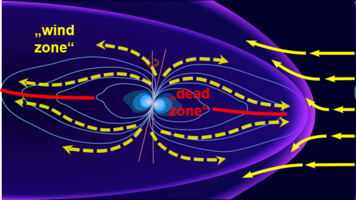
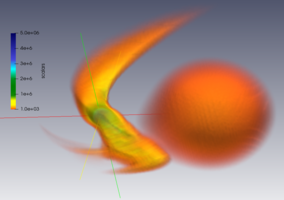
The ongoing work is focused on the following subjects