At Earth, earthquakes create electrical charges which generate seismo-electromagnetic waves that can be detected by satellites like China's CSES-1 & CSES-2 missions and ground-based antennas such as the INFREP network. In this field of research, we characterize and investigate the dynamo mechanism which generates electric fields and currents in the electrically conducting ionosphere. It interacts at higher altitudes with the magnetosphere and at lower altitudes with the atmosphere. It can be considered as a key region because of its relationship to the space environment via the magnetosphere and the Earth's lithosphere layer through the atmosphere.
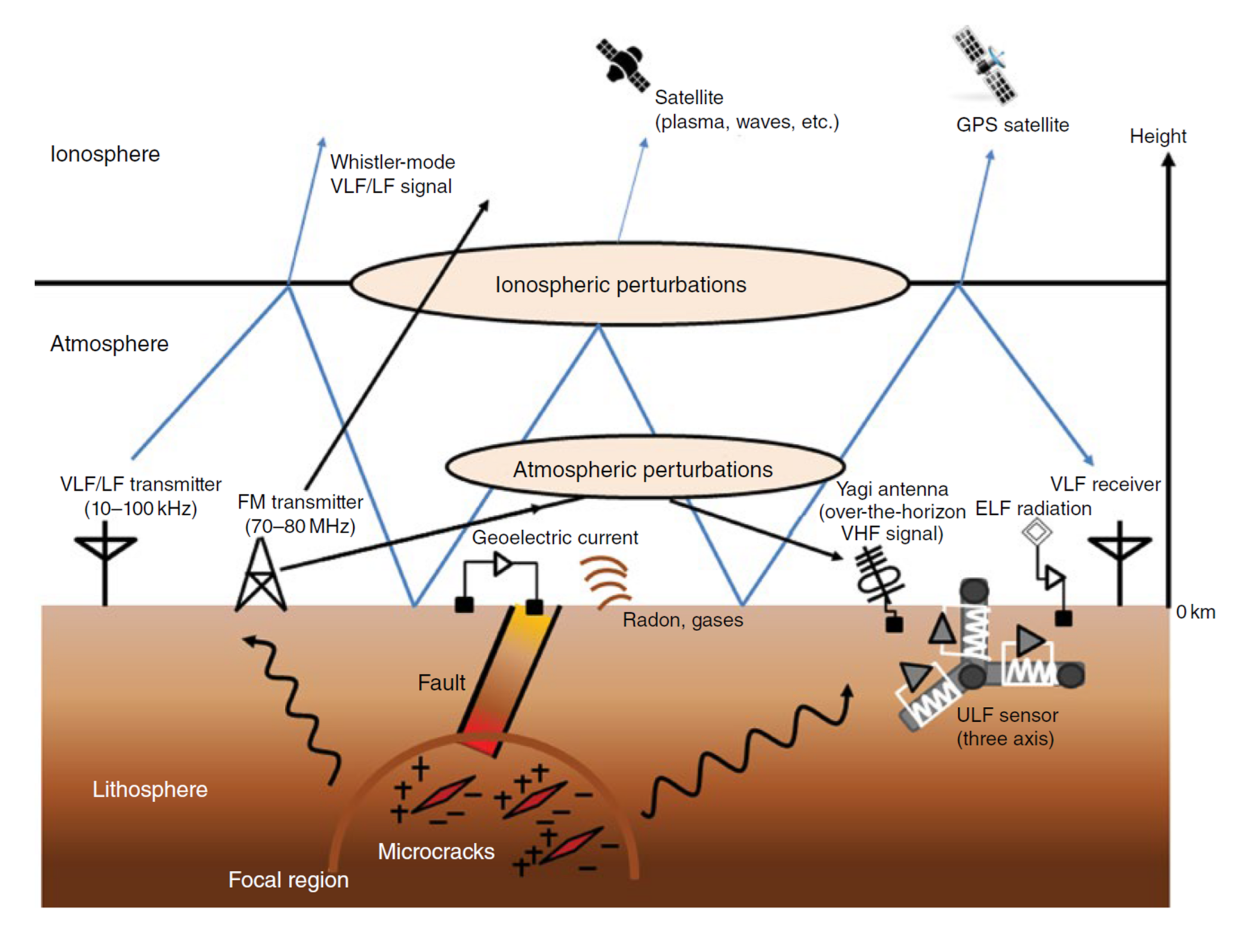
In this research area we use two approaches, one based on the modelization of the ionosphere wind dynamo and the other on the use of radio wave propagations allowing principally plasma remote sensing of ionospheric layers. The combination of both methods allows us to optimize our models and to compare observed values to the calculated electric fields and magnetic variations. The coupling atmosphere-ionosphere-magnetosphere is investigated in such way to highlight the solar activity effect on magnetic, plasma and neutral components of the Earth's environment. The modelization of the ionosphere physical parameters is explored in the manner to be consistent with observed ground magnetic perturbations.
We analyze and study the propagation of seismogenic electric currents through the Earth's atmosphere where such currents are associated to the earthquake preparation zone in the lithosphere. Also sub-ionospheric VLF/LF transmitter signals are used to emphasize on the dynamic of the D- and E-layers under the effect of the solar and geomagnetic activities. The VLF/LF propagation leads us to infer the radio spectrum between the ground and the lower ionosphere.