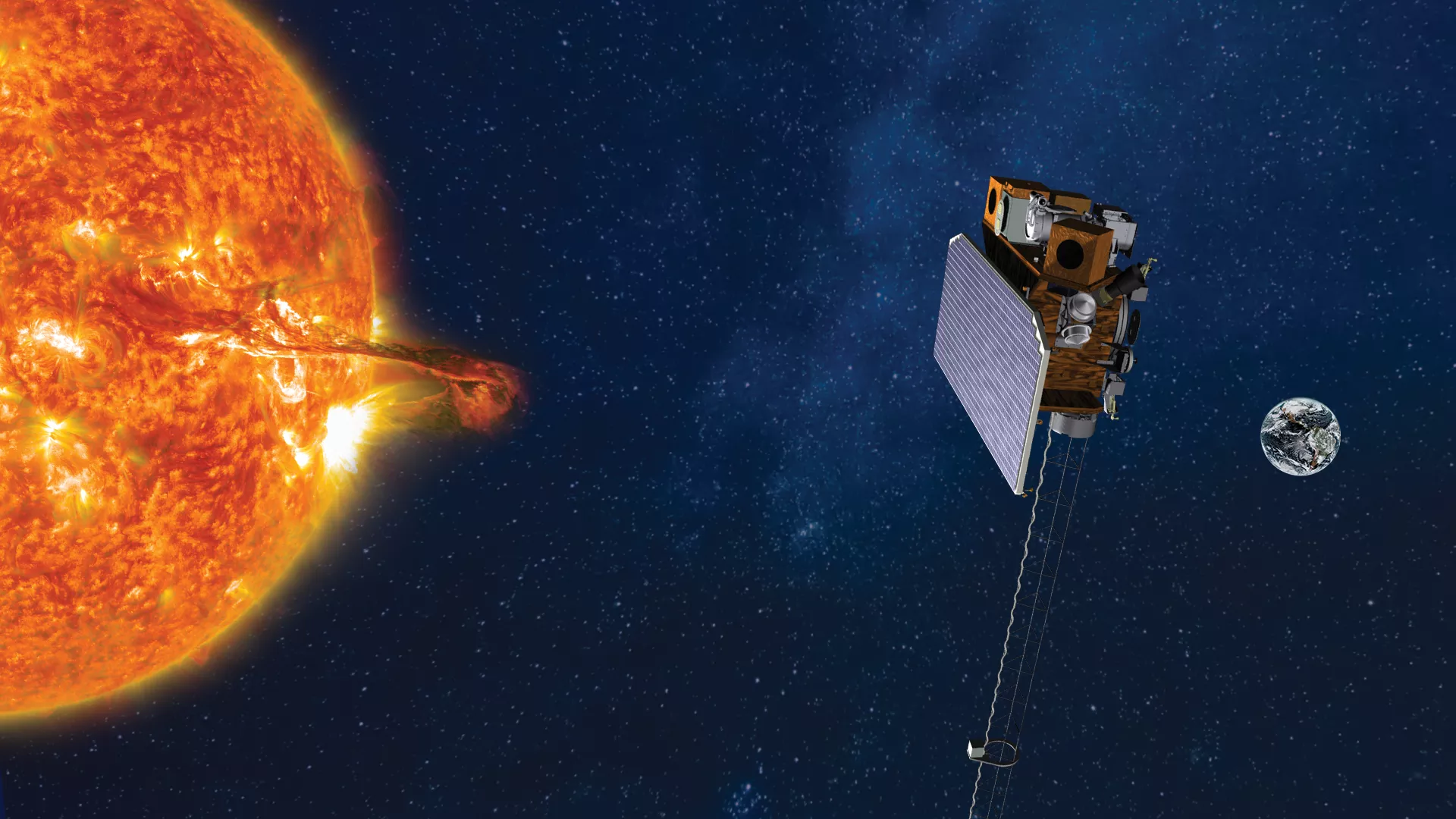
Space weather Observations at L1 to Advance Readiness (SOLAR)-1, originally known as Space Weather Follow On - Lagrange 1 (SWFO-L1), serves as an early warning system that is able to detect solar storms in space. These storms can have severe impact on satellite operations as well as on communication systems and power grids on Earth. On 24 September 2025, SOLAR-1 was launched to Lagrange Point 1, which is 1.5 million km closer to the Sun than Earth. At this position, the satellite can measure the effects of a solar storm 10-60 minutes before it arrives at Earth and provide early warning with a delay of less than 5 minutes. With this early warning, satellites in Earth orbit can be reconfigured or shut down in time to protect them from potential damage by a solar storm.
SOLAR-1 is operated by the US National Oceanic and Atmospheric Administration (NOAA) and serves as a replacement and upgrade for the aging ACE and DSCOVR satellites that previously performed this task.
One of the key instruments for early detection of solar storms is the magnetic field instrument MAG, which was developed by the South-West Research Institute in cooperation with the University of New Hampshire (UNH). The IWF provided the measurement electronics for this magnetometer, which is the core element that operates the UNH fluxgate sensors and preprocesses the data to a suitable digital format. The IWF-developed electronics board was subject to a thorough test and pre-calibration campaign at the institute, in order to guarantee the high measurement quality required for solar storm detection.
In January 2026, SWFO-L1 reached its intended orbit and was renamed SOLAR-1. It will be followed by SOLAR-2 in December 2028 and SOLAR-3 in October 2031.
More information on SOLAR-1 can be found at NOAA.