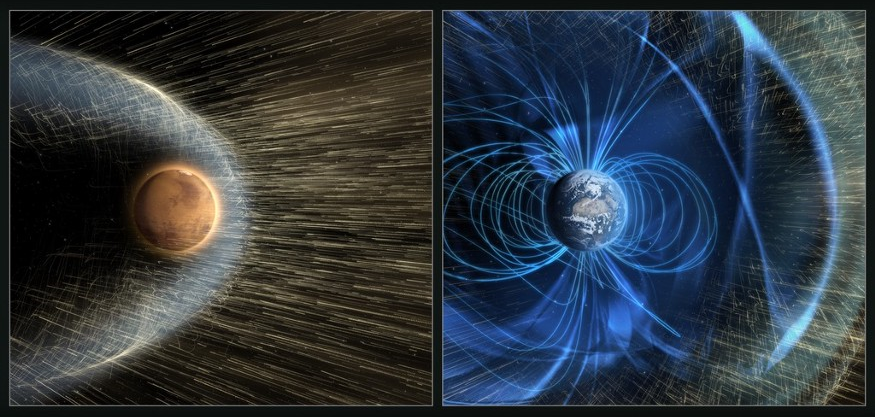
In this research area, we focus on the interaction processes of solar/stellar radiation and plasma with the upper atmospheres of terrestrial planets (e.g., Venus, Earth, Mars). The evolution of planetary atmospheres from primordial, steam to secondary atmospheres is studied. Variations of isotopes and volatile elements in different planetary reservoirs keep information about atmospheric escape, composition, and even the source of accreting material.

Secondary atmospheres are studied in the framework of comparative planetology with a focus on aeronomical processes between Venus, Mars, Earth, and terrestrial exoplanets. For studying the evolutionary processes, known atmospheric isotope and elemental ratios are used for evolutionary reproduction attempts. Atmospheric 36Ar/38Ar and D/H ratios, for instance, give important insights into the evolution of the Martian atmosphere (see schematic illustration) and its potential former habitability (for detailed information see, e.g., Scherf and Lammer 2021, and Lichtenegger et al. 2022). For Venus, the strong fractionation in its atmosphere shows that high amounts of H2O must have been lost into space over its history (see, e.g., Gillmann et al. 2022).
A better knowledge on how Earth's atmosphere and biosphere originated and evolved will also enhance our understanding of exoplanetary systems, in particular in view of the potential habitability of Earth-type exoplanets. How so-called Earth-like Habitats, i.e., rocky exoplanets with N2-O2-dominated atmospheres and minor amounts of CO2, emerge and evolve, together with their prevalence in the Galaxy, is one of the key questions that the group tries to investigate.

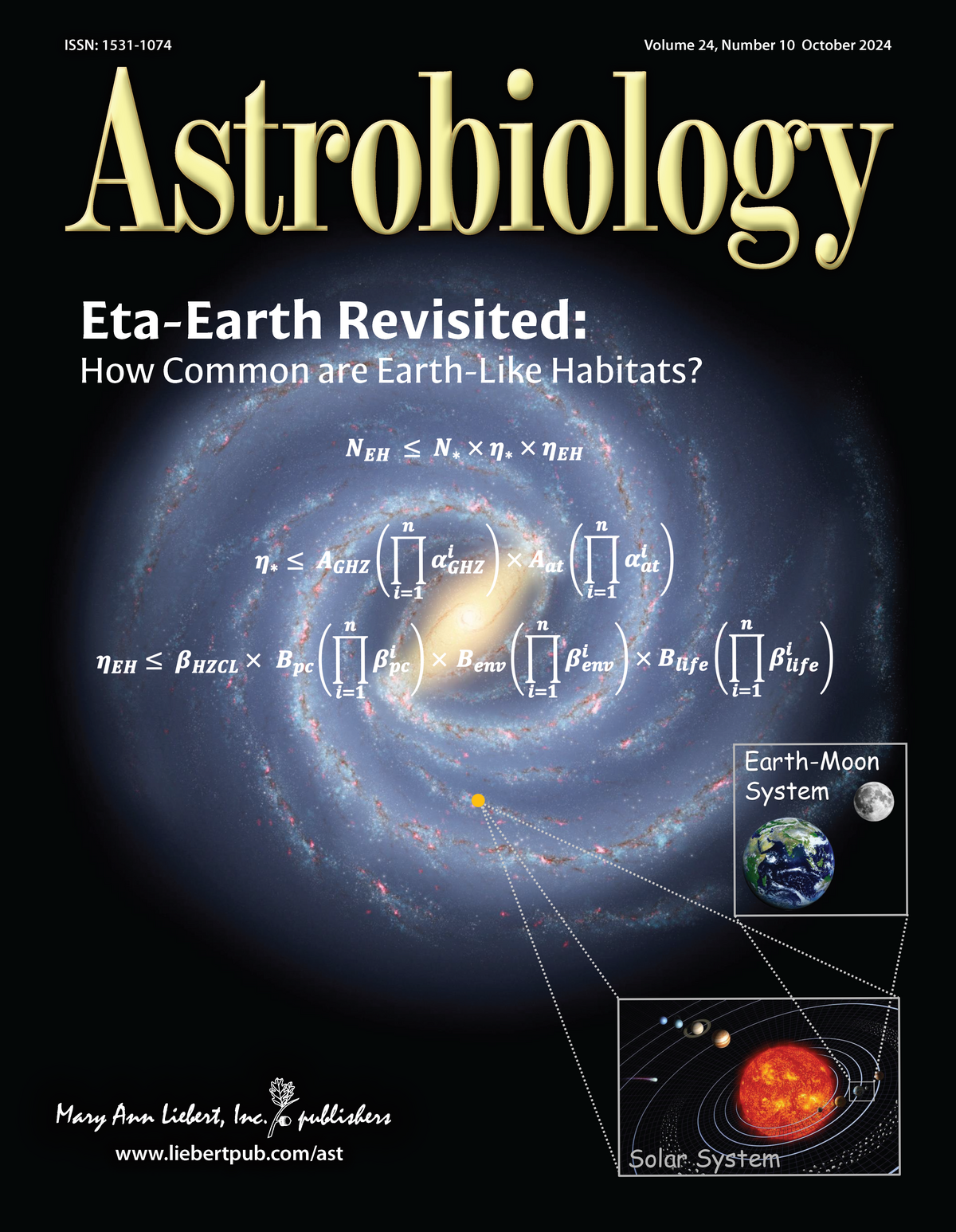
We present in a special paper collection in the October 2024 issue of Astrobiology, "Eta-Earth Revisited: How Common are Earth-Like Habitats?", a new formula that incorporates realistic arguments to estimate the maximum number of rocky planets with Earth-like N2- and O2-dominated atmospheres in the Galaxy (Lammer et al. 2024, Scherf et al. 2024). Contrary to the Drake formula, astrophysical and planetary parameter clusters are implemented instead of specific criteria. This approach results in an equation that is more flexible and not tied to individual speculative or disputed parameters. Correlations, temporal evolutions, spatial differences, and parameter ranges can be considered rather than point parameters. Because of this, one can distinguish between stars and planets that allow for the emergence of Earth-like Habitats, and those that do not. The parameters in the formula that are unknown today can be fine-tuned and constrained by atmospheric characterization with future space- and ground-based telescopes.
By applying this new formalism, it is found that these planets, i.e, Earth-like Habitats, will likely be rare, with a maximum plausible number of 2.5+71.6-2.4 × 10⁵ – 6.0+27.1-0.59 × 10⁵ planets that can potentially host N2-O2-dominated atmospheres with very low CO2 mixing ratios (Scherf et al. 2024). These results support the so-called “Rare Earth Hypothesis” and imply that complex life and extraterrestrial intelligence are likely rare in the Milky Way. One should note that the real number of Earth-like Habitats will be lower, because one can expect that many planets will not have functional plate tectonics or some may have had problems getting rid of possible primordial H2-He-dominated atmospheres, etc.
Thus, an Earth-like Habitat must meet certain requirements to provide habitable conditions for the evolution of complex life. These include, for example, the planet's composition and the amount of water it can accumulate and retain during its formation (Lammer et al. 2025). It was found that the amount of H2 and He of a growing planet that can accumulate from the protoplanetary disk is also of great importance. The results show that a planet growing to Earth-like mass towards the edge of the protostellar disk and located in the habitable zone of a weakly active, Sun-like star can bind considerable amounts of helium and hydrogen.
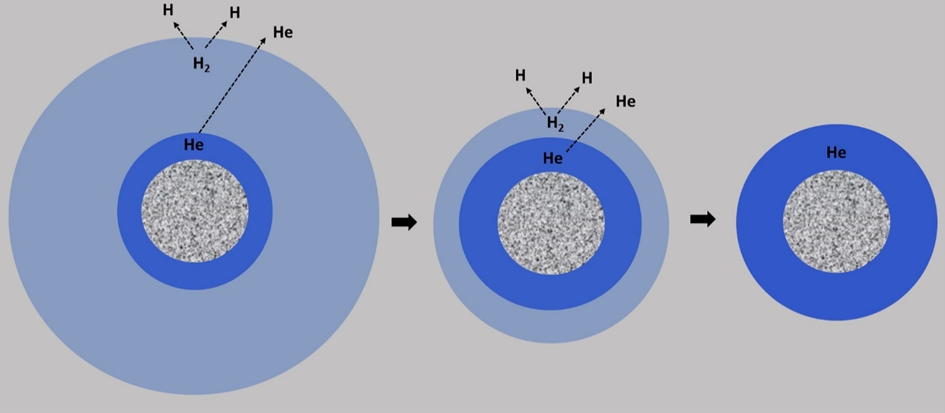
Approximately 200 bar of helium and 80 bar of hydrogen would remain on the planet for billions of years. This corresponds to 280 times the pressure of our current atmosphere, three times the pressure of Venus's atmosphere, or the pressure at an ocean depth of about 3 kilometers. If Earth had grown to its full size within the first 4 million years, it would still have a dense, helium-dominated atmosphere, and complex life on its surface would likely be impossible and could not have developed on Earth (Lammer et al. 2025).
The low oxygen-oxygen ratio expected in a helium-dominated primordial atmosphere would hardly be able to sustain complex life as we know it on Earth. Helium, which fills the lungs of mammals, is known to create a diffusion gradient that washes away the oxygen stored in the blood, causing its concentration to drop to a lethal level within seconds. However, a sufficiently high oxygen-oxygen ratio in the atmosphere is key to the evolution of complex organisms ranging in size from centimeters to meters - and also of humans or hypothetical extraterrestrial civilizations. Earth-like planets, even those located within the habitable zone, are therefore no guarantee of providing truly life-friendly conditions for complex life forms.
Based on these research results, it can be concluded that a thorough understanding of the complex interplay between the rate of mass enrichment of a planet and the associated lifetime of the gas disk, the enrichment of primordial atmospheres and the activity development of the parent star will be fundamental to be able to trace the formation of Earth-like Habitats, and thus also the emergence of complex life.