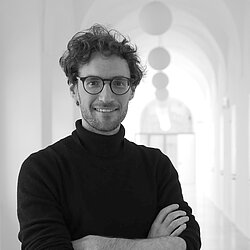
Jean Schmitt ist promovierter Umweltingenieur mit Schwerpunkt in Luftqualität, und hat eine Ausbildung in Mikromechatronik und Maschinenbau. Er verfügt über berufliche Erfahrungen sowohl in der Industrie als auch in der Wissenschaft. Seit Jänner 2025 ist er am ITA gemeinsam mit Gudrun Lettner für das NanoTrust-Beyond-Projekt zuständig.
Jean hat einen Ingenieurabschluss von der École Nationale Supérieure de Mécanique et des Microtechniques (Frankreich), sowie einen Masterabschluss in Mechatronik mit Schwerpunkt auf Mikrosysteme von der Technischen Universität Ilmenau (Deutschland). In seiner Masterarbeit befasste er sich mit energieeffizienten Mikrosensoren zur Detektion von Sauerstoff in Lebensmittelverpackungen.
Während seiner Promotion in Umweltingenieurwissenschaften, die er 2022 an der ETH Zürich (Schweiz) abschloss, arbeitete er an der Entwicklung von polymerbasierten 3D-gedruckten Mikrosensoren zur Überwachung der Luftqualität. Zudem entwickelte er während des Ausbruchs von COVID-19 ein Computermodell zur Bewertung der Schutzwirkung von Atemschutzmasken.
Vor Beginn seines Promotionsstudiums arbeitete er als Entwicklungsingenieur in der schweizerischen Automobilindustrie, an der Entwicklung elektrischer smart-Aktuatoren zur Regulierung der Schadstoffemissionen in Verbrennungsmotoren. Bevor er zum ITA kam, war er als Postdoktorand an der University of Toronto (Kanada) tätig, wo er sich auf die Quantifizierung der gesundheitlichen Auswirkungen der Einführung von Elektrofahrzeugen auf die Luftqualität in den USA konzentrierte.

The ‘stealth effect’ refers to a camouflage mechanism that enables bacteria to evade the immune system. In medical research, this phenomenon is utilized to significantly increase both circulation time within the body and precision in targeting disease foci. The primary areas of application lie in targeted tumor therapy, but also include the diagnostics of infectious diseases such as cholera, as well as the treatment of chronic inflammatory bowel diseases. This dossier provides an overview of various natural and synthetic coating methods, many of which are inspired by the model of camouflaged nanoparticles. These include coatings with polymers to increase circulation time in the bloodstream, as well as the use of biomimetic cell membranes that ensure excellent biocompatibility.
Per- and polyfluoroalkyl substances (PFAS) possess remarkable properties that make them attractive for many applications, including non-stick coatings, waterproof clothing, and firefighting foams. However, this is a double-edged sword: their thermal and chemical resistance also means that they do not degrade easily once released into the environment.
Consequently, PFAS are now regularly detected in even the most remote regions of the planet. They are found in blood samples of humans and wildlife, and are associated with a wide range of adverse health outcomes: PFAS have been shown to weaken the immune system, interfere with foetal development,disrupt endocrine function and increase cancer risk.
This NanoTrust Dossier provides an overview of occupational exposure limits for ENMs in Europe. It highlights the challenges in establishing these limits and effectively safeguarding workers in a rapidly evolving field, and presents initiatives to accelerate the toxicity assessment of nanomaterials.
Schmitt, J. (Speaker)
Dr.sc.
Tel.: +43 (0)1 515 81-6578
Fax: (+43-1-) 515 81-6570
Bäckerstraße 13, 1010 Wien
jean.schmitt(at)oeaw.ac.at