


Looking back to 2024
The IWF and its research
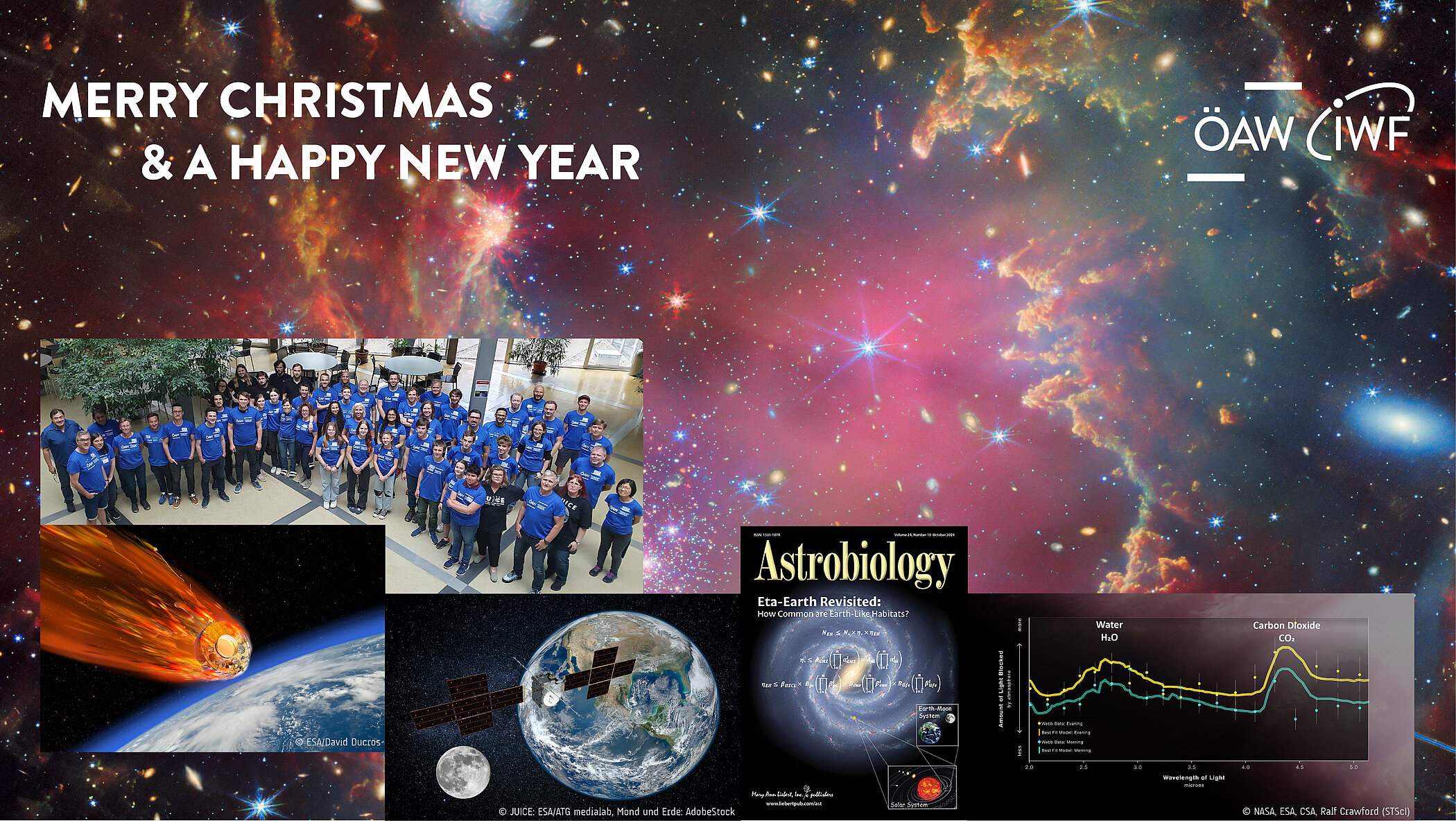
On its journey to Mercury, BepiColombo - during its flyby - provided new insights into Venus, which were published in Nature Astronomy.
In August 2024, JUICE performed the first-ever lunar-Earth flyby, and the first-ever double gravity assist manoeuvre. The aim was to change the spacecraft’s speed and direction, helping to guide it on its journey to Jupiter.
On 8 September 2024, the first of four satellites that make up ESA’s Cluster mission reentered Earth’s atmosphere over the South Pacific Ocean. This marked the end of a historic mission. During 24 years in space, Cluster has sent back precious data on how the Sun interacts with Earth’s magnetic field, helping us better understand and forecast potentially dangerous space weather.
While observing the hot gas giant WASP-76 b, the CHEOPS space telescope has probably discovered the first glory on an exoplanet.
Based on observations with the James Webb Space Telescope and supported by the IWF's climate and cloud models, differences in the chemical composition between the morning and evening terminators of the exoplanet WASP-39 b have been discovered.
In a special issue of Astrobiology, IWF researchers stated that complex life and extraterrestrial intelligence in the Milky Way are rather unlikely.
The IWF and its publications, awards and third-party funds
In 2024, around 150 refereed articles were published, 36 first-authored by the IWF.
Rumi Nakamura, head of IWF’s Space Plasma Physics group, was elected a full member of the Austrian Academy of Sciences. Peter Woitke, head of IWF’s Planet-Forming Discs and Astrochemistry group, successfully completed his habilitation in the field of astrophysics at the Graz University of Technology.
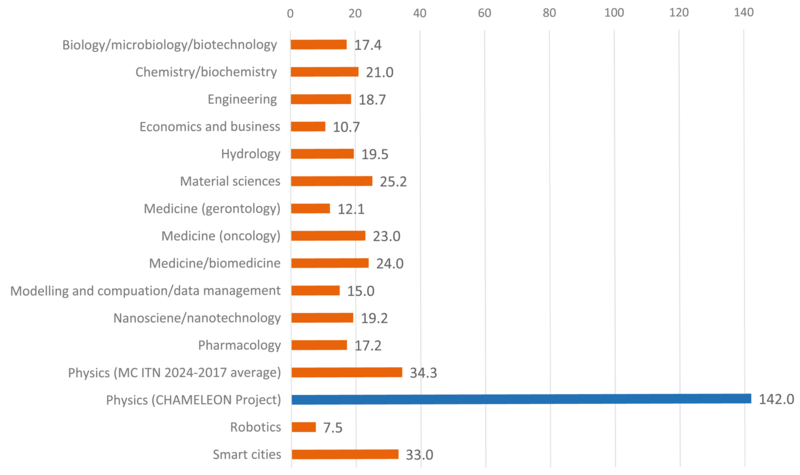
In the frame of the Marie Curie project MC ITN CHAMELEON the following PhD theses were defended:
- University of Copenhagen and TU Graz: Nanna Bach-Møller – Exoplanet Atmospheres in High-Energy Radiative Environments, Thorsten Balduin – Dust Grain Charging in Protoplanetary Disks and the Potential Emergence of Lightning and Beatriz Maria Campos Estrada – From Dusty Tails to Cloudy Skies
- University of Groningen and TU Graz: Jayatee Kanwar – The Warm Chemistry in Planet-Forming Disks and Till Käufer – Unlocking a Bayesian View on Protoplanetary Disks
- KU Leuven and TU Graz: Sven Kiefer – Cloud Formation in 3D Exoplanet Atmospheres and Helena Lecoq Molinos – Microphysics of cloud formation: the path to heterogeneous nucleation
Through DiGOS, ESA, FFG and FWF projects a total of more than EUR 2 million in third-party funding was acquired.
The IWF and the public
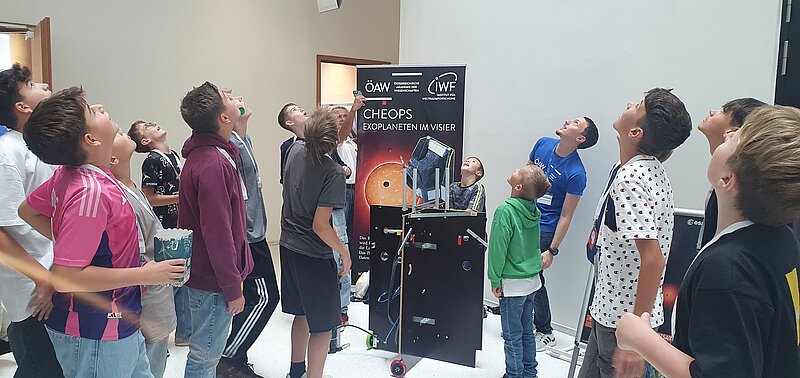
The Long Night of Research (Lange Nacht der Forschung – LNF) on 24 May 2024 attracted about 1,600 people visiting 16 stations in Schmiedlstraße and at the Lustbühel Observatory. The 70-strong team was made up of IWF employees, who were actively supported by the Styrian Astronomers' Association (Steirischer Astronomen Verein - StAV), the Aerospace Team Graz (ASTG), Norbert Steinkellner with his multi-level astronomy course from BRG Kepler and students from TU and NAWI Graz. José Luis Preza from the Orbital Hotel Band entertained the guests with his guitar sounds. Save the date for the next LNF on 24 April 2026!
At the first Science Garden Festival, which was held from 19 to 21 September 2024 at the TU Campus Inffeldgasse, around 3,000 children and young people from Styrian primary and secondary schools experienced science and technology up close. The IWF informed about its Young Researcher Program and the OeAW young science initiative Akademie im Klassenzimmer and presented its research focus ‘exoplanets’.
The IWF and its visitors
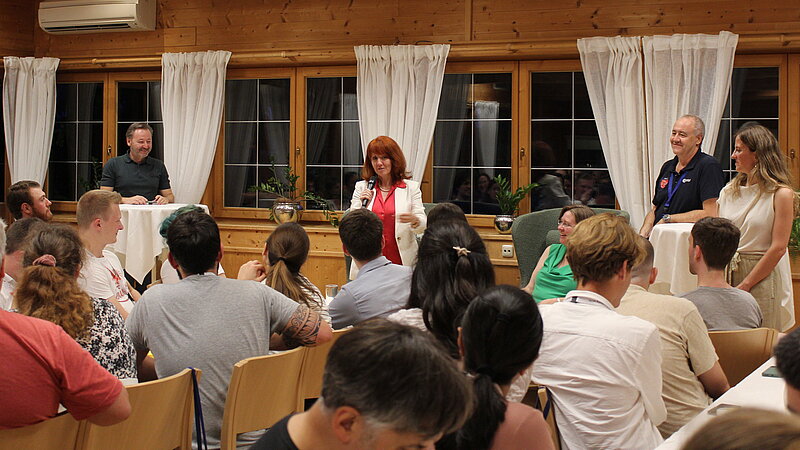
Invited by the IWF, Carole Mundell, ESA Director of Science, visited the Alpbach Summer School Alpbach in July 2024. In a lecture and a fireside chat with IWF Director Christiane Helling, she presented her visions for European space activities and gave an insight into her personal career.
As part of the EANA 2024 astrobiology conference, Carmen Possnig, member of the ESA astronaut reserve, and Cyprien Verseux, a researcher at the University of Bremen, gave a public lecture at the IWF on how to get from the ice to the stars.
In the IWF colloquium and seminar series, local and international speakers - including Kavli Prize winner Sara Seager from MIT - informed about current research topics and scientific results. Some of the presentations can be watched on the IWF YouTube channel.
The IWF and the media
The IWF received many media enquiries. A selection of the reports in print, radio and TV is summarized in our media review.
Martin Volwerk contributed to space blog in the newspaper DER STANDARD with an article on the space adventures of the participants of the Alpbach Summer School, Manuel Scherf - in search for a second Earth - described the complex conditions for the emergence of life and Günter Kargl recalled the historic landing of Rosetta/Philae on comet 67P/Churyumov-Gerasimenko 10 years ago.
For Terra Mater Wissen on Servus TV, Ruth-Sophie Taubner once again slipped into her role as a researcher at the University of Vienna. She explained how to recreate in the laboratory the conditions on Saturn's moon Enceladus and which microorganisms might survive there.
IWF’s social media posts can be found on LinkedIn , X and – new – on Bluesky. On Instagram, Federal Minister Martin Polaschek reported on the successes of JUICE and Cluster.
The IWF says goodbye
In just four months, the IWF mourned the loss of Univ.-Prof. Dipl.-Ing. Dr. Klaus Torkar (1950 - 2024), Ing. Gerhard Berghofer (1963 - 2024) and Dr. Konrad Schwingenschuh (1947 - 2024).
Preview to 2025
24 active and fiuture space missions
The IWF is currently involved in 14 active and 10 future space missions, four of which are scheduled to launch in 2025: CSES-2, Space Weather Follow On (SWFO), FORESAIL-2 and SMILE.
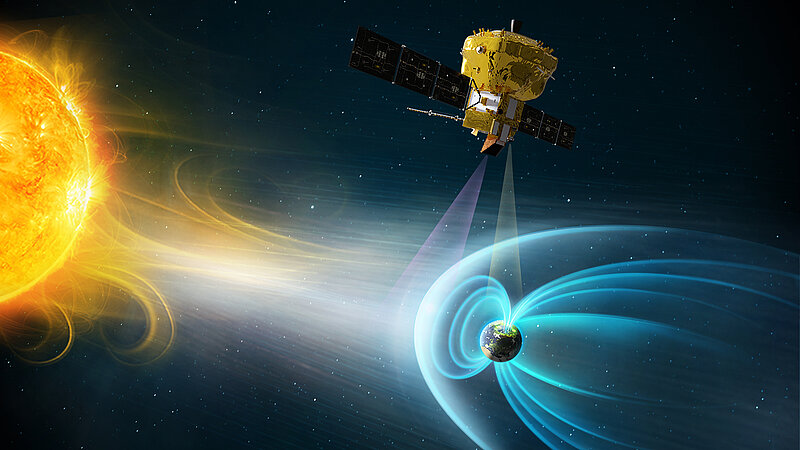
BepiColombo will fly by Mercury for the 6th and final time on 8 January 2025, before reaching its destination in November 2026.
After this year's moon-Earth flyby, JUICE will make a course correction to Venus in August 2025.
In November 2025, Cluster 1 (Rumba) will be the second of the four satellites to reenter Earth's atmosphere.
Some dates to mark in your calendar
The IWF event calendar already offers a small foretaste of the upcoming colloquia and seminars. Charlotte Götz from Northumbria University, Newcastle, UK, will mark the beginning on 16 January 2025.
From 8 to 17 July 2025, the Alpbach Summer School will be dedicated to small bodies in the solar system.
Graz in Space will be held from 4 to 5 September 2025. The lecture program will pay tribute to 50 years of ESA and 50 years of Alpbach Summer School.
Didier Queloz, who discovered the first extrasolar planet together with Michel Mayor in 1995 and was awarded the Nobel Prize in Physics in 2019, will attend the CHEOPS Science Team Meeting at IWF Graz and give a public lecture on 30 September 2025.
With the OeAW young science initiative Akademie im Klassenzimmer, schools can book IWF researchers to give a lecture in the classroom. The new program for the summer term 2025 and the winter term 2025/26 will be available online soon.
The next YRP@Graz PhD call is planned for the beginning of 2025, followed by a 3rd round of calls for summer projects.
If you would like to be regularly informed about news and events, please subscribe to the IWF mailing lists.
With these lines, IWF Graz wishes a peaceful holiday season and all the best for 2025.