

Ukraine: How Much Cultural Heritage Has Been Destroyed?
08.02.2026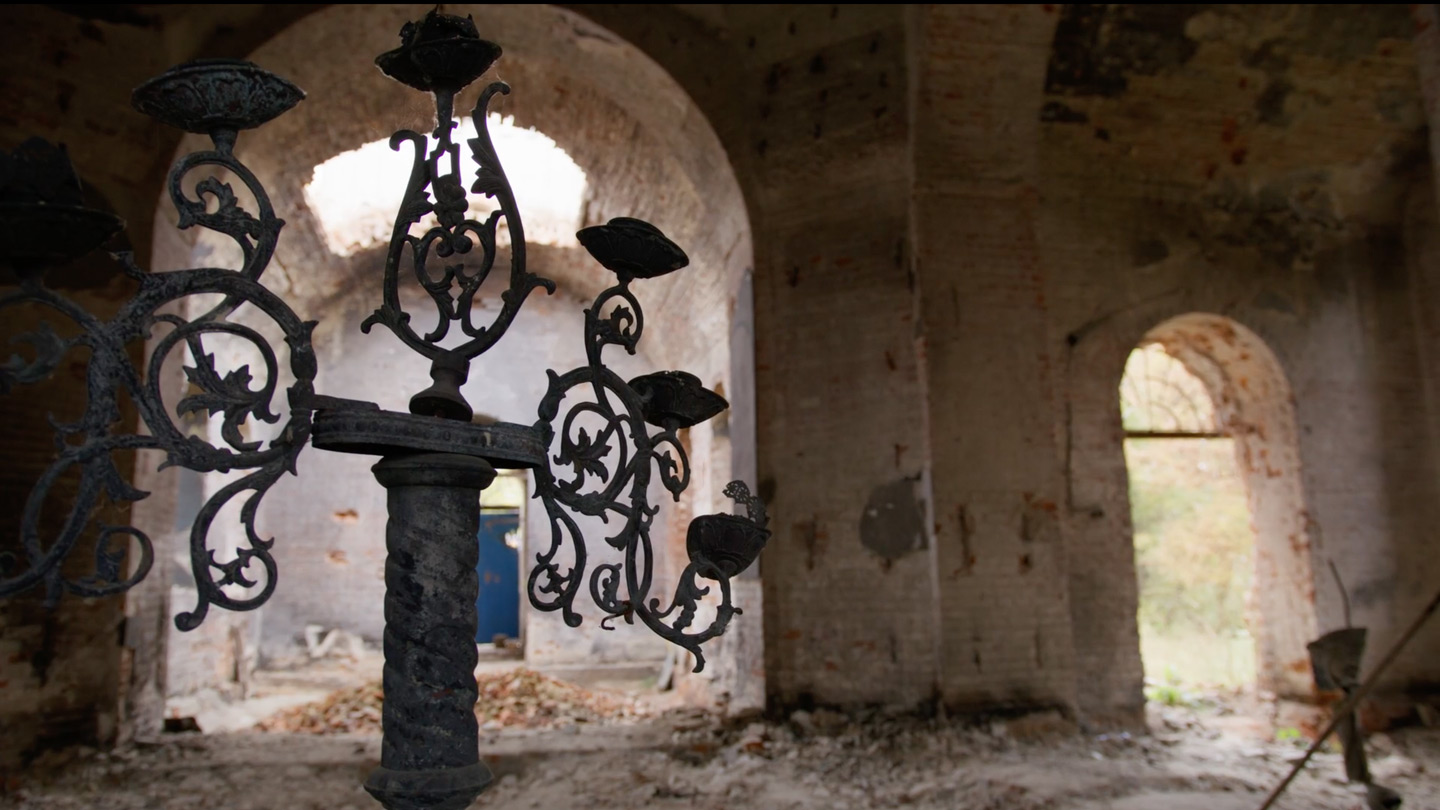
Tangible and intangible cultural heritage is massively damaged by wars. In Ukraine it is difficult to assess the full extent of this destruction, especially in the active military zones in the east and south of the country. It is confirmed, however, that the Russian military has deliberately targeted museums, churches, and libraries that are significant to the Ukrainian people.
Researchers are attempting to document the destruction of Ukrainian cultural heritage using satellite data, such as through the American Conflict Observatory. However, only on-the-ground observation can provide a concrete picture, emphasises Ian Kuijt, Professor of Anthropology at the University of Notre Dame (USA). He was part of an international team of archaeologists and filmmakers who, between 2023 and 2025, documented the targeted destruction of cultural heritage during three stays in central and northeastern Ukraine. Several short films have emerged from this work, including “Targeting Beauty,” which has been shown at international film festivals. In the interview, Kuijt—who opened a new lecture series at the Austrian Archaeological Institute of the Austrian Academy of Sciences (OeAW) in December 2025—explains the challenges they faced.
War Against Culture
Why is it important to advance documentation of the destruction of cultural heritage in Ukraine?
Ian Kuijt: Much of the international attention currently directed at Ukraine focuses either on the nature of the military conflict or on the loss of human life. But there is another, hidden story about how this war affects history, identity, and culture. Churches, museums, and libraries are deliberately targeted by Russian attacks. In reality, this contested landscape centers on the question of cultural identity—whether one is Russian or Ukrainian. To document what has been destroyed and to what extent, you have to be on site. But many areas of the country cannot be entered at all. Through satellites—such as those used by UNESCO—we can determine which churches are damaged. We may know that part of the roof of the Church of the Ascension in Lukashivka is missing, but for a long time we did not know what that meant for the interior. When we filmed there, we discovered that the church had been completely gutted inside. There had been several fires. The floors were entirely destroyed due to the burning of the wooden beam sections. All the windows are gone; the glasswork has been destroyed.
Churches Under Fire
Are such damages only visible on site?
Kuijt: Absolutely. In addition, there is much that we still cannot assess. In the first weeks of the conflict, locals tried to protect statues with sandbags. In churches, there were attempts to cover stained-glass windows from the outside with metal sheets or plywood. This required drilling into the building, which was done quickly and with little consideration. The stained glass may have been protected, but now there are large screw holes that have damaged wood, plaster, stone, and everything beneath. From an archaeological perspective, there is also the problem that important heritage sites have been destroyed or damaged by the construction of trenches, the use of mines, and the establishment of military fortifications.
How do you assess the extent of the destruction?
Kuijt: The damage is enormous, particularly in the eastern and northern regions. And we know that a large number of archaeological sites beneath the surface have likely been affected. Even if peace were declared immediately, it would take years to assess the true extent of the damage. Even in no-longer-occupied regions such as Chernihiv and Kharkiv, landmines and unexploded ordnance make access to many areas difficult, making it impossible to evaluate the scale of the destruction.
Were there programs to move important paintings or books abroad?
Kuijt: With the large-scale invasion in 2022, many museums had to make very quick decisions to protect the materials in their collections—without input from the Ministry of Culture or the national government. Individual Ukrainian museums went into emergency mode, packed up their collections, and distributed them to various locations within Ukraine, and sometimes outside the country. The problem is that much of this was provisional; it was not professionally packed for a war of this duration. There is no guarantee that archival conditions such as temperature or humidity can be controlled. We cannot yet assess the long-term effects of attempts to protect these materials. The damage may ultimately outweigh the benefit.
Cultural Property on the Black Market
Have many objects ended up on the black market?
Kuijt: In museums in occupied regions, including Kherson, Melitopol, and Mariupol, collections were expropriated and taken to Russia, while in other cases artifacts were looted by Russian soldiers to keep or sell. Most of this occurred in the first six months of war—from agricultural machinery to museum collections, library materials, and also gold and silver. This is being studied closely. In some cases, valuable objects have indeed appeared in Western auction houses or on the illegal antiquities market. To some extent, this has slowed because expansion has currently stalled. There are no new territories and new museums that could be looted.
At a glance
Ian Kuijt conducts research as an anthropologist at the University of Notre Dame (USA). In December 2025, he opened the new lecture series “Fragile Past: Destruction of Cultural Heritage in Crisis Zones,” jointly organized by the Heritage Science unit and the “Future Archaeology” initiative at the Austrian Archaeological Institute of the Austrian Academy of Sciences (OeAW).
More information on the conference
- 1,300-Year-Old World Chronicle Discovered in the Sinai
 Saint Catherine's MonasteryArchaeology
1,300-Year-Old World Chronicle Discovered in the Sinai