

Diversity Strengthens Research
05.03.2026
Why are women more strongly represented in the natural sciences in some countries than in others? How have the significance and concerns of International Women's Day changed over time? In this interview, quantum physicist Francesca Ferlaino and historian and Africanist Anaïs Angelo discuss the structural conditions of scientific careers, social developments and the role of diversity in excellent research.
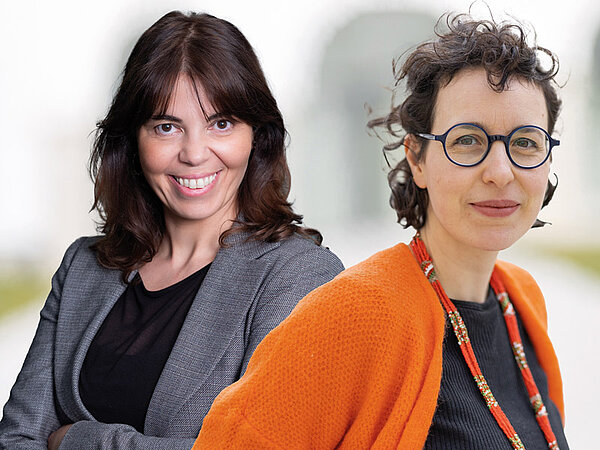
To mark International Women's Day, the Austrian Academy of Sciences (ÖAW) is inviting you to an event entitled "Different Minds, Better Science: The Benefits of Diversity in Research'. In their presentations, Francesca Ferlaino, a corresponding member of the ÖAW and Scientist of the Year 2025, and Anaïs Angelo, a member of the Young Academy of the ÖAW, will explore the role of diversity in innovative research teams from the perspectives of the natural sciences and humanities. Environmental historian Verena Winiwarter will provide an introduction and moderate the discussion.
Ms Ferlaino, your platform Atom*innen features an interactive map showing differences in women studying physics across Europe. What structural barriers explain these gaps?
Francesa Ferlaino: One reason we created Atom*innen is that statistical data exists but is hard to access. Looking at the map, Europe is clearly divided. Many Eastern European countries show surprisingly high shares of women studying physics after high school, often above 50%. Examples include North Macedonia, Albania, Poland, Romania, Bulgaria, Serbia, and Croatia.
Part of the explanation is cultural, linked to the legacy of former Soviet education systems. At the same time, many of these countries invest less than about 1.5% of GDP in research and innovation. Interestingly, women tend to be more represented in physics in countries where research careers are less well funded or less prestigious. In countries like Austria, where being a scientist is seen as a high-status, well-paid career, women are less represented. So the data suggests that gender participation is also shaped by social narratives about prestige, value, and which jobs are considered desirable.
Ms Angelo, you noted that International Women’s Day is shifting from collective solidarity to individual empowerment. Does this reflect a global trend, or has personal success begun to outweigh structural change?
Anaïs Angelo: It is definitely not a simple or purely global shift, and women are certainly not only fighting for personal success. Rather, personal success is often understood as a pathway toward collective change. What I try to do is question this equation, which sometimes appears self-evident. As mentioned: Numbers and indicators do not always tell the full story – there is always more behind them.
International Women’s Day has a long, complex, and highly diverse history, far more diverse than the idea of a single global event might suggest. I want to encourage us to reflect on the meaning of the day not only for individual women, but also for society as a whole and for the kinds of societies we want to create.
When did you first personally become aware that gender plays a role in science?
Ferlaino: Well, I don’t think that gender plays a direct role in the research itself in my field. The physics we work on is, in principle, gender-neutral. However, gender does play a role in the broader academic environment. What is clearly true is that there is a very strong gender imbalance in physics. I first became aware of this when I came to Austria. In Italy, I worked in a laboratory where women and men were more or less equally represented. I never felt the need to count how many women or men there were. When I moved to Innsbruck I was almost the only woman – certainly the only female postdoc at the time, and later for a long period the only female professor. There I realized that this imbalance was not an exception but a widespread structural issue.
Angelo: In the humanities, women have often brought in gender perspectives that were otherwise overlooked, so gender does matter in science—but mostly on a structural level. Personally, my awareness changed when I became a mother. I suddenly faced structural obstacles that made balancing academic work and caregiving very difficult. This made me realise that gender is a source of inequality and affects people on a personal level. I’m certainly not the only one. Maternity leave is very short in France, where I come from. In Austria, for example, it’s long enough to be helpful, but academic institutions still lag behind.
Ferlaino: The real issue is that women should have the choice over how long maternity leave lasts. In Austria, this is hard because quality childcare is very limited before age one. The system implicitly expects one parent – usually the mother – to stay home. Parental leave for fathers exists but isn’t widely used or socially accepted.
Which scientific questions are still missing today due to a lack of diversity?
Angelo: Research itself can be gender-neutral. For me, diversity isn’t about assuming women or men approach science differently – it’s about enriching knowledge, thinking critically, and making knowledge accessible to everyone. The focus should be on for whom we produce knowledge, not just who produces it. Often, research fails to be truly diverse when it serves only an elite few.
Ferlaino: I completely agree. More diversity brings different perspectives, which can spark new ideas. But despite all efforts in physics across Europe – awards, grants, interviews, public awareness – the numbers of women haven’t significantly changed. Part of the problem is that initiatives often target women alone, without engaging men. Real change requires explaining and embedding gender equity as a shared value. Otherwise, men may feel excluded or unfairly treated, and divisions remain.
Angelo: Looking at International Women’s Day historically, it began with universal demands, like women’s suffrage – you couldn’t say “30% of women can vote, that’s enough.” Today, progress is often measured in quotas, which, while important, can normalize the idea of women as a permanent minority. The challenge now is to move beyond that mindset: women are not the exception, and men should not be treated as the default.
What responsibility do scientific institutions have towards politics and society today with regard to equal opportunities?
Ferlaino: For a long time, academia has held a special position in society. Institutions have the opportunity to serve as examples for redefining power, promoting equity over mere equality, and demonstrating how achieving meaningful goals can enrich society.
Angelo: Celebrating outstanding women is important, but it can obscure the institution’s responsibility to create inclusive environments for everyone. It’s not just about making space for women – it’s about rethinking how we produce and share knowledge, and for whom. Institutions could be as innovative as they expect individual researchers to be.
- Different minds, better science!
Different minds, better science!
