

US star researcher: “Iron Man's laboratory is no longer science fiction”
22.08.2025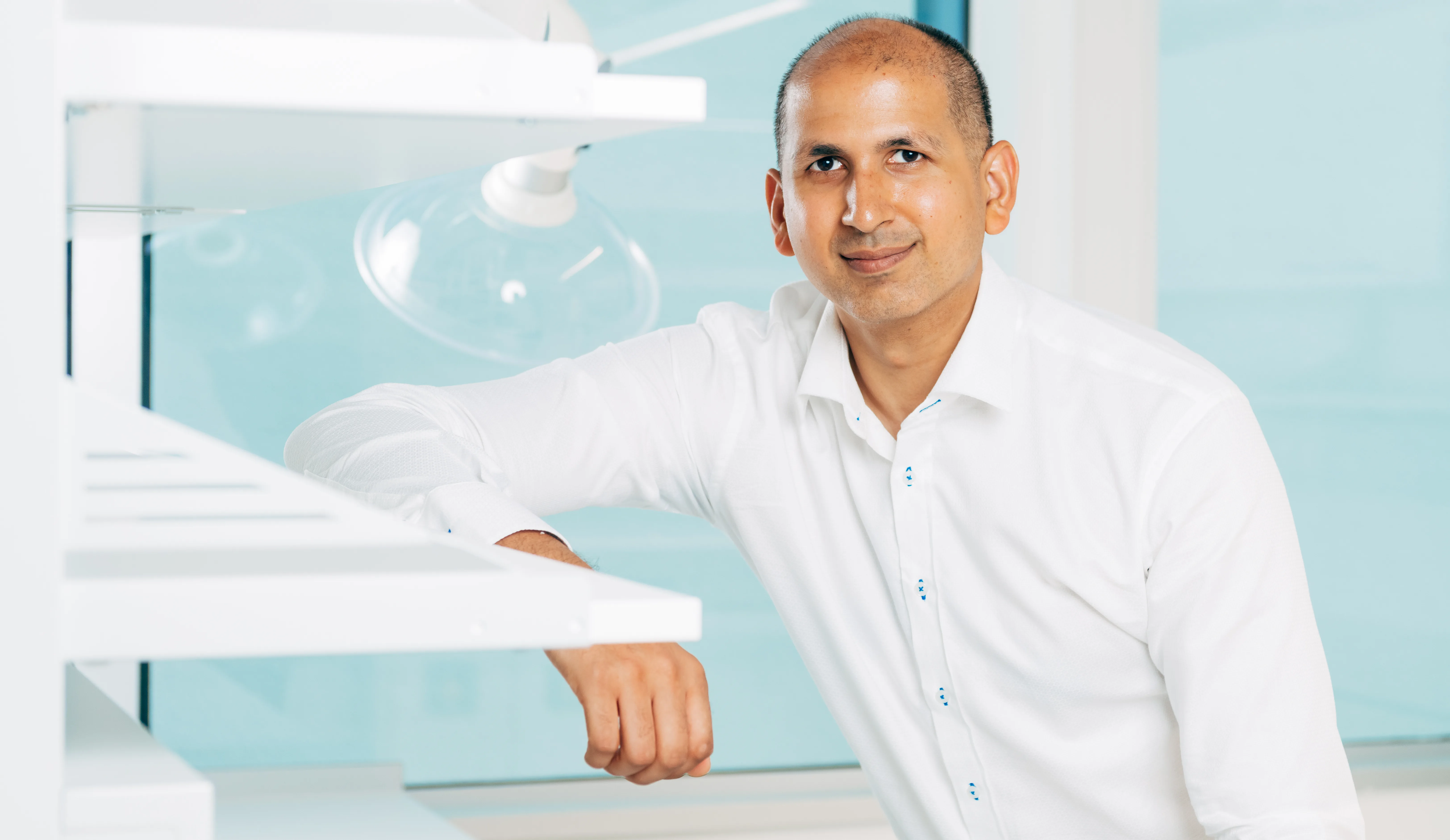
AITHYRA, the new research center of the Austrian Academy of Sciences (ÖAW) for Biomedical Artificial Intelligence, was founded in September 2024 and is currently in the middle of its development phase. In this interview, Wali Malik, the newly appointed head of the Robotics Lab at AITHYRA, talks about the potential of AI systems and data integration in everyday research.
How does one become an expert in biomedical robotics?
Wali Malik: After graduating from university, I developed and tested antibodies at Astra Zeneca. Since I had a strong background in programming and engineering, I quickly learned how to automate a good part of this work with some unused robots. I also implemented the first data analysis systems at a time when most researchers were still working with college pads and pens. After that, I implemented the use of robots in vaccine development for Merck in the US. Later, I worked as an automation consultant at GlaxoSmithKline, doing machine learning-assisted research on small molecule compounds. We developed a robust and automated clinical testing platform that enables small teams of researchers, robotics engineers, and data analysts to work efficiently on new breakthroughs.
Robotics, artificial intelligence, and science
What is the potential of laboratory automation in biomedical research?
Malik: We want to automate every process, but in the life sciences, this can sometimes be very complex. We make new discoveries in the labs, have to find the next CRISPR enzymes, handle data from thousands of images of cells and genetic information, conduct animal experiments, and link all these experiments and data sources to find new active substances. AITHYRA's goal is for all scientists to use robots on a daily basis to make new discoveries and develop drugs faster and more cost-effectively. I want to achieve a successful marriage of robotics, artificial intelligence, and science here.
The current situation in the US is certainly having a dampening effect on academic research.
What makes working in the new robotics lab attractive?
Malik: At the big pharmaceutical companies, the perspective was always very goal-oriented and the scope for innovation was limited. In an academic environment, it is much easier to push the boundaries of what is possible. Because I am the first employee of our new robotics lab, I can set up the robotics and data infrastructure we need to achieve real innovation even before the first researchers start their work. This is a unique opportunity for me, and the leadership of the new institute shares my vision.
Did the political situation play a role in your decision to leave the US?
Malik: The current situation in the US is certainly having a dampening effect on academic research. That was an additional reason for me to try something new, and Vienna is known for its excellent quality of life. In addition, our new institute here has long-term funding and will take on a leading international role in our field. We can conduct innovative basic research at the highest level here, and that convinced me. And, of course, my wife and children had to agree. We've only been here a week, but we're already enjoying the lifestyle here very much, especially because I no longer have to commute for hours every day.
Open source and collaboration
What is different at AITHYRA compared to the pharmaceutical industry?
Malik: I am looking forward to sharing the robotics and data analysis tools we are developing with other researchers. This is also the first time I can publish freely, because my work for industry was always proprietary. I love open source approaches and collaboration because they are the best way to disseminate knowledge. We want to train a new generation of researchers and engineers so that they can understand and use robots, AI, and data to drive new innovations. The pharmaceutical industry also does not produce enough data. My goal is to scale data generation and create the infrastructure to apply appropriate analysis tools. We want to create a closed experimentation cycle.
It's about automating the entire research process.
What is that?
Malik: It's about automating the entire research process. Today, researchers read the relevant literature to find interesting research questions. An LLM can do this much faster and spit out research ideas. Specialized AI models can then design experiments, which are then carried out by robots. This allows large experiments to be carried out much faster and small trials to be scaled up quickly. Researchers can then see more quickly whether an idea works or not, and even failures provide interesting data that can help us figure out why something doesn't work.
What does a robot do in a laboratory?
Malik: The simplest robots in laboratories are liquid handlers, which are part of a larger system. They mix substances and transfer them from one laboratory station to the next. Collaborative robots look similar to those used in the automotive industry and can use different tools to perform various analyses. There are also humanoid robots, such as those used in warehouses. These robots perform their tasks reliably and without interruption. With the right system, a researcher can test tens or even hundreds of thousands of samples per month. Doing this manually would require up to 100 researchers, who are now free to develop new drugs. The bottleneck is data analysis and strategy development. That's why it's so important that data is automatically described and stored correctly. Only by combining data, AI, software, and appropriate workflows can we gain efficiency.
Start of research
When can the new robotics lab start regular operations?
Malik: I hope that our new lab will be fully equipped within the first year. Immediately afterwards, we can start using the large amounts of data from the new instruments. The first two new researchers will start work shortly and help set up the first research platform. We are looking for colleagues who either already have experience with robotics and data analysis or are eager to learn how to use these tools. We will support all new employees in becoming experts in this field.
How will the work change for researchers?
Malik: We can design new proteins virtually using AI systems that specialize in protein folding. Robots can then test thousands of variants at once to determine whether a protein switches genes on or off in cell cultures. This also generates valuable data that describes exactly what properties and effects an enzyme has. So we not only know what works, but also why. The goal is to integrate the entire laboratory with automation. The entire system can then be managed by an AI system.
This is a once-in-a-lifetime opportunity.
That sounds almost like Iron Man's lab from the Marvel movies, where AI designs things and performs experiments on command?
Malik: Iron Man's lab is actually no longer science fiction. Such systems already exist for isolated work steps, and we will work on further improving this technology.
We want to become a central hub for AI robotics and data-based research infrastructure. If another institute needs our tools, we will be happy to collaborate with our colleagues there. For complex research, for example in the field of virtual cells, our approach is a basic requirement. That's why I'm very happy to be here. It's a once-in-a-lifetime opportunity.