

Staggered twins: scientists show the shape of replicated chromosomes is asymmetrical
03.09.2026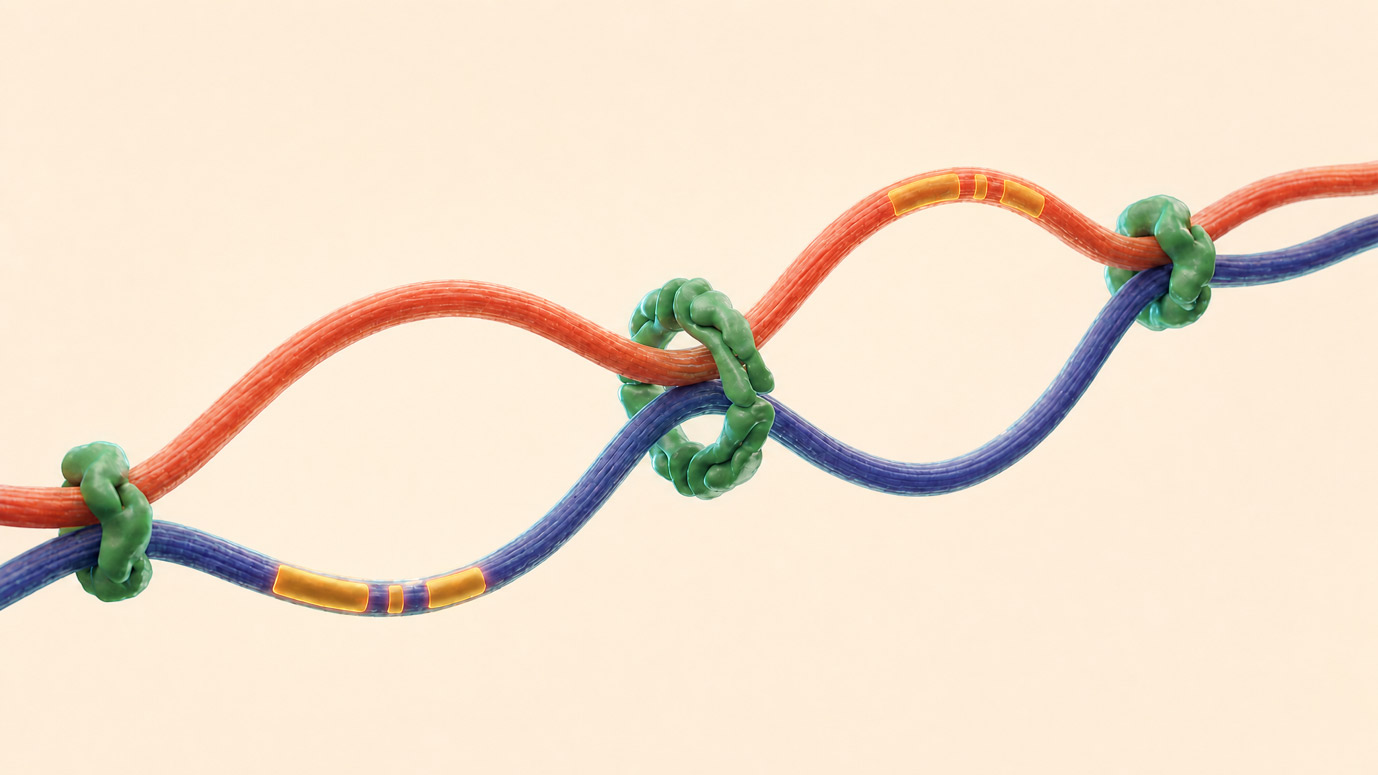
Before a cell divides, it copies each of its chromosomes, producing two sister chromatids with the same genetic sequence. Because their sequence is identical, it was long assumed that the sisters are also arranged in space as true mirror images. In the study now published in Science, the scientists show that the two sisters cannot be fully superimposed: matching points on the two chromatids are offset from each other by a small, fixed distance, and in a consistent direction. Picture a zipper where the two rows of teeth are nudged out of alignment by just one tooth's width: each individual tooth still looks fine on its own, but that tiny, consistent offset is enough to keep the two sides from meshing properly all the way up.
The team measured this shift in two independent ways: by mapping physical contacts between the two sister chromatids across the genome, and by directly imaging matching points on both sisters under the microscope. Both methods agreed: instead of sitting neatly across from one another, corresponding stretches of DNA on the two sisters are staggered, shifted by 120 nanometers, roughly a thousandth of a full chromosome.
The direction of the shift can be traced back to a built-in asymmetry in DNA replication itself. When the double helix is opened for copying, its two original strands run in opposite chemical directions, so the copying machinery handles them differently. One new strand is built continuously, in one smooth pass, much like reading a sentence straight through from start to finish. The other is built backward, in short fragments that are only stitched together afterward, more like reading that same sentence in reverse, one short chunk at a time. This difference between the two new strands may leave a lasting, physical mark on the two sister chromatids, nudging them out of perfect alignment in a consistent direction, even long after copying itself is finished.
The genome architect at fault
The researchers also found what locks this offset in place: the protein complex cohesin, a well-known genome organizer intensively researched at IMBA. Among other crucial functions, cohesin is responsible for tethering the two chromatids together after DNA replication. When the team removed a specific type of cohesin from cells, the shift disappeared. Cohesin, it turns out, doesn't just hold the sisters together, it also fixes their misalignment in place.
“This study grew out of a close collaboration with Daniel Gerlich and his team, and it simply would not have been possible without techniques we developed specifically for this project, combining genomics, high-resolution imaging, and computational modelling,” says Anton Goloborodko, group leader at IMBA. Flavia Corsi, then postdoctoral researcher and lead author, held these threads together, driving the project forward over several years.
A small offset with big implications
Why would a shift measured in nanometers matter to a cell? The two sister chromatids are not just copies: they are also each other's repair template. When DNA breaks, cells can fix the damage by copying the missing information from the intact sister chromatid, a process that depends on the ability of the two chromatids to find and pair with one another. A built-in, directional offset between the two copies could influence how well that search succeeds.
“For decades, sister chromatids were treated as perfectly symmetric copies of each other, simply because their DNA sequence is identical,” says Goloborodko. “We now see that the very process that creates them leaves a physical signature that persists across the entire chromosome. Our findings raise new questions about how cells manage DNA repair and about how genome stability is maintained.”
At a glance
Publication:
Conformational asymmetry of replicated human chromosomes. Flavia Corsi, Thomas L. Steinacker, Sofia Kolesnikova, Zsuzsanna Takács, Paul Batty, Michael Mitter, Daniel W. Gerlich, Anton Goloborodko. Science, 2026.