

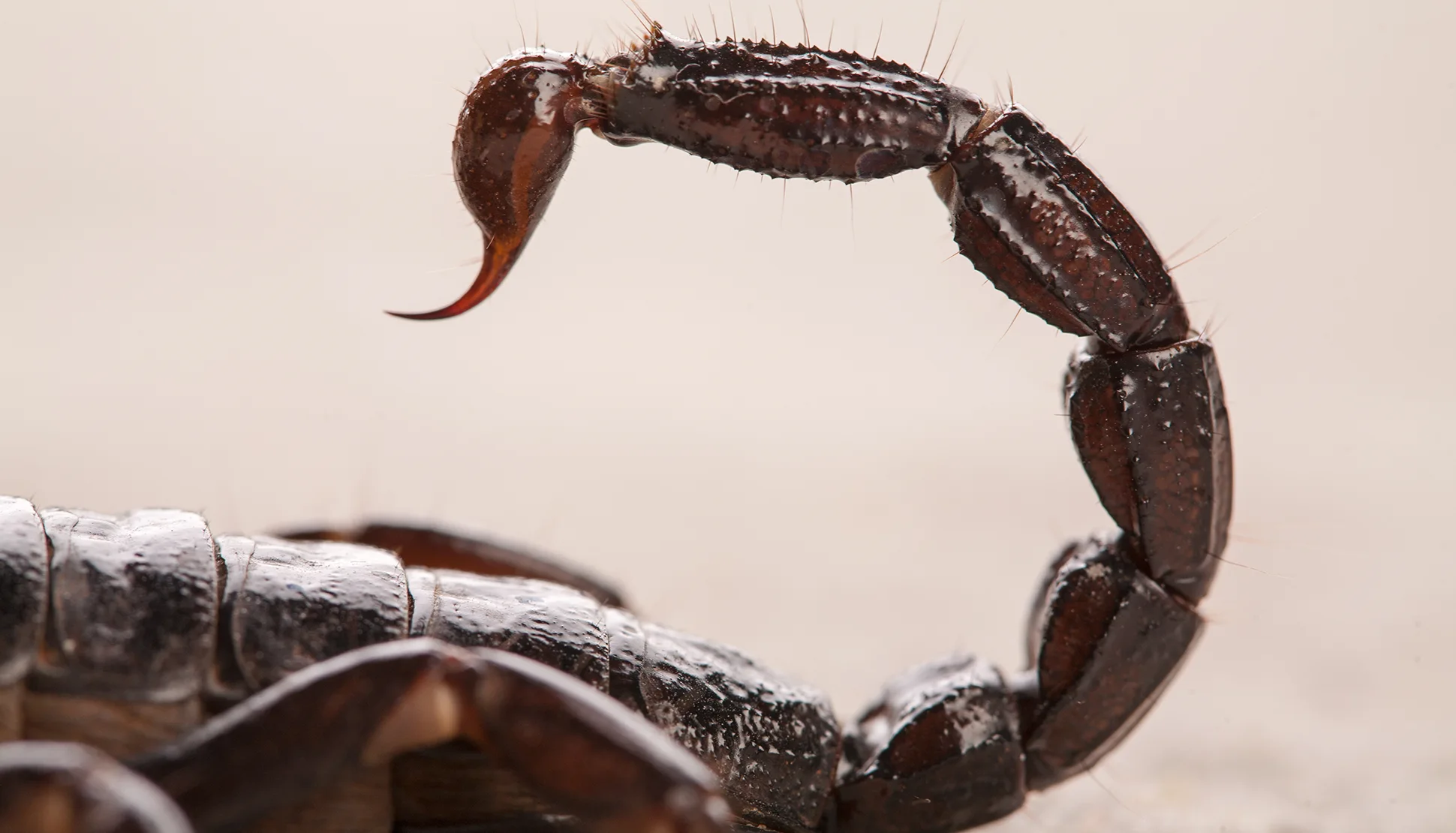
Some scorpions use their stinger regularly for hunting, while others primarily use it for protection and self-defense. A new study now shows that these different lifestyles are directly reflected in the material structure and chemistry of their stingers. What matters is not only which metallic elements are incorporated, but also how the chitin fibers are arranged inside. The results provide clues as to how robust, lightweight, and durable materials can be developed—and why certain properties have prevailed in nature over the course of evolution.
The team led by Megan Cordill and Stanislav Zak at the Erich Schmid Institute for Materials Science of the Austrian Academy of Sciences (OeAW) was involved in the mechanical investigations. The study was led by Helga Lichtenegger from the University of Natural Resources and Life Sciences, Vienna. Two scorpion species with different lifestyles were analysed: Centruroides platnicki, which actively uses its stinger for hunting, and Nebo whitei, which mainly uses it for defense. “So one stinger is used or stressed daily, while the other only occasionally,” explains Zak. “We wanted to understand whether this is also reflected in the material properties,” says Cordill.
Different strategies for different uses
The mechanical properties were investigated using so-called nanoindentation. This method uses a fine diamond tip to measure objects smaller than a human hair. The tip is pressed into the material with precisely controlled force. “As far as we know, we are the first to indent scorpion stingers and obtain results from it,” says Cordill. From the material’s response, researchers were able to determine how hard and stiff the different layers of the stinger are. “This allowed us not only to measure differences between the two species, but also to show how the properties change along the stinger from the tip to the base,” explains Cordill.
While Nebo whitei has a higher zinc content in its outer layer, the stinger of Centruroides platnicki is more strongly characterized by manganese and calcium. Manganese and calcium contribute more to stiffness and stability, whereas zinc does not automatically lead to greater hardness and is more associated with short-term hardening.
Mechanics follows lifestyle
The differences fit precisely with the animals’ behavior: a stinger that is used frequently—for example, for hunting—must be durable and resistant to wear. It must not wear out quickly but withstand many uses. If the stinger is used only rarely, such as for defense, long-term durability is less important; instead, maximum strength at a critical moment matters. It must be able to withstand particularly high forces for a short time when needed.
The results also show that mechanical properties do not increase linearly with metal concentration. Instead, there appears to be an optimal interplay between chemical composition and structure—an indication of how precisely biological materials are adapted.
Inspiration for new materials
Such systems are of particular interest for research. “We can learn a great deal from nature when it comes to designing materials,” says Cordill. “This allows us to see how functionality relates to mechanical behavior and lifestyle. That helps us design better materials.”
The findings also provide insights into evolution and help us better understand it: “Using scorpions as an example, different properties are needed if a stinger is used only occasionally versus daily. Nature has evolved differently in these two species accordingly.”
At a glance
Publication
Sakr, C.; Cook, P.; Seiter, M.; Hörweg, C.; Žák, S.; Cordill, M.; Burghammer, M.; Sztucki, M.; Lichtenegger, H. (2025): Different strategies towards strength: Unveiling the role of Zn vs Mn/Ca and chitin arrangement in scorpion stingers. Journal of Structural Biology, 217(1), 108174.
DOI: 10.1016/j.jsb.2025.108174
- Papageien nennen Namen – Studie zeigt überraschende Sprachkompetenz

Papageien nennen Namen – Studie zeigt überraschende Sprachkompetenz
