

The importance of using Artificial Intelligence (AI) in biomedical research has been demonstrated by this year's Nobel Prize in Chemistry which has been awarded to the developers of AI-based protein research AlphaFold. The recent establishment of the AITHYRA Institute for Artificial Intelligence and Biomedicine at the Austrian Academy of Sciences (OeAW), which is funded by the non-profit Boehringer Ingelheim Foundation (BIS) based in Mainz with 150 million euros, also underscores the relevance of collaboration between AI and life sciences experts.
At the Falling Walls Science Summit, Michael Bronstein, DeepMind Professor of AI at the University of Oxford and Scientific Director of the new AITHYRA Institute at the Austrian Academy of Sciences, highlighted the impact this ‘marriage of AI and biomedicine’ could have on diagnostics, the personalisation of treatments and healthcare as a whole. ‘With the help of AI in biomedical research, we can probably develop drugs for diseases which are currently uncurable. These drugs can potentially be personalised and clinical studies themselves can be accelerated with the help of AI.’
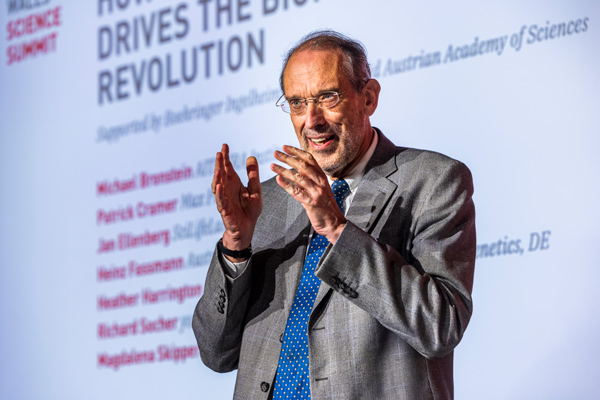
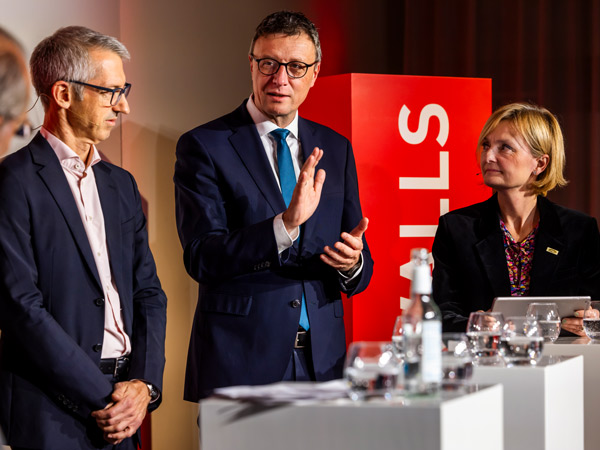
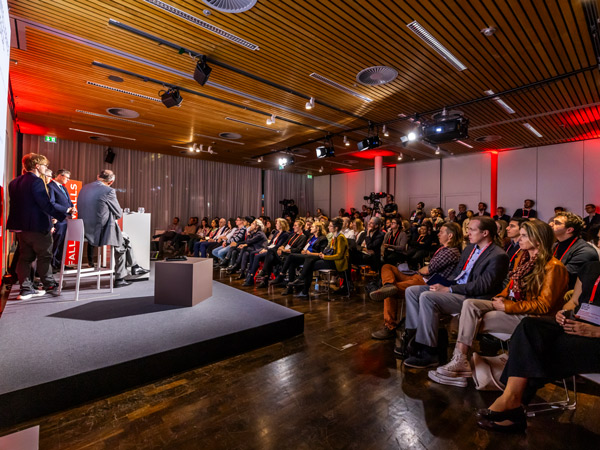
Bronstein was one of the participants at a Falling Walls Round Table hosted by OeAW and BIS entitled ‘How Artificial Intelligence Drives the Biomedical Revolution’ on 8 November 2024, along with the presidents of the OeAW and the Max Planck Society, as well as leading experts in AI and biodemedicine, such as IT linguist Richard Socher.
Socher, founder and CEO of the AI search engine you.com, spoke of an era of AI that will change medicine. He talked about advances in biotechnology and machine learning that have made it possible, for example, to grow tiny organoid lymph nodes on a large scale and thus carry out clinical trials in a petri dish. Thus, much more data can be collected in a shorter period of time and the cycle of drug development can be significantly shortened.
The ‘next big thing’ that could promise a completely new approach to medical problems is AlphaFold, Alpha Cell. Jan Ellenberg, molecular biologist and director of SciLifeLab, explains: ‘For me, the next big revolution is being able to predict how the basic unit of life, a whole cell, works.’ And Sochor continues: ‘Once we can simulate a cell, we can test hypotheses and try things out an infinite number of times. This will solve numerous problems in biology – and be very exciting.’
When asked by the presenter and Nature's editor-in-chief, Magdalena Skipper, about a possible timeframe for when Alpha Cell will be available, Ellenberg explains: ‘I expect a first, very rudimentary version in about three years’.
All the participants in the discussion round agree that interdisciplinarity is a particularly important factor for research progress. Heather Harrington, for example, is a professor of mathematics at Oxford and a director at the Center for Systems Biology in Dresden and at the Max Planck Institute. ‘I am convinced that the potential lies in overlapping disciplines. For example, mathematics is playing an increasing role in the discovery and understanding of AI sciences in order to analyse arguments, verify them logically and explain AI results.’
And Heinz Fassmann, President of the Austrian Academy of Sciences, emphasises: ‘A change in science or in the culture of scientific work is a challenge if you want to break into this area, because it is clear that you need much more interdisciplinarity than before. You need bigger teams and you need data, and to get data you need international cooperation, so you have to think big in this area.’
Data and how to generate it, is another important point that was discussed at the forum. As Patrick Cramer, President of the Max Planck Society, notes, it is important that ‘people are not afraid of AI, but are willing to provide data because they see the benefits.’ It's about trust. And since people don't just trust machines or algorithms, events like the Fallings Walls Science Summit are important, according to the expert. ‘Because you have to know the scientists behind the science and know that they are doing the research for the benefit of humanity.’ There is one thing Cramer wants to leave beyond doubt – despite all the help provided by AI: in the end, every final decision will be made by a human.