

Hot Jupiter's magnetic shield
28.10.2015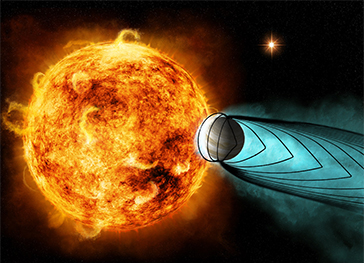
Hot Jupiters are Jupiter-type giant exoplanets close to their host star. This close neighborhood leads to intensive heating and ionization of the planetary upper atmosphere by the stellar X-ray and EUV radiation. As a result, the ionized upper atmospheric material expands and is blown off in the form of a supersonic planetary wind. The planetary magnetic field is a crucial factor that influences the planetary mass loss as well as provides the protective shield for the upper atmosphere. Now, an international research team, in which IWF scientists collaborate with the Institute of Laser Physics of the Russian Academy of Sciences, has investigated the dynamics and structuring of the inner magnetosphere of such Hot Jupiters. By means of numeric simulations and laboratory experiment it has confirmed the formation of a distinct magnetodisk, which extends the planet’s magnetic shield further outward.
“It is of principal importance for a realistic numerical model of an exoplanetary magnetosphere to include self-consistently all crucial elements: e.g., the basic photochemical reactions in the upper atmosphere, the generation of the escaping planetary plasma wind driven by the stellar radiation, the gravity, tidal, and the magnetic forces”, explains the lead author, Maxim Khodachenko. “Such a unique and complex numerical simulation requires thousands of processors working simultaneously for several days. It was performed on the supercomputers of the Lomonosov Moscow State University and the Siberian Supercomputer Center in Novosibirsk.”
The performed numerical simulation enabled to quantify the influence of the planetary magnetic field on the mass loss and to conclude about the field values at which the significant portion of the planetary plasma stays locked inside the so-called “dead-zone” and therefore cannot join the escaping material flow. Moreover, a periodic restructuring of the magnetodisk, which results in the ejections of plasma, has been discovered. “The next step will be the observational discovery of such processes around the real exoplanets”, Khodachenko says.
Publication
Khodachenko, M.L., et al.: Atmosphere Expansion and Mass Loss of Close-Orbit Giant Exoplanets heated by Stellar XUV. II. Effects of Planetary Magnetic Field; Structuring of inner Magnetosphere, Astrophys. J., 813, 50 (2015)
Contact:
Dr. Maxim Khodachenko
Space Research Institute of the OeAW
+43 316 4120-661
maxim.khodachenko(at)oeaw.ac.at
Space Research Institute - SRI