ESI Project Leader:Megan J. Cordill
ESI Team Members: Stanislav Zak
UniWien Team Members: Jiamin Chin, Amirhossein Jalali Kandeloos
AIIS: Thomas Neubauer, Reinhard Puffing
Rail Tec Arsenal Fahrzeugversuchanlage GmbH:Ingeborg Bednar, Benjamin Lanner
Villinger GmbH: Ira Villinger, Markus Villinger
In this groundbreaking FFG-funded TakeOff 2023 project led by the University of Vienna, with a team of researchers the Erich Schmidt Institute, the Austrian Institute for Icing Sciences, Rail Tec Arsenal and Villinger GmbH target the development of electro-thermal ice-protection systems to enhance energy efficiency and safety for airplanes and other aerial vehicles.
One of the key challenges in aircraft de-icing lies in balancing aviation safety with minimizing environmental impact and energy consumption. Traditional on-ground de-icing methods rely on vast quantities of de-icing fluid, leading to significant chemical run-off and water contamination. In-flight electrothermal de-icing, on the other hand, demands substantial energy input. IceBreaker seeks to address these issues by exploring the synergy between active and passive de-icing techniques. The project will focus on the development of durable, low-cost, and easily applicable ice-phobic coatings, as well as the advancement of energy-efficient electro-thermal ice-protection systems. By harnessing the potential of passive de-icing through anti-icing coatings, IceBreaker aims to reduce the reliance on on-ground de-icing and its associated environmental repercussions. Moreover, the outcomes of this project have the potential to extend beyond aviation, benefiting other aerial vehicles and renewable energy infrastructure such as wind turbines and solar collectors.
IceBreaker also takes great pride in championing women in science across Austria. Led by distinguished female scientists, including Professor Jia Min Chin (project coordinator) at the University of Vienna, Dr. Megan Cordill at the Erich Schmid Institute, and Dr. Ingeborg Bednar at Rail Tec Arsenal, and Ms. Ira Villinger at Villinger GmbH, the project showcases the invaluable contributions of women in driving innovation and sustainability.
Join us on this exciting journey as IceBreaker paves the way for a more efficient, environmentally conscious, and safe future in aviation. Together, we will break the ice and soar to new heights of aviation performance.

IceBreaker project’s successful Icing Wind Tunnel campaign
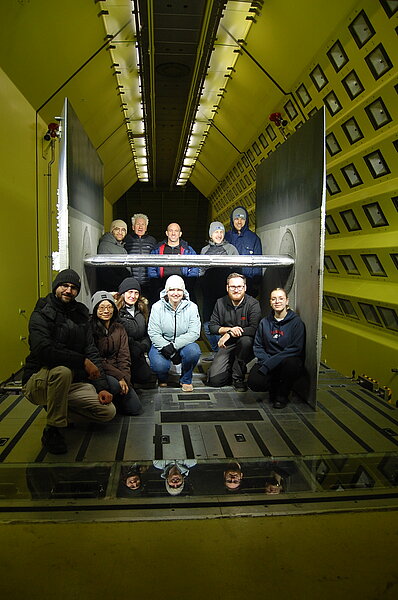
The last two weeks in January, the team members from the FFG Take Off project IceBreaker spent testing the developed icephobic coatings under real icing conditions in an icing wind tunnel (IWT). For the past two years, the team has been developing robust icephobic polymer-based coatings made from less toxic materials that could be applied to airplane wings to help improve ice shedding in combination with internal heating systems. This research aims to contribute to a safe and sustainable future of aviation. The novelty of the coatings made at UniWien and further tested at the Erich Schmid Institute of Materials Science (ESI-ÖAW) is the surface structure made of slippery omniphobic covalently attached liquid-like surfaces (SOCALs) – which can be best described as tiny brushes (approximately 5 nm in length) – that decrease the ability of water/ice droplets to adhere to the surface. A NACA 0012 airfoil wing section mock-up fitting in the customized RTA jig was built by partner Villinger GmbH . It was built with sectional removeable leading edge caps to allow changing between reference and coated surfaces efficiently. The electro thermal leading edge de-ice system was also implemented and controlled by Villinger. The IWT campaign was performed at Rail Tec Arsenal (RTA) and icing runs were organized by the Austrian Institute for Icing Sciences (AIIS). RTA provided the necessary icing conditions, almost on demand, as well as extra warm clothes for entering the tunnel in between icing runs when the tunnel was a cold as -20°C. AIIS setup their innovative imaging systems to watch the ice accumulation on the upper and lower sides of the wing and to document the ice shedding in real time (check out the video). Before shedding the accumulated ice, 3D scans were made to further study how ice forms due to different icing conditions. More than 40 experiments were done during the 5 icing days on reference and two coatings. In the end, a side-by-side experiment with a simulated one-hour flight through icing conditions was successfully performed. The new coatings performed well and decreased the ice shedding time by about 10 seconds (approximately 20% improvement) compared to no coating. Next steps for IceBreaker are characterizing the tested coatings and planning an ice-adhesion test campaign using a centrifuge to further study how ice adheres to surfaces.
This project is funded by the granting organization (Bundesministerium für Klimaschutz, Umwelt, Energie, Mobilität, Innovation und Technologie) and the FFG (www.ffg.at). The FFG is the central national funding agency and strengthens Austria’s innovative capacity.

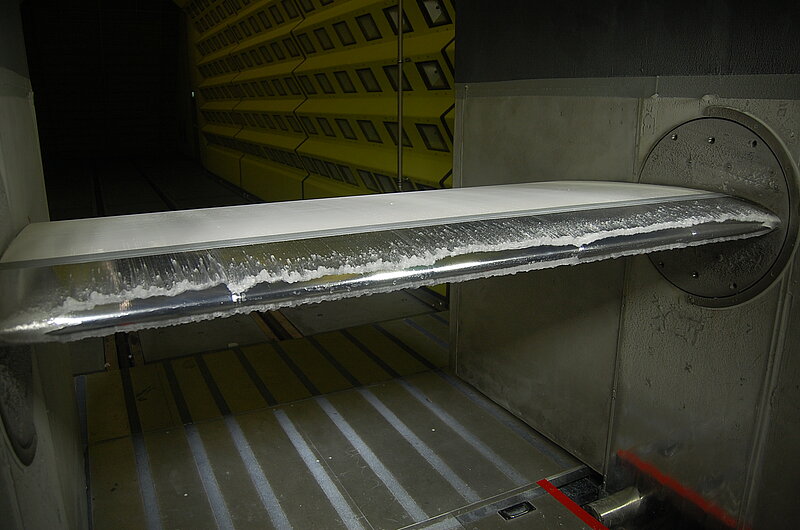
The IceBreaker coating improved ice shedding times by about 10 seconds!
FFG via the Take Off Ausschreibung 2022
FFG Project Number: F099903046
Project Duration: November 2023 - October 2026