


by Alisa Shablovskaia, University of Oslo
How do you criticise Sufis when you have already announced that they were the first communists? For a supporter of newly established Soviet power in Central Asia, this was more than an awkward editorial question. In April 1921, the Persian periodical Shuʿla-yi Inqilab (“The Flame of Revolution”) celebrated Sheikh Bedreddin as a communist ancestor. Two weeks later, it recounted the grotesque downfall of Halim Ishan, a sheikh whose attempt to swallow an incriminating receipt ended in his death. Between revolutionary sainthood and a swindler’s greed lay a debate about authority, truth, and who could speak for Islam.
Published in Samarkand between 1919 and 1921 under Sayyid Rida Alizadah, Shuʿla-yi Inqilab was the first Persian-language periodical in Soviet Central Asia.[1] Bringing Persian literary culture, Muslim reform, and Bolshevik politics into conversation, its pages invite us back into the historiographical debate over Jadidism. While Adeeb Khalid foregrounds intellectuals transformed by modern education, print, and wider Muslim connections, at the same time Paolo Sartori redirects attention towards local genealogies of reform: Muslim literati contesting alliances between rulers and influential Sufi shaykhs and reclaiming authority for the ulama.[2] These different emphases need not describe mutually exclusive populations: what happens when we read them together, across a periodical’s successive issues?
An opportunity for such an exercise presents itself when reading “Islam and Communism” published in Shuʿla-yi Inqilab on 11 April 1921, where the view stretches towards Ottoman history. Drawing on the Tatar journal Shura and Ottoman historians, the contributor presents the rebellion of Sheikh Bedreddin (1359-1420) as a precedent for communal property, equality, and solidarity across religious boundaries. Bedreddin deserves a place on the first page of the Third International’s history. European comrades, apparently, had some catching up to do. The intellectual itinerary matters: Shura, shaped by Cairo’s al-Manar, connected Muslims of the Russian Empire to wider reformist conversations.3]
Two weeks later, the publication of “The End of a Deceitful Sheikh” (here offered in full translation) brings us to Bardaliq. Attributed to a local qadi, the account appears under the initials S. ʿA., possibly Sadriddin Ayni. Its provenance matters: legal scholars were important participants in disputes over Sufi authority, articulating projects of renewal that could strengthen their own standing. Revolutionary publication gave such criticism a new platform. The judge’s authority lent weight to revolutionary criticism; publication, in turn, amplified his judgement. Halim trades on devotion, profits from commerce and interest, and serves the emir. As the regime collapses, he persuades Bardaliq’s fleeing governor to entrust him with state property against a receipt, ostensibly for delivery to the new government. He then withholds the property and attempts to swallow the documentary evidence. Fraudulent holiness, greed, selfishness, credulous followers: the repertoire looks familiar from later Soviet caricatures, but its setting locates the polemic within local struggles over authority.
The narrative’s geography is equally revealing. Halim arrives from Afghanistan; his Turkmen disciples connect Bukhara to surrounding regions; the emir exploits his influence among tribal communities. The contrast between supposedly gullible Turkmens and clever townspeople exposes an urban hierarchy of judgement. Migration, relations with steppe populations, and the ruler’s tribal alliances become subjects of revolutionary denunciation.
Yet local satire and cosmopolitan reform share more than an enemy. Both could draw on ethical language resonant with Sufism. Halim’s death makes the point with gruesome economy. He tears open his belly and, the narrator declares, tears away his “veil of hypocrisy.” Unveiling becomes involuntary self-disclosure. The image belongs to a broader Persian literary and Islamic repertoire, but acquires particular resonance alongside the journal’s positive invocations of Sufism.
Thomas Bauer’s “culture of ambiguity,” and Oliver Scharbrodt’s exploration of its relevance to Islamic modernism, help illuminate this coexistence. Inherited religious language could accommodate competing meanings and projects of renewal.[4] Knowledge (maʿrifa), truth (haqq), and moral self-transformation belonged to the intellectual world surrounding al-Manar and pan-Islamic reform as well as to mystical practice. Criticising a sheikh did not require abandoning that world.
What, then, did revolutionary print invite readers to become? Halim’s exposure encouraged them to judge sanctity by conduct and recognise revolutionary allegiance as an ethical possibility. Their responses remain beyond these pages. I suggest that Shuʿla-yi Inqilab offered an arena where local grievances and transregional Muslim reformist visions could be articulated together under Soviet patronage. Their selective recombination made synthesis conceivable, while raising the question of who acquired authority to tell saints from swindlers.
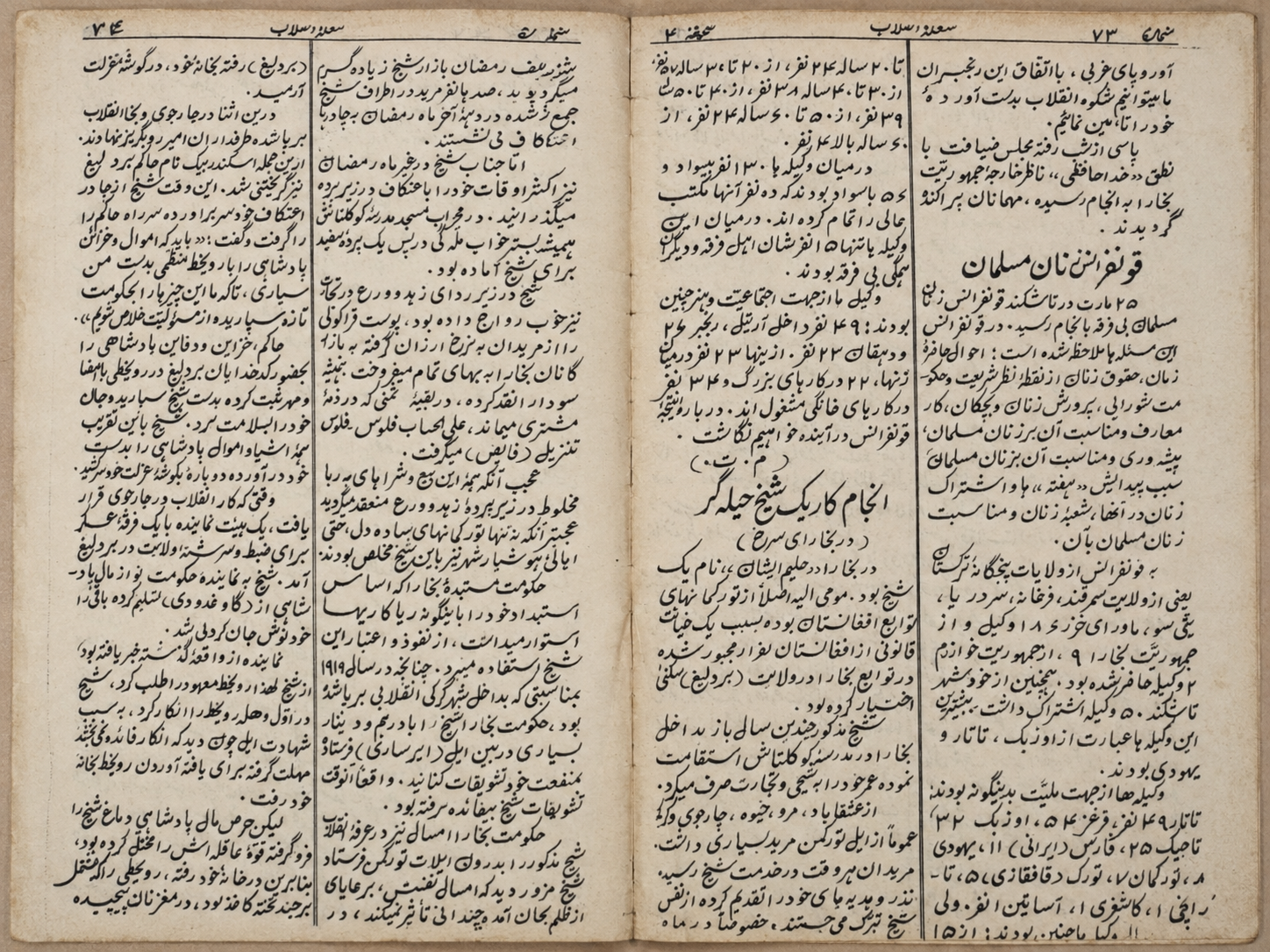
“The End of a Deceitful Sheikh” (Shuʿla-yi Inqilab No. 73, 25 April 1921, pp. 4-5)
In Bukhara there was a certain sheikh by the name of Halim Ishan. Originally, he was one of the Turkmens from the dependencies of Afghanistan. Because of a legal offense, he had been forced to flee Afghanistan and settled in the Bukharan district of Bardaliq.
For many years the famous sheikh resided in Bukhara itself, in the Kukeldash madrasa, spending his life in saintly pursuits and trade. From Ashgabat, Merv, Khiva, Charjuy, and other places, he had many Turkmen disciples. These disciples regularly came into the sheikh’s presence, bringing offerings and gifts and seeking blessings from the breath of the holy man. Especially during the blessed month of Ramadan, the sheikh’s “market” became lively: hundreds of disciples gathered around him, and during the last ten days of Ramadan they sat in retreat beneath the tents of seclusion.
But the honorable sheikh spent much of his time in retreat even outside Ramadan. In the prayer niche of the Kukeldash mosque-madrasa, a sleeping place was always prepared for him behind a white curtain.
Beneath the cloak of piety and asceticism, however, the sheikh also carried on a thriving business. He bought karakul pelts cheaply from his disciples and sold them to Bukharan merchants at full price. He always demanded immediate payment; and on whatever portion of the price remained owed by the customer, he charged interest down to the very last coin.
What amazed me was that all these transactions of buying and selling, mixed with usury, were concluded beneath the veil of piety and sanctity. More astonishing still was that not only simple-hearted Turkmens, but even the clever townspeople remained devoted to this sheikh.
The despotic Bukharan government, whose rule rested precisely on such hypocrisy, made use of the sheikh’s influence and authority. Thus, in the year 1919, when revolutionary agitation had broken out inside the city, the Bukharan government sent the sheikh among the Ersari tribes with large sums of money in order to encourage them in support of the regime. At that time, indeed, the sheikh’s propaganda had not gone without effect.
This year as well, on the eve of the revolution, the Bukharan government dispatched the same sheikh among the Turkmen tribes. But this time the hypocritical sheikh’s breath no longer had much influence over people already driven to desperation by oppression. He went to Bardaliq and rested quietly in the corner of his house.
Meanwhile revolution broke out in Charjuy and Bukhara, and the supporters of the Emir began to flee. Among them was the governor of Bardaliq, a certain Iskandar Beg. At that moment the sheikh emerged from his retreat-tent, stopped the governor on the road, and said:
“It is necessary that you hand over the royal treasury and state property to me under a properly written receipt, so that I may deliver these things to the new government and free us from responsibility.”
The governor, in the presence of the elders of Bardaliq, formally transferred the treasury and royal goods to the sheikh under a signed and sealed document, and then fled to save his own life.
By this means the sheikh gained possession of all the state property and once again withdrew into his corner of seclusion.
When revolutionary authority in Charjuy became established, a delegation accompanied by soldiers arrived in Bardaliq in order to seize and administer the district. The sheikh handed over to the representatives of the new government only a sickly cow from among the royal property and intended to swallow the rest himself.
The representative already knew of the previous events and demanded from the sheikh the written receipt. At first the sheikh denied the existence of any such document. But because the tribespeople testified against him, and denial no longer served any purpose, he requested a delay and went home supposedly to retrieve the paper.
Yet greed for the royal wealth had clouded the sheikh’s mind and destroyed his reason. At home he took the receipt – written on several sheets of paper – wrapped it inside bread, and began swallowing it.
But before he could swallow all the pages, his stomach became swollen with wind and bloating, and he fell into agony. The pain became so severe that the sheikh hurled himself about like a dog pierced by needles, until at last he took a knife and ripped open his own belly.
Thus, for the sake of greed, he surrendered his sweet life and with his own hands tore away before the eyes of the people the veil of hypocrisy he had maintained for many years.
Alas! Filth of such a kind, polluted beneath the cloak of sanctity, can be purified only by the sword.
— Narrated from the qadi of Bardaliq, S. ‘A.
[1] For the scholarly discussion of the importance of Shuʿlah-yi Inqilab, see Paul Bergne, The Birth of Tajikistan: National Identity and the Origins of the Republic (I. B. Tauris, 2007), 23-25; Adeeb Khalid, Making Uzbekistan: Nation, Empire, and Revolution in the Early USSR (Ithaca: Cornell University Press, 2015), 290-6; Lutz Rzehak, “How Tajik was made into a national language,” in Tajik Linguistics, ed. Shinji Ido and Behrooz Mahmoodi-Bakhtiari (De Gruyter Mouton, 2023), 1-44.
[2] Khalid, Making Uzbekistan; Paolo Sartori, “Ijtihād in Bukhara: Central Asian Jadidism and Local Genealogies of Cultural Change,” Journal of the Economic and Social History of the Orient59, no. 1-2 (2016): 193-236. For an overview of the polemic, see Alexander Morrison, “The Jadidology Wars. A Plea for Peace from a Neutral Bystander,” Central Asia through the Ages: Society, Culture, Texts. Essays in Honor of Prof. Dilorom Alimova, edited by Marianne Kamp and Florian Schwarz (Akademnashr, 2025), 118–30.
[3] Stéphane A. Dudoignon, "Echoes to al-Manar among the Muslims of the Russian Empire: a Preliminary Research Note on Riza al-Din b. Fakhr al-Din and the Mura (1908–1918)," in Intellectuals in the Modern Islamic World, ed. Stéphane A. Dudoignon, Komatsu Hisao and Kosugi Yasushi (Routledge, 2006), 85-116.
[4] Thomas Bauer, Die Kultur der Ambiguitätt : Eine andere Geschichte des Islams (Berlin : Verlag der Weltreligionen, 2011); Oliver Scharbrodt, Muhammad ʿAbduh. Modern Islam and the Culture of Ambiguity (Londres : I.B. Tauris, 2022).