by Albert Cavallaro, University of Michigan, Ann Arbor
Thursday, February 25, 1899: Europeanization or Something Else
On Thursday, February 25, 1899, at 1:00pm, thirty Muslim men – composed variously of qazi (Islamic judges), village elders, lower-level officials, and wealthy local merchants – gathered to visit the Turkestan Public Library and Museum in Tashkent. There they were met by three figures from the Russian colonial administration: Captain D. B. Belov, a representative of the Turkestan Public Library and Museum’s Observatory Committee, Rittsmaster Asfendiarov and Shtabs-Rittsmaster Dzhurabekov. Asfendiarov and Dzhurabekov served as translators between Belov and those assembled.
A week later, on March 4, a short article appeared in the state-run Russian-language newspaper Turkestanskiia Vedomosti describing the visit of these thirty men to the museum. Their tour began in the archaeological department, “which greatly interested the visitors,” before they were shown a “relief map” of the Turkestan region that especially “aroused [vosbudila]” their attention. At the tour’s conclusion, “about ten native visitors expressed a desire to assemble collections representing various aspects of their daily life and to donate them to the museum.”[1]
Another article published the same week in the state-run Turki-language newspaper Turkiston Viloyatining Gazetasi elaborated upon this visit and the desire of these prominent Muslim men to serve as future patrons for this institution:
Having seen the above mentioned instruments and objects and understanding their benefits several promised to give objects to that museum, thus, Rahim Xoja qazi [promised to give] objects related to jewelry and gilding, Sayid G’ani boy Sayid Azimboy og’li [promised to give] instruments made from copper and iron, Sayid Karim Sayid Azimboy o’gli [promised to give] instruments related to smithing, Maqsud Xoja [promised to give] objects made of leather, Majid aqsaqal [promised to give] sweets and sugar intended to be atop a dasturxon [tablecloth], Qurban aqsaqal [promised to give] various types of tobacco, Arif Xoja [promised to give] women’s patterned clothes, Asil aqsaqal [promised to give] various types of grain, and Muhiddin Xoja qazi and Sayid Baqihan qazi promised to give various books, papers, pens and other needed goods. [2]
Writing to its Russian-reading public, Turkestanskiia Vedomosti described this museum visitation as part of Governor General Sergey Mikhailovich Dukhovskoi’s plan of “familiarization and rapprochement [sblizhenie] of our natives with European science.” [3] In doing so, the article presupposed a specific European genealogy for the history and development of the Turkestan Public Museum and public museums more broadly, an understanding that was present both in the 19th century and remains extant today.[4] However, the contemporary Russian press’s impulse to describe visitation to the museum by local Muslim men as “rapprochement” with “European science,” elides the ways in which the museum served not only as a site of transformation but also as a site that could itself be transformed. By visiting and promising to donate items, these representatives of local Muslim society—from the powerful merchant brothers Sayid G’ani and Sayid Karim Azimboy to a number of judges, officials and others—made claims to participation and collaboration in, and ownership of, the collections.[5] Their desire to donate items—be they of metal, cloth, or tobacco—explicitly sought to change the museum and its holdings. Thus, while the Russian press framed this encounter as a transformation of the visitors by the museum, the desire of these men also allows us to think about the ways in which visitors may also transform museums.
In the following sections, I turn from the above-described invocation of an urge to donate to the museum in 1899 to a Turki-language representation of the Turkestan Public Museum published in the following year. Here, I will show how this article presented, discussed, and claimed this museum’s collections as both Central Asian and Muslim.
November 21, 1900: Exploring the Ajoyib Xana
This November 21, Tuesday, Russians and a few Muslims went to the Tashkent City Museum, or ajoyibxana [wonder room], to receive enjoyment and were amazed.
The above excerpt published on November 27, 1900, describes yet another visit by “some Muslims” six days earlier to the Turkestan Public Museum, also referred to as a “ajoyib xana” or “wonder room.” However, here the focus is not on the desires of the Muslims visiting the museum, but instead on the objects they came into contact with inside this space. First mentioned among the objects that may have brought “enjoyment” and “amazed” its visitors in November, 1900, were “coins” and various other objects “remaining from ancient times.” Beyond these numismatic and archaeological collections, to which we and the author will return later, the author also noted that the museums’ walls were decorated with photographs of the “late Emir of Bukhara” and “this lord’s heir to the throne” as well as photographs of the “Khivan Khan and this lord’s precious children.” Both of these rulers of Russian protectorates had formal and informal connections to the museum. The Bukharan Emir, who funded a variety of societies and organizations across Tashkent, also donated items to the museum, and the Khivan Khan had also visited the museum during a recent trip to Tashkent. The author also listed photographs of “other great Muslims” as decorating the walls of the museum.[6] These other “great Muslims,” unnamed in the article, may in fact have been several of the men described in the previous 1899 article; it was typical that donated collections would have the names, and even photographs, of their donors hung alongside them.
This photograph depicts some of the collections of the Tashkent Museum, also known as the Turkestan Public Museum, around 1914. In the top right of the photograph is a portrait of the Bukharan emir Muzaffar bin Nasrullah (ruled 1860-1885) and in the bottom right is a portrait of Abd al-Ahad (1885-1911) the fifth son of Muzaffar and his successor as emir. I thank Alexandra Dennett for help in identifying these photographs.
Emotional Displays: Learning to Regret in the Museum
Having read the Ferghana populations’ petitions, every Muslim will feel extreme regret and be sorrowful.[7]
Beyond the above-discussed photographs of “great” and famous Muslims, there were also photographs of what we might term, following the logic of the Russian administration, “bad” Muslims. Chief among these was the Dukchi Eshon who led the 1898 rebellion against Russian rule in the Fergana valley. This brief uprising against Russian rule caused not only a widespread campaign of violence and retribution inside the Fergana valley by Russian imperial forces, but also a changed museum display in the colony’s capital in Tashkent. According to this article, the Andijan exhibition contained “an image of the Ishan conspirator who came from Ming Tepe”, as well as printed “addresses” from the populations of Kokand and Osh, in which the “common people” made clear their “regret” regarding this revolt.[8] The public performance of loyalty and regret done by the addresses’ authors was intended to be repeated within the museum, which demanded further invocations of sorrow and regret by any visiting Muslims.
Iskander’s Horns: Or, How to Become a God
You are not a normal human [Siz rasmi adam emasiz][9]
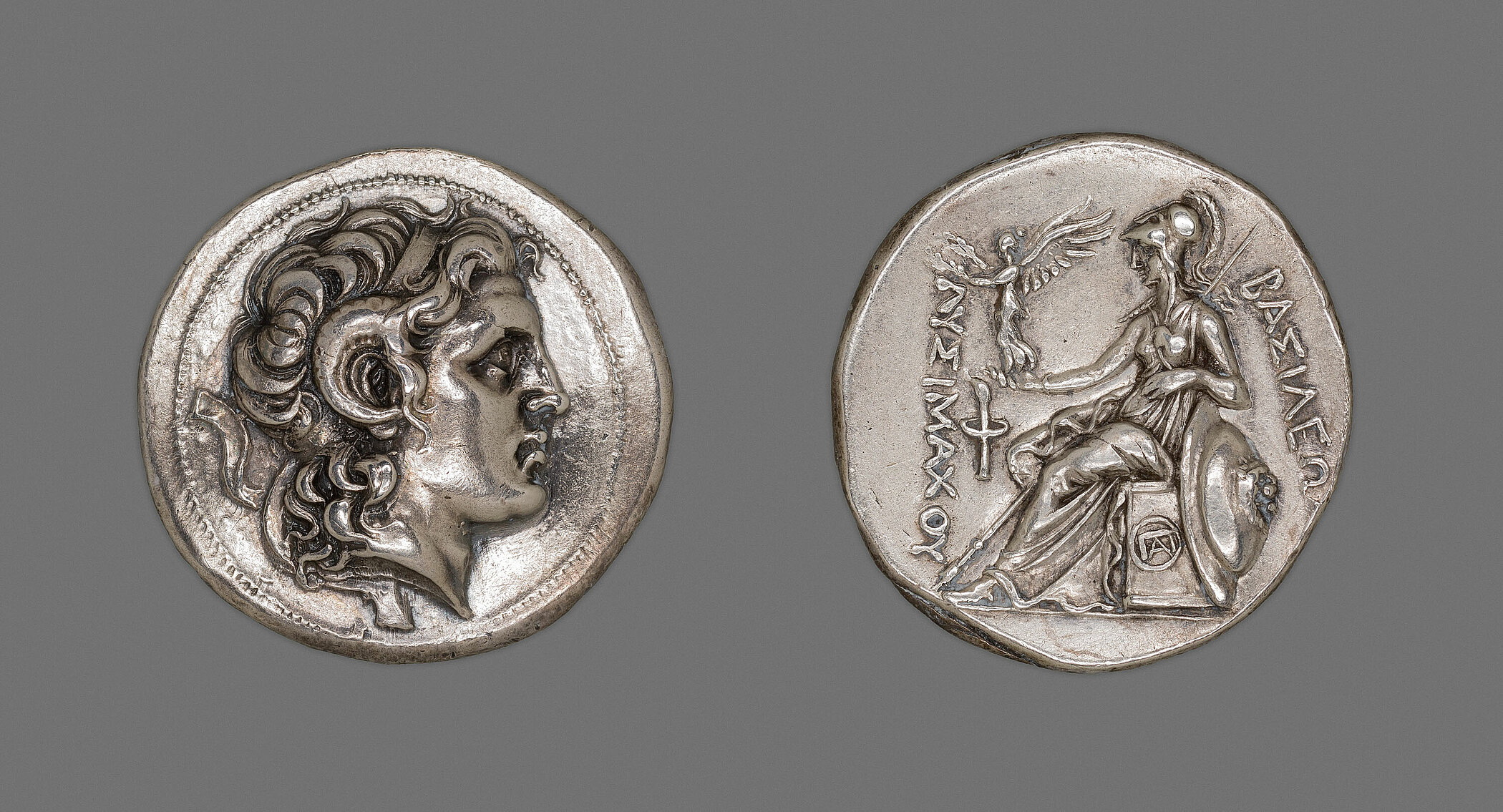
Following this account of Muslim crimes and subsequent regret, the article then described the coin and ceramic collections of the museum, writing that one could find the images of the 14th century conqueror Amir Timur, as well as the 4th century BCE empire builder Iskander Qarnayn, or Alexander the Two-Horned (commonly known as Alexander the Great) on some of the museum’s various objects. A prominent figure in Central Asian Islamic culture, the mere mention of Iskander Qarnayn’s image on coins in the museum’s collection dramatically transformed the article: suddenly no longer interested in the exhibitions of the museum, the author now related a long-winded tale describing Iskander’s realization of his divine status one day in Egypt.
The author wrote that during the “time of war” Iskander Zulqarnayn went to Egypt where inside one desert he entered a “idol-temple” and inside it he came across an image of depicting “two horns.” A person, working inside this temple, then “complimented” Iskander, saying, “you are a great sir,” calling him a conqueror, taker of cities and further declared “you are not a normal human [siz rasmi adam emassiz], but you are our great god’s son” and due to this “you will take many territories.” Accordingly, he told Iskander, “you must put horns on your head.” Hearing these “wonderous words” Iskander accepted them, and replied in turn, “‘My mother told me: you will go to your father, and your father is not my husband. In the desert the two horned god of this temple worker is your father’ and having said these words, Iskander took this image of the two horns and put it to his head.” The author writes that subsequently coins were made with Iskander’s image depicting him with two horns, and such coins were available for viewing in the museum.[10]
Following this sojourn to Egypt with Iskander, the anonymous author then concluded the article, writing: “all Muslim persons who go to this museum will see with their own eyes and become amazed by objects, of course this will bring a benefit to their intellect and work” and that “nonliterate people if they cannot read books, also could receive amazement from seeing these objects, and this will cause happiness to appear.[11] Thus, this short article elaborated a Muslim, and Central Asian, understanding of this institution. Muslims could go to this place, and see Muslim rulers and elite, both current and of the past, see Muslim criminals, such as the Dukchi Eshan, and learn more about the deeper cultural history of the period, such as learning how Iskander got his two horns.
Towards a Conclusion: Thinking Otherwise about “Europeanization”
In 1997 James Clifford famously borrowed Mary Louise Pratt’s term “contact zone” to describe museums as an institution and site located between – and mediated by – multiple publics. Pratt’s term, which she utilizes to “foreground the interactive, improvisational dimensions of colonial encounters so easily ignored or suppressed by diffusionist accounts of conquest and domination,” and to stress the “copresence, interaction, interlocking understandings and practices often within radically asymmetrical relations of power.”[12] Clifford in bringing this term to the world of museums and their work highlights museums as vectors of asymmetrical power exchanges and as sites of “an ongoing historical , political, moral relationship – a power-charged set of exchanges, of push and pull.” [13]
By highlighting, first, the (invited) movement of prominent Muslim men into the space of the Turkestan Public Museum in Tashkent in 1899 and, second, a later Turki-language description of this museum and its collections, I seek to go beyond a view that posits this museum solely as a site of Europeanization as I show its functioning as a “contact zone” in colonial Tashkent. Museums were (and are) sites of (attempted, desired, planned) ideological control as many scholars have elaborated upon. However to reduce this museum only to Europeanization – or, as the Russian press of the period claimed, as solely synonymous with “European science” – elides the range of contacts and relationships that this space generated. For a reader of the above-described 1900 Turki-language article on the Tashkent museum, or for a visitor who had come to admire the items donated Sayid G’ani boy Sayid Azimboy og’li or his brother Sayid Karim Sayid Azimboy o’gli, this Russian imperial institution would appear (and for this reader and visitor simply was) Central Asian and Muslim. Thus, these two Turki articles present an understanding of this space as one with multiple publics, including a Muslim public. And it was this Muslim public that the museum sought to cater to and shape, and, in doing so, made itself available to be shaped in turn by this same public.
Albert Cavallaro’s dissertation “Things Disappear: The Russian Empire, Central Asian Museums, and Imperial Love, 1876-1925” examines the growth and changing roles of museums in a developing and then crumbling colonial society. Drawing on sources he gathered from over two years of fieldwork inside of Uzbekistan and research in over 21 archives, museums, and libraries, he argues that this period—divided by war, imperial collapse, and regime change—was united by a widespread belief in the efficacy of museums to meet the changing demands of the age. He is a current Weiser Center for Europe and Eurasia Dissertation Completion Fellow at the University of Michigan, Ann Arbor.
[1]Turkestanskiia Vedomosti no. 17 (1899).
[2]Turkiston Viloyatining Gazetasi no. 9 (1899).
[3]TV no. 17 (1899).
[4] “To the history of Greece let us go for the origin of the museum idea, which, in its present form, seems to have found its only congenial home among the European off- shoots of the great Indo -Germanic or Aryan division of the world's inhabitants,” G. Brown Goode, “The Museums of the Future” (Washington: Government Printing Office, 1891): 428. Jeffrey Abt in his foundational article, “The Origins of the Public Museum,” traces the terms “public” and “museum” and shows their intersection in ancient Greece and in Europe during the Renaissance. Jeffrey Abt, “The Origins of the Public Museum,” in A Companion to Museum Studies, ed. Sharon Macdonald, (Malden, MA: Blackwell Publishing, 2006): 115-134.
[5] Eileen Kane discusses Sayid G’ani Sayid Azimboy’s tumultuous and short-lived tenure as the hajj director for the Russian empire in Russian Hajj: Empire and the Pilgrimage to Mecca. See especially, Eileen Kane, “Chapter 4: The Hajjf and Religious Politics after 1905,” in Russian Hajj: Empire and the Pilgrimage to Mecca (Ithaca and London: Cornell University Press, 2020): 191-241.
[6]TVG no. 47 (1900).
[7]TVG no. 47 (1900).
[8]TVG no. 47 (1900).
[9]TVG no. 47 (1900).
[10]TVG no. 47 (1900).
[11]TVG no. 47 (1900).
[12] Mary Louise Pratt, Imperial Eyes: Travel Writing and Transculturation, (New York: Routledge, 1992): 7.
[13] James Clifford, Routes: Travel and Translation in the Late 20th Century, (Cambridge: Harvard University Press, 1997): 192.
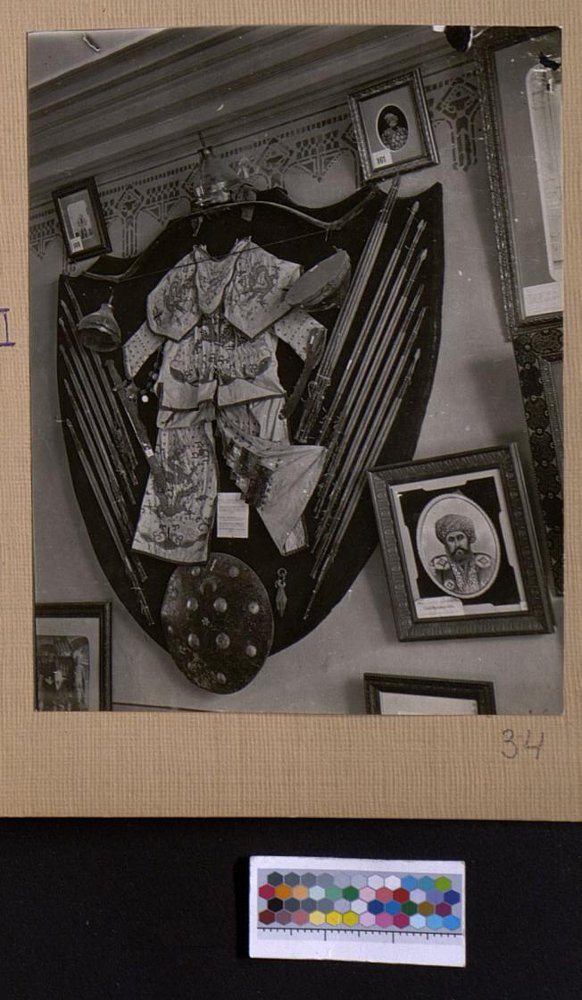
“Tashkentskii muzei. Iz al’boma Kassiana Liubarskogo.” 1914. Held at the State Historical Museum of Russia. Inventory Number: IA 933/34. See, https://catalog.shm.ru/entity/OBJECT/6348762?query=альбома%20Кассиана%20Любарского&index=15