


by Giorgio Rota, ÖAW
Why should we still speak about renegades today, when we allegedly live, at least in the Western world, in a deeply secularist society and religious tolerance is a given? One possible answer is that the figure of the renegade was not only a religious, but also a social and political phenomenon, omnipresent during the early-modern period in the vast area that stretches from the Strait of Gibraltar to the Gulf of Bengal and that includes regions as different as North Africa, the Balkans, the Black Sea basin, the Levant, East Africa, the Ottoman Empire and Iran, Central Asia, northern India and the Deccan coast.
Well known to modern scholarship, the renegade (he or, quite often, she) was the product of the contact between Islamdom and Christianity (be it Catholic, Protestant or one of the different branches of the Orthodox community). Before the late 18th century, the Christian states were only occasionally successful in their struggle against aggressive Muslim neighbours, or in their own attempts at colonial expansion. Conventional wars and frontier Kleinkrieg produced large numbers of Christian prisoners who, once in Muslim hands, often saw conversion as a way to improve their lot. Moreover, the lack of an aristocracy in the Western sense of the word allowed a social mobility in the Muslim lands that was unconceivable in Europe: the possibility to alter one’s life spectacularly for the better could be a powerful incentive to change religion and serve a Muslim ruler. Therefore, for centuries, as Lucetta Scaraffia put it, “the frontier between Christianity and Islam can be crossed only in one sense, towards the Muslim world”. To be sure, there were cases of Muslims (some of them well investigated by modern historians) who converted to Christianity in the early modern period: slaves or prisoners of war, political exiles and, in a few cases, individuals who freely accepted Christianity as the true religion. Their number is however relatively low and not comparable with the masses of Christians who crossed the religious divide in the opposite direction. Things will change, but only to a limited extent, with the rise of the modern European colonial empires. The phenomenon of the renegades was, inevitably, typical of the border regions, areas of political and cultural contact.
Transition from Christianity to Islam could also be caused by legal troubles experienced in an Islamic land, reversals of fortune at home, personal curiosity for Islam and its culture, or spirit of adventure. Whatever the reason, in an age when religion was not a matter of personal choice but was one of the most powerful identity-markers as well as a sign of political loyalty or, at least, submission (and given the fact that the Christian West was still militarily inferior to the Muslim East until at least the end of the 17th century), the figure of the renegade was religiously, politically and socially extremely unsettling and even subversive: at the very least, it showed that a life outside the norms prevailing in the Christendom was possible, even desirable. It is therefore not by chance that the word “renegade” had and still has an unquestionably and unmistakably negative meaning: the renegade is (I quote from the Merriam-Webster on-line dictionary) “a deserter from one faith, cause, or allegiance to another” or “an individual who rejects lawful or conventional behavior”. Conversely, a Jewish or pagan or Muslim convert to Christianity was, from a Christian point of view, indeed a convert or a neophyte. However, here we will show also one case of transition from Islam to Christianity and we will use nonetheless the word renegade, not out of political correctness but because forsaking one’s own religion was not less unsettling for the Muslims than it was for the Christians.
The Caucasus is located more or less in the middle of the above-mentioned “Gibraltar to Bengal” complex and is, without doubt, an area of cultural and political contact since time immemorial: nonetheless, when it comes to research on the larger Eurasian region, it remains often to the margin, as if there were no meaningful communication between the Caucasus itself and the rest of Eurasia. However, comparing the phenomenon of the renegades there with the situation in other regions of the world, where the same phenomenon has been abundantly studied, is a way to bring back the Caucasus into the larger “Eurasian discourse”: “opening” the Caucasus, making it comparable, instead of treating it as a precious oddity full of interesting but basically isolated realities, makes it easier to understand.
Here I will present three cases of Caucasian renegades which have both an extraordinary and an exemplary character. Extraordinary insofar as two of them had particularly eventful lives which already drew the attention of their contemporaries and brought about the production of written sources, while the other was himself a man of letters. They are also exemplary (all three of them) because their conversion was not just the outcome of a personal act of free will but rather of larger political and social dynamics. For this reason, they shed light on the lives of many other, more obscure fellow renegades, whose trajectories were affected by similar dynamics but who hardly left a trail of documents, or none at all.
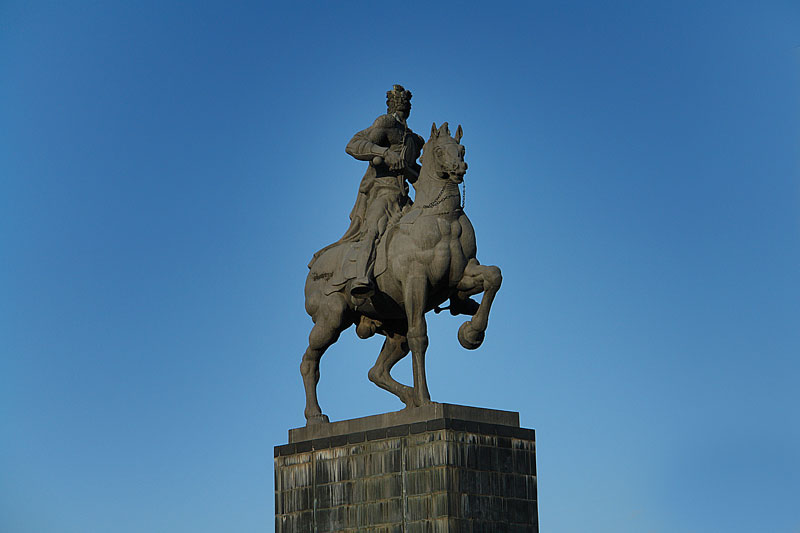
For our intents and purposes, given the chronological scope of the present contribution, we may begin outside the region, namely, in Iran. In 1612, a member of the Georgian lesser aristocracy, Giorgi Saak’adze (1570-1629), fled to Iran, where at a certain point he became a Shiite Muslim. In Georgia he had been the strongman behind the throne of the young King Luarsab II of Kartli (1606-1615) as well as his brother-in-law, despite his relatively low social standing and by dint of his military victories: in this way he annoyed some members of the higher aristocracy, who managed to turn the king against him. After many adventures, in 1625 he took part in the Persian invasion of K’axeti (eastern Georgia). The Georgian sources claim that he intercepted a message of the Shah ordering the commanders of the Safavid army to murder him: therefore, Giorgi made an agreement with the local aristocracy, took the lead of a general insurrection against Safavid domination, and implicitly or explicitly returned to Christianity. Shortly afterwards, he fell out with the other rebel leader, the King of K’axeti, and, defeated in 1626, he took shelter in the Ottoman empire, where he was appointed governor of the province of Karaman after, presumably, having become a Sunni Muslim. In 1629 he was executed in Aleppo: the official reason was his mistreatment of the population of the province, but there is a strong likelihood that he was planning to return to Persia or to Georgia, with or without Ottoman consent. This of course would have entailed yet another change of religious affiliation. Like many others before and after him, Saak’adze was induced to apostasy by a political setback: unlike most, however, he never gave up his own plans or ambitions. While the Persian sources describe Giorgi as an apostate from Islam, and the Ottomans seem to have seen him fundamentally as a man without a definite religion, he is now considered as a national hero in Georgia, where his conversion(s) to Islam is simply seen as a matter of expediency to continue the war against foreign invaders. Stalin clearly was of the same opinion since he ordered a high-budget film to be produced about him: the movie appeared on the screens in 1943 but the beginning of the shooting was officially announced on 22 June 1941, which was, in a very suggestive way, the day Operation Barbarossa began. Furthermore, Saak’adze was celebrated with at least two monuments in post-Stalinist Soviet Georgia, one in his home village and one in Tbilisi. As a footnote to this story, and since we have mentioned the possibility and the methodological necessity to draw parallels between the Caucasus and the rest of the world, it may be interesting to recall that the actor who impersonated Saak’adze, the charismatic Ak’ak’i Xorava, a decade later played the role of another renegade and national hero, Skanderbeg, in a major Soviet-Albanian production celebrating the (short-lived) friendship between the two Communist countries.
We now reach the Caspian littoral, which played a role in the conversion of our second example, Aleksandr Kasimovich Kazembek (1802-1870), who was born as Mohammad Ali in the Persian city of Rasht. His “precise” ethnicity is debated, but what really matters for us now is that he was educated in the Daghestani city of Derbend (then already under Russian control). Derbend traditionally was, like the rest of the region, an important centre of production of Islamic scholarship in Arabic. In 1821 he followed his father, who had been exiled to the Russian city of Astrakhan, and there he became acquainted with the Scottish missionaries operating in the city. In 1823 he was baptised, and in 1824 he wrote a treatise aimed at demonstrating the superiority of Christianity over Islam. This of course irritated the local Muslim clergy and, to solve the problem, the Commander-in-Chief of the Russian forces in the Caucasus had the young Kazembek appointed as a lecturer of Oriental languages in the city of Omsk, in Siberia. On his way there, Kazembek fell ill in Kazan, where he drew the attention of the rector of the University of Kazan. The rest is history: the meeting between these two men marked the beginning not only of a beautiful friendship but also of a spectacular career, and Kazembek became one of the most prominent Russian Orientalists of his generation. However, and most important for us, is the fact that he, as an Oriental, played a decisive role in the transformation of the university of St. Petersburg into the main centre of Oriental Studies in Imperial Russia (and then in the Soviet Union). With his anti-Islamic pamphlet, Kazembek placed himself squarely in a long tradition of converts (Christian, Muslim and Jewish alike) who wrote to extol the virtues of their new religion and refute the tenets of their old faith – a tradition that, mutatis mutandis, is still alive in our days. However, he also lived in an age when European and Russian colonialism and Orientalism were about to reach their maturity, a circumstance that shaped his future forever.
The third and last case is that of Semën Semënovich Atarshchikov. He was born in 1807 in the village of Naurskaja (in present-day Chechnia): Naurskaja was populated by Terek Cossacks, who already saw themselves as Russians and Orthodox but actually were still a frontier society, culturally and ethnically very mixed. Indeed, his mother was a former Noghay slave who had become fully integrated into Cossack society. His father, a Chechen, had been surrendered to the Russians at a young age as a hostage and then sent to a boarding school, in order to train him for a career in the Russian administration or the army: later he was baptised as Semën and became a military interpreter as well as a Cossack. Semën senior, unlike his wife, never severed his connection with tradition and, when his son was eight years old, according to custom he sent him to live for seven years with a neighboring Kumyk chieftain, in order to become thoroughly familiar with the way of life and the languages of the Caucasus (although Semën junior was born Christian) (the Kumyk are a Turkic-speaking population living in Daghestan). After the seven years had passed, Semën junior returned to “civilization”: in 1823, he joined a Cossack regiment as an interpreter, like his father, and between 1830 and 1832 he was part of the so-called “Circassian Guard” of the Tsar in St. Petersburg. In 1832 he was back in the Caucasus, and this time he served also in the western Caucasus, where the Russians faced the Circassians. In October 1841, Semën Atarshchikov, now a Russian officer, defected and joined the Circassians. When he came back almost four months later, in January 1842, he explained to his Russian superiors that he had been overcome by his grief for the sudden death of his two children. He was eventually pardoned in November 1842, but he was also transferred to a Cossack regiment stationed in Finland: immediately he defected and joined the Circassians again. This time was for good: Semën Atarshchikov converted to Islam, perhaps he married again, took up the name Hajret Muhammad and joined the resistance against Russia. Finally, in August 1845 (at the age of 38), he was treacherously shot by his own Russian servant: captured by the Russians, he died shortly thereafter. Like Giorgi Saak’adze, Atarshchikov changed his religious and political allegiance more than once, but for other reasons. Like Aleksandr Kazembek, he typified for a while Russia’s alleged cultural superiority, validating the Russian mission civilisatrice: unlike Kazembek, however, he eventually became a subversive element. Atarshchikov’s personal background was particularly complex, one where Russo-Orthodox and Caucasian-Muslim identities were inextricably entangled. His decision to change sides certainly had material reasons too but, in common with many fellow renegades all over the world, life on the frontier had produced a “clash of identities” that Atarshchikov could not easily solve. He is also a modern figure: he reminds us of 20th-century Western soldiers who defected and sided with the resistance movements they were supposed to fight, and he forces us today to ask what “integration” actually means.
The renegades were not only conduits of communication in a general or abstract way, but were also brokers and middlemen: they could be indispensable instruments ofimperialexpansion and control as well as, for smaller peoples like the Circassians, an invaluable source of information on a much more powerful enemy, but they were not necessarily mere blind tools in the hands of their masters or hosts. Many, despite displaying political allegiance through religious conversion, either never forgot or rediscovered their origin and, at a certain point in their lives, tried to go back “home”. Among those who stayed in their host society, many retained a measure of independent agency. To compare the experiences of Caucasian renegades with those of renegades from other parts of the world allows us to make the Caucasus comparable and, at the same time, appreciate its specific traits.
In conclusion, the Caucasian renegades help us debunking ever-present clichés of the Caucasus, from the Golden Fleece and Prometheus to the noble savage, the cliché of a region rich in history but inherently archaic, isolated and “unique”: in a way, the renegades are the very embodiment of the connectedness and commensurability of the Caucasus.