
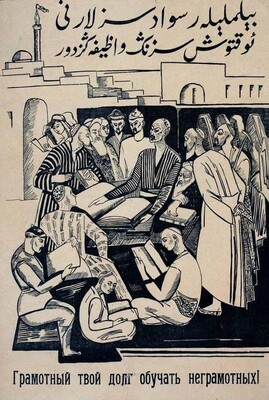
“Literate people, it is your duty to teach those who are illiterate!”, Turkestan State Publishing House 1920s. “Грамотный, твой долг обучать неграмотных!,” Russian Perspectives on Islam, accessed September 14, 2021, islamperspectives.org/rpi/items/show/9941
Are you hooked on the history of Central Eurasia? Do you want to know more about Muslims under Tsarist and Communist rule? Would you like to share with us the stories behind your research and reflect on your fieldwork or teaching experience? Then this is the place for you! In this blog we’ll uncover the galaxy of voices from Central Eurasian archives, raise awareness about the significance of Muslim communities in Russian, Soviet and Chinese history, and bring the study of Islam in the successor countries to the USSR and in the PRC into conversation with global history.
Through Khiva to Golden Samarkand, or Ella Enchanted
Green is the Color of Islam: A Glimpse from the Uzbek Archives (1960s)
“Qazaq is the Purest of Turkic languages!” Tatar Periodicals and the Qazaq Language in Turn-of-the-Century Russia
Back to Stalinism and its Tropes? Islam and Europe in Zuleikha Opens Her Eyes
Dagestan 1984: How I Learnt Arabic under Late Socialism (Part 1)
Ghost Mosque: Discovering a Sacred Space in North-Eastern Kazakhstan
History of conversion to Islam in Russia: An account still to be written?
Tinkering with Ethnicity and the First Census in the Fergana Valley, 1889-1890
Dancing Boys and Gay Escapades in Fin-de-siècle Tashkent: A Sketch from a Queer History of Central Asia
Archival Tensions: Reminiscences of a Research Trip to Karakalpakstan
Riding the Tiger: Hasan Ponomarev and the Edge of the Empire
A Bukharan Dignitary of Russian Origin: The Curious Case of Khan Quli Bek, né Urakov
Empire Made Me: Pervukhin and His Exploits in the Kazakh Steppe
The Madrasa and its Economic Worlds: Towards a Broader History of Education
Covering Design: Exploring Typography and Graphic Design through Soviet Turkic Publications of the 1920s and 30s
From Soviet to Saudi: On Central Asian Ulama and their Hijra
Folklore and Religion: Is the Shurale Just a Comic Character of Tatar Fairy Tales?
Uninvited Guests, or Tatars in Revolutionary Turkestan
Two Khans and a Brown Pig: Notes on a Quarrel between Sayyid Asfandiyār Khān of Khiva and Sayyid ‘Ālīm Khān of Bukhara
What do we talk about when we talk about ‘decolonizing Russian history’?
What Does a Decolonized Field Look Like and How Do We Get There?
Becoming Mullah Ishaq: An Uzbek Man in 19th-century Hungary
Discovering Niyaz-Muhammad Suleymanov and Muslim Book Culture in the Kazakh Steppe
Sovietized Memory: The Imamate and the Muslim clergy in a Daghestani Memoir (1957)
Richard Pipes Redux: Of Soviet Islam and the Revisionists
Are We Talking to One Another? Barthold and Togan on the Meaning of Empire and Central Asian History
The Ulama and Public Health in Imperial Russia and the Kazakh Steppe
Tsarist Extra Virgin: Imperial Russia’s Quest for Domestic Olives
Questioning Imperial Minority Rights: The General Islamic Conference of 1931 in Jerusalem and the fate of Soviet Muslims
The Unyielding Dead: Interring Conquest in the Graves of God’s Friends
The Earliest Copy of the Shajara-yi Turk: An Autograph?
The Mysterious “Black Lord” of East Turkestani Rain Prayers
“Qazaq Princess” on Russian Throne: Catherine II’s “Tale of Khlor” and its Literary Spin-offs
How Central Asianists Adopted An Ottomanist, And What Came Out Of It: A Reflection
“There Is, After All, Something Erotic About What Is Happening on the Borders of Our Empire”
Message in a Thermos, or Story of a Contrarian in Socialist Dagestan
Modeling Motherhood in O‘tkir Hoshimov’s Dunyoning ishlari (“Earthly Things”): The Soviet Memoir of Childhood and its Transformations in Central Asia
“We don’t care about the Parthenon!”: Passion for the Government House in Tashkent in the 1940s
Renegades of the Caucasus: Cultural Brokers and Agents of Empire (1500-1850)
Convert, Victim, or Impostor? Making Sense of a Colonial Report
Falling through the Cracks of Empire: The Plight of Ḥābbī Khwājā Niyāzov
Deforestation and Indigenous Religion in Eastern Russia
How the Crimean Tatar Chancellery Handled Diplomatic Correspondence: Sefer Shah Agha’s Mission to Poland–Lithuania in 1714
