Project leader: Jürgen Eckert, Florian Spieckermann
Initial project (completed):
A key enabler for the widespread use of hydrogen is its cheap and easy storage. Promising candidates for solid-state hydrogen storage are metal hydrides; examples of such hydride-forming metals are FeTi, Mg, LaNi5, and high-entropy alloys. Metal hydrides exhibit high volumetric energy densities, safety, and efficiency. Despite these superior properties, many challenges, including complex activation treatments, sluggish kinetics, insufficient (mechanical and chemical) stability, and unfavorable pressure-temperature conditions for loading-unloading operations, need to be surmounted.
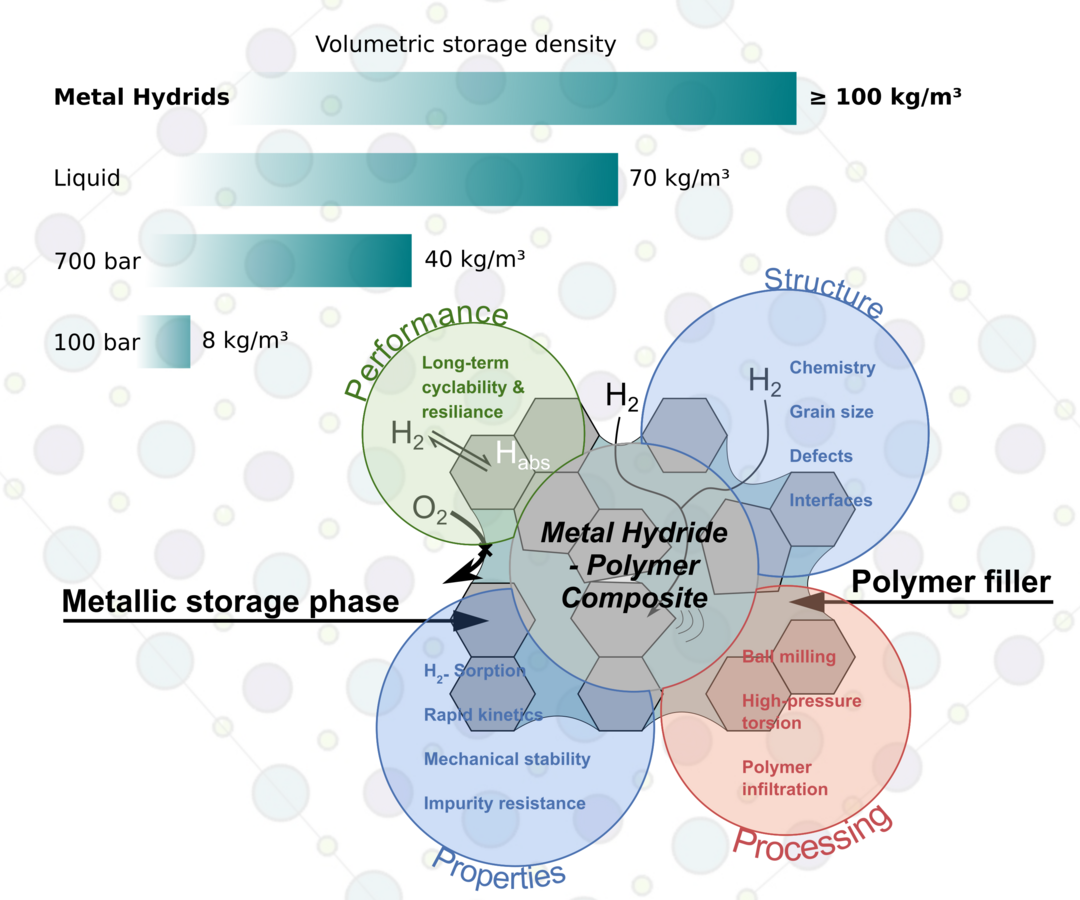
This project aimed to tackle the mentioned problems by prototyping porous metal hydride materials (Fig. 1). The project encompasses all required steps for achieving this - from preparation over characterization to functionalization. Nanoporous material can exhibit excellent properties such as high surface-to-volume ratio, high strength-to-weight ratio, and electrical and thermal conductivity. Heat treatment allows the tailoring of the composites and subsequent foam microstructures.
The pores can be infiltrated with a polymer that provides mechanical stability and selective hydrogen gas permeability. Additionally, the polymer adds another degree of freedom for engineering a high-performance storage material with minimal detrimental effects on the gravimetric storage density.
The investigated material systems include FeTi, as a chemically simple and well-studied model system, and promising high-entropy alloys, e.g., TiZrVNbHf.
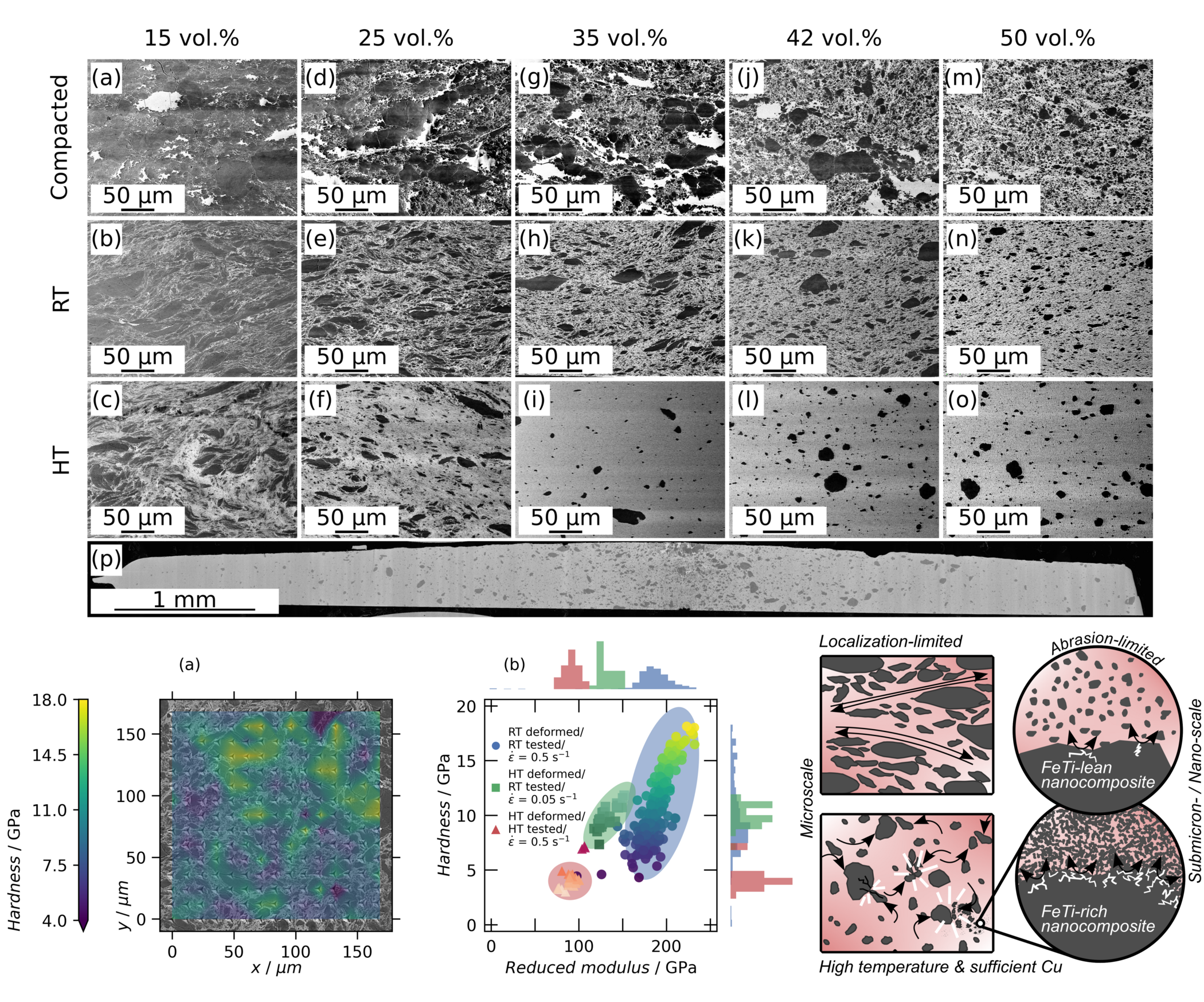
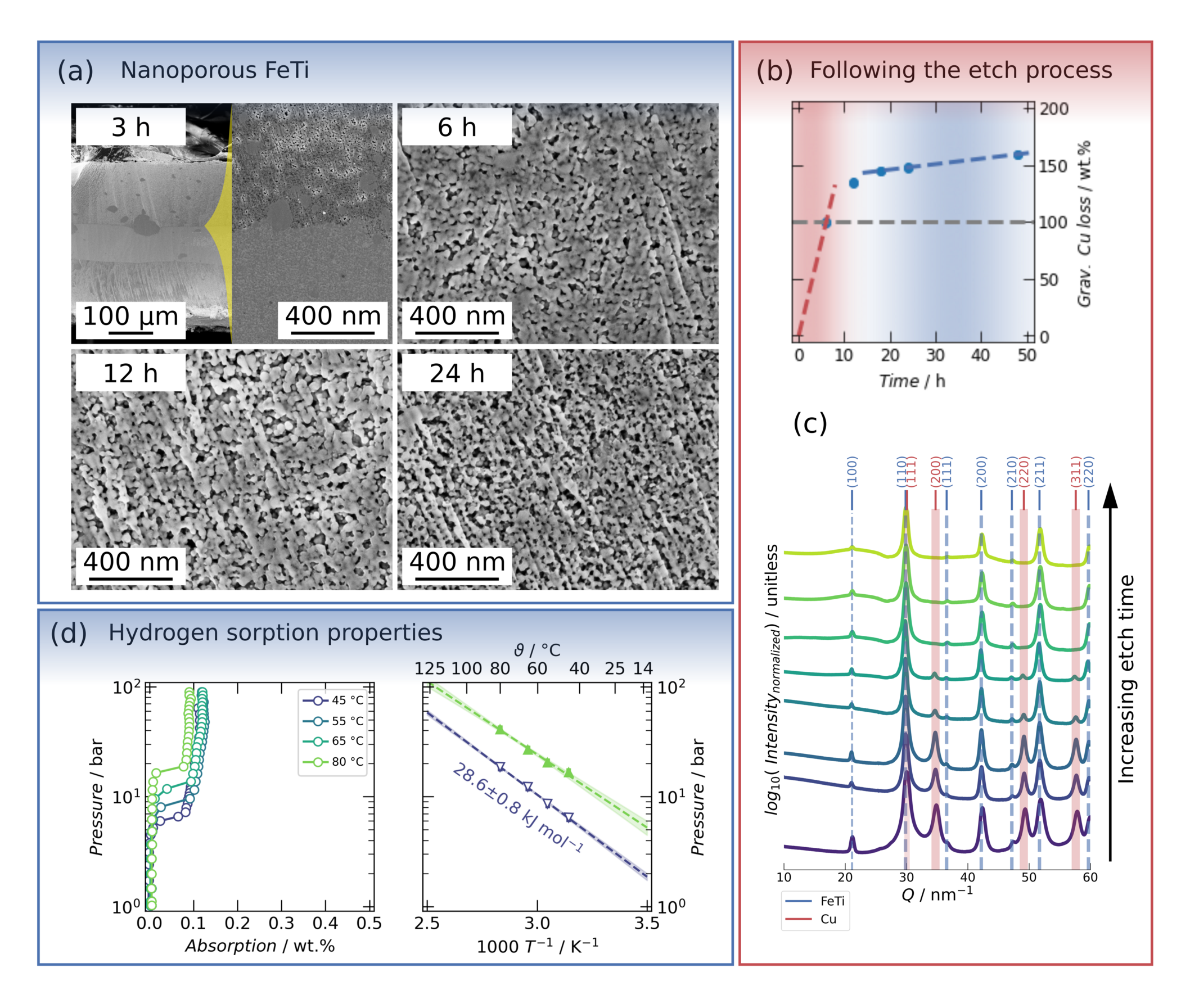
As a starting point, composites of immiscible storage and sacrificial phases are synthesized by High-Pressure Torsion (HPT), with the first model system being FeTi-Cu. Then, the sacrificial phase is selectively dissolved by wet-chemical processes, yielding a nanoporous and nanocrystalline metallic foam with high defect densities. Finally, the pores are infiltrated with polymers. The resulting hybrid material, the precursors (nanocomposite, metallic foam), and the involved processes (ball milling, HPT, (electro)chemical etching) are carefully investigated to shed light on the underlying processes and find optimization and tuning possibilities.
The investigations involve detailed structural characterization of the composition, nano- and microstructure, and morphology. In particular, the aim is to understand the impact and interplay of various interfaces (surface, grain boundaries, phase boundaries) on the material's (hydrogen sorption) properties. Primary characterization methods include electron microscopy (SEM, TEM) and (Synchrotron) X-ray diffraction. We complementarily probe the mechanical properties using micro- and nanoindentation. Hydrogen sorption performance is investigated using a Sievert's apparatus, enabling the determination of absorption and hydride formation capacity, kinetics, and thermodynamics.
A first milestone was achieved by preparing a FeTi-Cu nanocomposite with tunable grain size and mechanical alloying.1,2 These structural features directly translate into the nanoporous metallic foam. Additionally, the investigation of the promising HEA TiVZrNbHf, encompassing in-situ synchrotron experiments, revealed the effect of hydrogen on the microstructural evolution and decomposition during annealing.3
Follow-up Project (HEAfine4H2, ongoing):
A follow-up FFG project in collaboration with RHP-Technology GmbH and the University of Vienna has been underway. The goal is to build on the lessons from the initial research project and scale up the severe plastic deformation process, transitioning from high-pressure torsion to equal-channel angular pressing.
The preparation approach for porous materials derived from the resulting severely deformed composites remains the same as described previously. High-entropy alloys, known for their potential as metal hydride-forming storage materials, have been selected for this purpose.
The HEA composites will be subjected to a selective phase dissolution, obtaining metallic foams that can again be infiltrated with polymers to improve the mechanical and functional properties.
Gregor Mori - Department Chemistry - MUL
Daniel Kiener - Department Materials Science - MUL
Oskar Paris - Department Physics - MUL
Michael Zehetbauer / Erhard Schafler - University of Vienna - Faculty of Physics
Helmholtz-Zentrum Hereon - Institute of Hydrogen Technology
Deutsches Elektronen-Synchrotron DESY
RHP-Technology GmbH (Follow-up FFG project)



01.06.2021 – 31.05.2024 // 01.09.2024 – 31.08.2026


