


In recent years interdisciplinary research of archaeological heritage in Slovenia has made enormous steps forward. At least three archaeological projects, dealing intensively also with the Early Iron Age in Slovenia, were aiming in this direction,Tradition and Innovation in Prehistory, headed by Biba Teržan (Univ. of Ljubljana),BorderArch Steiermark, headed by Marko Mele (Universalmuseum Joanneum Graz) and Encounters and Transformations in Iron Age Europe, headed by Ian Armit (Univ. of Bradford), where the presenting author was the principal investigator at his (partner) institution.
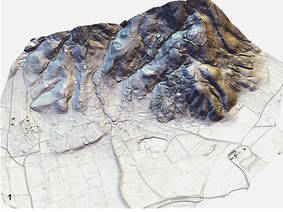
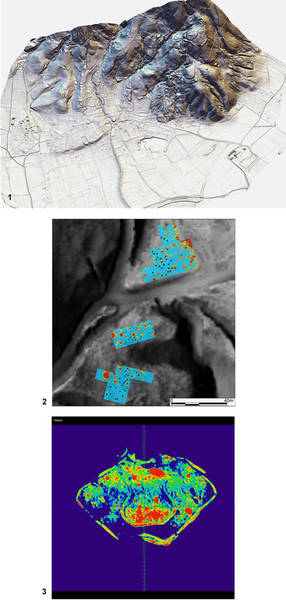
Focusing mainly on the hillfort Poštela near Maribor with its extensive cemeteries (1), every technique and analytical method used has added specific independent information, gaining an added value by intertwining them with each other and therewith forming new layers of information (2).
We started with aerial photography and historical analysis, added new layers of data with lidar scanning and an array of geophysical methods integrated in a multi-method approach (GPR, magnetics, resistivity, susceptibility, low frequency EM …). However, we have always included the intermediate steps, i.e. “ground-truthing”, where we use different low invasive investigation methods (core-drilling, test-trenching etc.), to guide our further steps, not only gathering enormous amounts of data “for later analysis”, but collecting data with “reason”.
As the broader understanding of archaeological sites is the main research goal, the collected data are also combined with a series of GIS analyses to explore different viewpoints of the site and its position in the wider landscape.
Other material specific analytical methods as multi-detector computed tomography for scanning of urns, containing cremated human remains and grave goods (3), microscopy for the analysis of fabric, used for pottery, petrography of stone debris and soil micromorphology etc., were also introduced for further in-depth investigations of specific research questions.
Postgasse 7/1/10, Seminarraum