


Lectury by Ariane Jacobs
The Late Bronze age site of Alassa, dated to the LC IIC–LC IIIA period (14th–12th century BC), has been acknowledged as a key-site in the understanding of Late Cypriot society. The spectacular architecture and finds, such as the ashlar buildings and storerooms with seal-impressed pithoi from the locality of Alassa-Paliotaverna as well as the rich grave goods and the metallurgical and agricultural activities from the adjacent locality of Alassa-Pano Mandilaris attest to Alassa’s important role in the wider landscape. Moreover, it is very likely that some of the Amarna tablets sent from the land of Alasiya to the Pharaoh originate from the Alassa region. The ceramic assemblage from Alassa therefore presents an excellent case to examine the organization of ceramic production and its relation to the socio-economic and political organization at the site and within the Kouris Valley region.
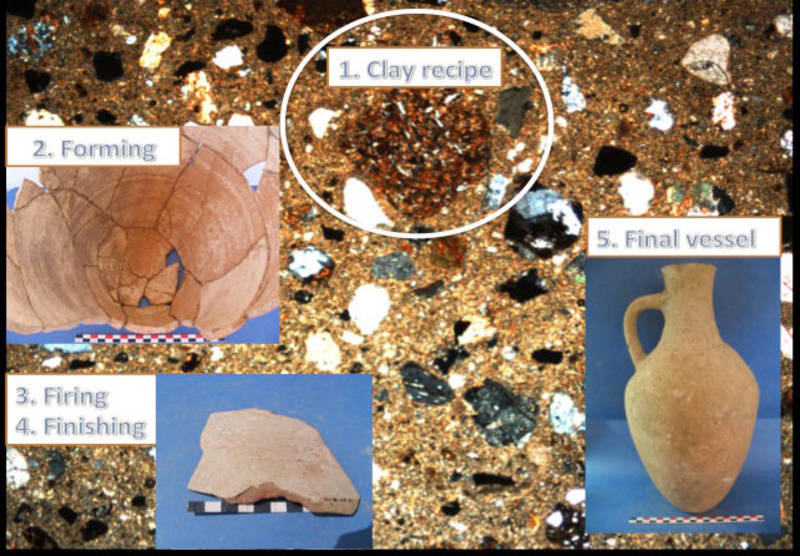
A broadly standardized repertoire of wares and shapes from Alassa can be compared with the assemblages from other contemporaneous major sites but at the same time regional and local iodiosyncracies have been observed, which suggests the existence of regional production centers. To this end, an in-depth examination of the Alassa ceramic assemblage has been undertaken, including petrographic and chemical analyses (lead and strontium isotopic analysis) on a large dataset of ceramic and geological samples. This interdisciplinary research is carried out in collaboration with Dr. Viringie Renson and Dra Christina Makarona from the Department of Geology at the Vrije Universiteit Brussel, Belgium. This joint study clearly demonstrates the presence of a number of local workshops producing both coarse and fine wares as well as a marginal occurrence of imported fine wares from other centers on the island.
Postgasse 7/1/10, 1010 Wien – Seminarraum