


A COMPARATIVE ANALYSIS OF PROTO-AURIGNACIAN AND EARLY BARADOSTIAN LITHIC ASSEMBLAGES FROM EUP-TYPE SITES OF KREMS-HUNDSSTEIG AND YAFTEH CAVE
25.11.2015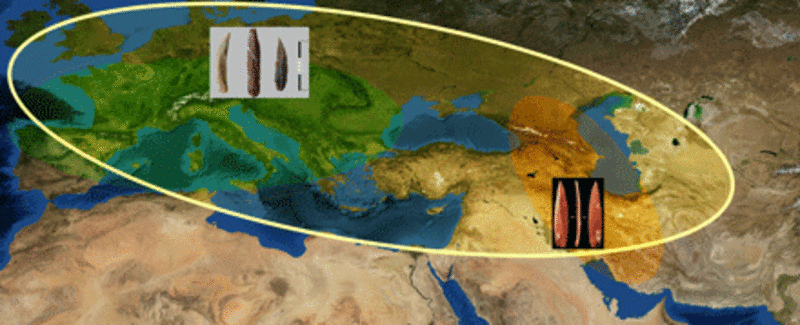
The debate of the first Aurignacian dispersal and its relation to the first widespread dispersal of Anatomically Modern Humans in western Eurasia is still growing with new discoveries. New evidence from Iran, particularly Zagros, which almost located on the Southeastern border of Aurignacian technocomplex expansion territory and traditionally considered as one of the potential core areas might shed new lights on this issue. However, in order to reach a common level of information that enables us to compare and reconstruct a more complete image of human evolution history and population movements during this period, we need more detailed studies from all the involved geographical regions. While new excavations using modern technology and refined methods are vital to clarify and test the validity of current reconstructions, there is still much to be learned from old museum lithic collections like Krems-Hundssteig or Yafteh collections. This study has chosen two lithic assemblages from eastern and western part of this territory to examine the typo-technological similarities and differences of the very early part of the Aurignacian culture. These lithic assemblages come from Krems-Hundssteig as one of the type-sites of this period in Central European context and Yafteh as the type-site of Zagros in Southwest Asia. A taphonomical approach followed by a precise typo-technological analysis of these lithic assemblages enable us to reexamine the characteristics of the first fully flagged Upper Paleolithic of Europe and compare it with Early Baradostian of Zagros which located in the eastern part of the Aurignacian technocomplex territory.
Postgasse 7/1/10, Seminarraum