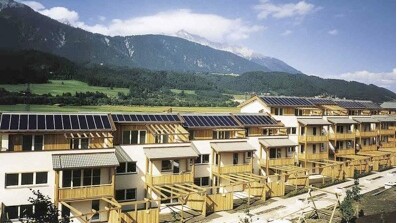
Bis zum Jahr 2050 sollen EU-weit die CO2-Emissionen um bis zu 90 Prozent reduziert werden. Dafür notwendig sind ein hocheffizientes Energiesystem, eine absolute Verbrauchsreduktion um bis zu 50 Prozent und ein radikaler Schwenk in Richtung erneuerbare Energien. Wie können diese langfristigen Ziele in Österreich erreicht werden?
Im Projekt E-Trans 2050 wurden qualitative Zukunftsbilder für das österreichische Energiesystem entwickelt. Eingebunden waren verschiedene Interessengruppen aus Politik, Wissenschaft und Wirtschaft. Ziel war es heraus zu finden, wie bestehende und zukünftige technische Möglichkeiten in sozio-ökonomische, institutionelle und kulturelle Entwicklungen eingebettet werden können.
Eine langfristige Transformation des Energiesystems, wie sie von Energiefahrplan 2050 der Europäischen Union vorgezeichnet wird, ist für alle Beteiligten ein komplexer Lernprozess. Notwendige Umstellungen erfordern ein Zusammenspiel von Technologien, Institutionen, wirtschaftlichen Rahmenbedingungen, kulturellen Werten, dem Verhalten und den Lebensstilen der Bevölkerung. Auch die Interessen und Strategien von Unternehmen und zivilgesellschaftlichen Akteure müssen dabei berücksichtigt werden.
Zunächst wurden mehrere Szenarien zur Beschreibung möglicher zukünftiger Entwicklungen erstellt: Im erstes Szenario geht es um die schrittweise Optimierung des gegenwärtigen Systems, das zweite beschreibt einen radikalen Wandel in Richtung Nachhaltigkeit, und das dritte ist ein Krisenszenario.
Diese Zukunftsbilder wurden in zwei Workshops mit VertreterInnen verschiedener Interessengruppen diskutiert. Danach wurden alle drei Szenarien auf ihr Potenzial für Nachhaltigkeit hin überprüft. Gemeinsam mit den beteiligten Interessengruppen wurden Handlungsfelder identifiziert, die für eine nachhaltigen Umbau des Energiesystems als zentral angesehen werden.
In weiteren Workshops wurden für drei ausgewählte Handlungsfelder – Raum und Energie, Ausbau der Strominfrastruktur, Bedeutung der Zivilgesellschaft – konkrete Ansatzpunkte zur Gestaltung der Energiewende erarbeitet.
The transition to a sustainable energy system faces more challenges than a simple replacement of fossil energy sources by renewable ones. Since current structures do not favor sustainable energy generation and use, it is indispensable to change the existing infrastructure. A fundamental change of the energy system also requires re-organizing spatial structures and their respective institutions and governance structures. Especially in Austria, urban sprawl and unsustainable settlement structures are regarded as one of the main developments leading to increased energy demand. One of the aims within the project E-Trans 2050 was to identify socio-economic constellations that are central to the further transformation of the energy system and to focus on actors and their socio-technical framework conditions. Based on a sustainable future vision for the year 2050 a backcasting workshop was conducted to identify necessary steps for the envisaged transition to a more sustainable energy system. The results shed light on the necessary changes for a transformation towards sustainability in the specific Austrian situation. Critical issues are region-specific production of energy and its use, settlement and regional structures and values and role models, which all have a determining influence on energy demand. Combining the knowledge of extensive energy use with available energy resources in spatial planning decisions is a main challenge towards a long term sustainable energy system.
Reducing greenhouse gases by 80%, as demanded by the IPCC, is one of the great long-term challenges facing our societies today and will doubtless require transformative changes to current energy regimes. Large-scale system transitions such as the one envisaged for the global energy system in the next 30-40 years can only be realized through complex processes of change involving global, regional, national, and local levels. In this paper we use sociotechnical scenario analysis to contribute ideas for the transformative change of the current Austrian energy system over the long term and to identify some of the particular policy measures, as well as structural changes and broader shifts in perspective, that would be necessary to deal with such challenges. There is less emphasis on the technical issues involved than on the socio-economic and governance requirements such a shift would demand. We also explain our experiences with the sociotechnical scenario process and its outcomes. In particular, we identify examples of some critical issues and opportunities within one of the identified key action fields and discuss their various implications for energy policy and everyday practices.
Economic growth rates as well as energy consumption rates have never been risen to such an exponentially amount as they did last decades. The pressure on the eco-system is immense: energy resources are exploited and GHG emissions cause temperature rise leading to climate change. Energy as one of the pillars of economic growth plays a crucial role in production and consumption processes. The paper wants to explore if a decline in energy supply necessarily leads to stadium of economic degrowth. Neoclassical and other approaches and their empirical findings give no clear results what the causal relationship between energy and economic growth is. Subsequently, the emerging degrowth movement is explored to reflect on the influence of spatial planning decisions, land use and energy on economic growth going further with some considerations about energy efficiency and energy exporting countries and their impact on economic growth. The paper concludes that the impact of energy on degrowth remains unclear but a fall in energy resource use is unavoidable.
Ornetzeder, M. (Speaker)
Ornetzeder, M. (Speaker)
Ornetzeder, M. (Speaker)
Ornetzeder, M. (Speaker)
Ornetzeder, M. (Speaker)
Ornetzeder, M. (Speaker)
Wächter, P. (Speaker)
Wächter, P. (Speaker)
Paier, M. (Contributor), Weber, M. (Contributor), Knoflacher, M. (Contributor), Rohracher, H. (Contributor), Schreuer, A. (Contributor), Ornetzeder, M. ((Co-)Author) & Wächter, P. ((Co-)Author)
Meisel, M. (Contributor), Kupzog, F. (Contributor), Leber, T. (Contributor), Ornetzeder, M. ((Co-)Author), Stachura, M. (Contributor) & Schiffleitner, A. (Contributor)
Wächter, P. (Speaker)
Ornetzeder, M. (Speaker)
Wächter, P. (Speaker)
Wächter, P. (Speaker)
Ornetzeder, M. (Speaker)
Ornetzeder, M. (Speaker)
10/2008 - 11/2010