A comparative examination of the building regulations of Vienna and Berlin in the 19th and early 20th centuries promises to distinguish, for the first time, location-specific Viennese characteristics from general developments in architecture, legislation, building administration and urban planning. The project provides international and transdisciplinary context to facilitate a better understanding of the connections between organised urban growth as a part of metropolitan development from a regulatory perspective.
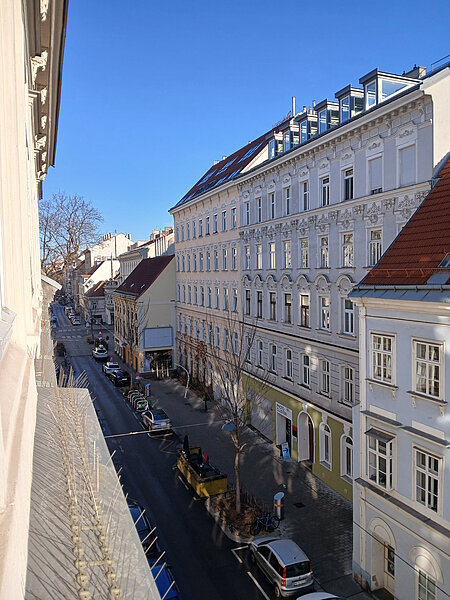
The legal basis for all construction activities lies in ‘building regulations’. A topic of discussion in Europe since the 18th century (initially among state ministerial authorities), these were introduced in the 19th century alongside the gradual establishment of self-government at the municipal level and were regularly adapted to the specific needs of growing cities. The first modern Viennese building code was created as early as 1829, based on earlier planning regulations. Its structure and scope (as well as the administrative control of the legal norms laid down by the official building inspectorate) already demonstrate how familiar its authors were with developments in other European cities: similar debates to those seen in Vienna were taking place simultaneously in London, Paris, Madrid, Rome and German-speaking areas, especially Berlin and, later, Hamburg.
Nonetheless, the respective building regulations reflect not only general developments but also location-specific adaptations. This is particularly true of the Viennese building regulations of 1859, which were amended in 1868 and 1883. The central areas of legislation now included the following:
o zoning plans (usage regulations for the plots of land available for building),
o building heights in relation to street width,
o fire safety regulations and
o green space planning.
The amended building regulations of 1883 remained the basis for planning throughout the subsequent phase of metropolitan development, which lasted until 1918. They governed the incorporation of new districts as part of the general regulatory plan, transport infrastructure projects (roads and railways) and the modernisation of sanitation (water and sewerage). To ‘read’ Vienna from its building regulations is to uncover a seemingly invisible network of facts that has been largely ignored by historical research into urban and architectural topics: no building, street, green space or piece of infrastructure was planned and constructed without its complying with the basic principles of the building regulations. This applied to both public and private construction across all areas of the city. Architectural history, in particular, should analyse the professional debates that shaped the 19th century against the backdrop of these building regulations, whose practicability was repeatedly called into question as professionals discussed the need for the technical adaptation of urban space to address, for example, modern transport (cars) or medicine (in the face of cholera epidemics).
The Viennese building regulations introduced from 1829 to 1883 (including supplementary amendments up to 1918) will be presented in terms of their specific characteristics and practical planning consequences for the development of the city’s urban design. This will form the basis for the decisive steps of contextualisation. First, we will examine which aspects of the already established state ministerial building administration were incorporated into the remit of municipal building regulations from 1829 onwards and transferred to the municipal self-government of the city and which remained under the care of state authorities.
The second level of contextualisation will be achieved through comparison on a European level. For Vienna and Austria, a comparison with Berlin and Prussia is particularly appropriate. Around 1850, Berlin was still lagging behind Vienna in terms of the dynamism of its metropolitan development, but the former’s magistrate took two far-sighted steps that attracted attention throughout Europe: the municipal building regulations of 1853 and the city expansion plan presented in 1862 (the ‘Hobrecht Plan’, named after the building official responsible). Among other points, aspects of zoning and land development in the form of parcel-like building blocks, which were to be filled with construction of varying densities depending on their designated use, were incorporated into the revised Viennese building regulations of 1859 and 1868.
The nature of developments in Vienna only becomes clear when the interrelationship between building law and urban planning in both Vienna and Berlin is examined. One means of achieving this will be to consider the texts of the regulations themselves. Another will be to analyse the regulations’ practical implementation and the topographical visual media used for this purpose (maps, plans, views and sketches), with examples selected based on their representativeness and comparability.
The next step will be to relate the urban development resulting from the Viennese building regulations of 1883 to issues of ‘urban planning’, which was then establishing itself as an independent discipline. The ‘Generalregulierungsplan’ (Vienna’s general regulation plan), conceived as a concrete planning implementation of the 1883 building code, plays a central role in this context: in 1892, the City of Vienna announced a competition for exemplary planning proposals (including the Stubenviertel competition) that would provide the framework for urban development for the next fifty(!) years. Discussions about the results culminated in the ‘Bauzonenplan’ (building zone plan) of 1893. The leaders of the debate, including the influential Camillo Sitte in Vienna and Joseph Stübben in Berlin, had already linked urban planning with sociopolitical aspirations before the emergence of modernism. In the context of the general regulation plan, urban development always encompassed more than just the aesthetic form of city design; it also entailed regulatory intervention in the economy and society, especially with regard to medicine, hygiene (‘public health’), work, transport, recreation and education. The Viennese debate can thus only be understood in an international, technical and planning policy context.
Contact
Dr. Christian Welzbacher
Term
September 2024 to August 2025
Funding
Stadt Wien, MA 7 – Kultur-, Wissenschafts- und Forschungsförderung
Workshop
12 June 2025 (Wien, PSK-Building)