


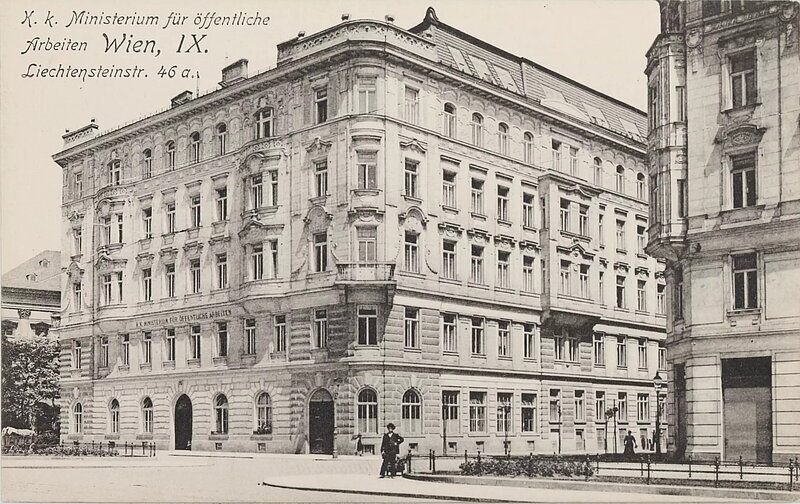
The spatial framework of the towns, villages and landscapes within which we live and move today was established by past architectural developments and building measures, particularly those of the 19th century. Research on architectural history thus enables us to better understand the conditions that shaped our current environment.
One of the core research areas of the Art History unit is the history of architecture. Architecture, by its very nature, cannot exist without a spatial context, and due to its relatively high development costs, it inherently involves a large number of actors. As such, it is deeply embedded in urban (or rural), cultural-historical, and social contexts. Chronologically, our research spans from Neoclassicism and the pre-March period (Vormärz, i.e. the decades preceding the 1848 revolution) through the height of Historicism in the latter half of the 19th century, to early Modernism in the first decades of the 20th century. This long period of observation makes it possible to identify trends and strands of development across traditional epochal concepts in the longue durée. It allows us to identify enduring patterns - for example, the evolving responsibilities of building administrations, the delayed realisation of Enlightenment ideals in architectural governance, and the longevity of these ideas once implemented. At the same time, the conditions under which architecture is produced changed significantly during this period. Key factors include the increasing scientisation of knowledge - both in terms of construction techniques and historical models and the sweeping economic and social transformations, particularly in the second half of the 19th century. A transhistorical perspective also reveals that the diverse expressions of modernism prior to 1914 laid important foundations for the architectural culture of the interwar years.
Geographically, our research begins in Vienna - a city that evolved into a major metropolis during this period. Influenced by international developments, particularly those in Western Europe, Vienna, as the capital city, became both a reflection of global urban trends and the central stage for architectural and social developments within Cisleithania in the global context of a general metropolisation. Its connections extended not only to the surrounding regions but also to neighbouring countries within the Habsburg Monarchy and to other states of Central Europe.
Currently, our research is particularly focused on the phenomenon of state-led construction within the Habsburg Monarchy. A key example is the bilateral project Invisible Agents. Alongside institutional history and studies of individual architects and professional networks - including investigations into training systems, such as the monograph project on Pietro Nobile - we also examine architecture as a formal object within its visual context and as part of specific building typologies. Methodologically, architectural and object-based research is always contextualised within broader frameworks. These include legal questions (e.g. the role of building codes in shaping architectural form and urban design), the functional and socio-spatial effects of buildings (as in the project on Healthcare Architecture in Vienna, and the conditions of constructing urban narratives, as well as the phenomena of regionality or vernacularity.