


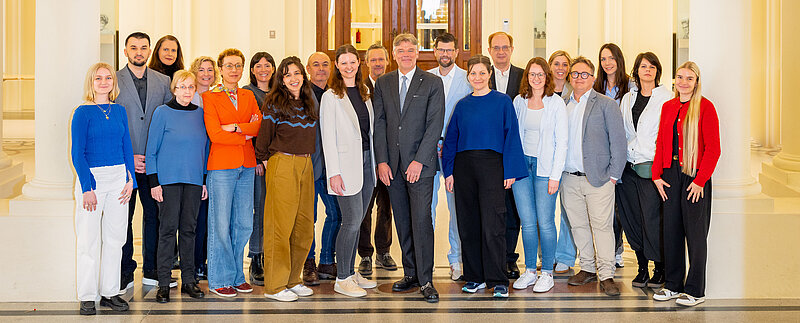
CMC investigates the transformation of public media communication in society. With a cross-media, comparative, interdisciplinary, and independent approach, it combines basic research with practice-oriented questions, thereby generating problem-relevant knowledge for academia, politics, and civil society.
The three research groups address questions of media-related change and the evolution of public spheres from complementary perspectives, focusing on three central institutions: media, politics, and science. The research groups share a theoretical perspective on mediated publics and adopt a comparative approach that emphasizes the European context, with a particular focus on Austria. From this starting point, they pursue distinct yet interrelated fields of research: media accountability, political communication, and science communication. The research perspectives differ and complement one another; key categories such as ethics and responsibility, democracy and participation, as well as truth and factuality are weighted differently across the groups and generate valuable synergies where they intersect.
CMC combines its strong theoretical profile with qualitative, quantitative, and computational methods to develop multi-dimensional approaches in the social sciences at the meta, macro, and meso levels. Its innovative thematic, theoretical, analytical, and methodological diversity is directed toward a comprehensive research agenda: the investigation of public media communication in all its dimensions and interrelations – both synchronic and diachronic – and in international contexts. This results in a strategic profile that links scientific and societal spheres of impact, integrates research and teaching, and is embedded in a broader epistemic context. In this way, CMC pursues the normative goal of contributing to the strengthening of democracy.