


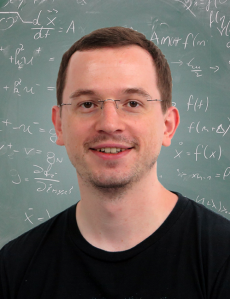
Wissenschafter
Leiter Fachbereich Mathematik
Leiter Information and Inference
Maschinelles Lernen
Tel. +431 51581-2548
Email: guenther.koliander(at)oeaw.ac.at
Wissenschaftliche IDs:
ORCID: orcid.org/0000-0002-4750-3305
Google Scholar: Günther Koliander
Bildung
Günther Koliander schloss 2011 das Studium der technischen Mathematik an der TU Wien mit ausgezeinetem Erfolg ab (Diplomarbeit “Hilbert Spaces of Entire Functions in the Hardy Space Setting”). Von 2011 bis 2017 war er Mitarbeiter am Institute of Telecommunications der TU Wien wo er sein Doktorat im WWTF Projekt NOWIRE im April 2015 mit Auszeichnung abschloss (Dissertation "Information-theoretic analysis of noncoherent block-fading channels and singular random variables").
Er besuchte zweimal die Chalmers University of Technology, Göteborg, Schweden sowie einmal die Georg August Universität Göttingen, Göttingen, Deutschland als wissenschaftlicher Mitarbeiter.
Seit Juli 2017 ist er Mitglied des Fachbereichs "Mathematik und Signalverarbeitung in der Akustik" des Instituts für Schallforschung, mit kurzer Unterbrechung einer Anstellung an der Fakultät für Mathematik der Universität Wien von Juli bis Dezember 2021.
Derzeitige Forschung
Günther Koliander ist einer der Projektleiter des Projektes "Digitization, Recognition and Automated Clustering of Watermarks in the Music Manuscripts of Franz Schubert" und arbeitet in dem Projekt "Zeit-Frequenz Analyse, Zufälligkeit und Abtastung" mit.
Aktuelle Themen:
- Information Theory
- Machine Learning
- Compressed Sensing
- Point Processes
- Time-frequency and Time-scale Analysis
Publikationen
- Rhythmic Structure Shapes Dyadic Self−Other Representations Through Interpersonal Action Coupling. / Sadaphal, Dhwani P.; Koliander, Günther; Blum, Christian R. et al.
in: Annals of the New York Academy of Sciences, Jahrgang 1562, Nr. 1, e70344, 03.08.2026, S. e70344.Moving in unison to a musical beat can blur boundaries between individual movements, fostering prosociality. However, structured patterns of sounds and silences in rhythms (meter) allow various ways of moving to the beat. How do these different rhythmic interpretations affect social connectedness? Unacquainted dyads drummed in unison, and at more complex integer multiple and polyrhythmic ratios. Coordination requires continuously tracking who does what and when. We varied trackability by manipulating task-sharing (the same or separate drum pads, and audible or inaudible partner drumming). More complex ratios decreased social connectedness. However, coordination revealed a dichotomy between unison and the more complex ratios: in unison drumming, participants automatically tracked and adjusted to each other's actions, but both integer multiples and polyrhythms separated the two participants' actions in time, allowing one to be stable despite their partner being variable. Hearing each other increased participants' mutual reliance on each other's actions, but by itself did not increase connectedness. However, sharing a drum pad and audio significantly boosted self-other merging ratings. Notably, more stable coordination facilitated integrated self-other representations. Our findings are consistent with the premise that meter provides a shared cognitive-motor scaffold that enables group cohesion, while simultaneously allowing individual expression through multi-part rhythm production.
- Hyperuniformity and non-hyperuniformity of zeros of Gaussian Weyl-Heisenberg Functions. / Feldheim, Naomi; Haimi, Antti; Koliander, Günther et al.
in: Probability Theory and Related Fields, Jahrgang 195, Nr. 3-4, 27.06.2026, S. 1699-1764.We study zero sets of twisted stationary Gaussian random functions on the complex plane, i.e., Gaussian random functions that are stochastically invariant under the action of the Weyl-Heisenberg group. This model includes translation-invariant Gaussian entire functions (GEFs), and also many other non-analytic examples, in which case winding numbers around zeros can be either positive or negative. We investigate zero statistics both when zeros are weighted with their winding numbers (charged zero set) and when they are not (uncharged zero set). We show that the variance of the charged zero statistic always grows linearly with the radius of the observation disk (hyperuniformity). Importantly, this holds for functions with possibly non-zero means and without assuming additional symmetries such as radiality. With respect to uncharged zero statistics, we provide an example for which the variance grows with the area of the observation disk (non-hyperuniformity). This is used to show that, while the zeros of GEFs are hyperuniform, the set of their critical points fails to be so. Our work contributes to recent developments in statistical signal processing, where the time-frequency profile of a non-stationary signal embedded into noise is revealed by performing a statistical test on the zeros of its spectrogram (“silent points”). We show that empirical spectrogram zero counts enjoy moderate deviations from their ensemble averages over large observation windows (something that was previously known only for pure noise). In contrast, we also show that spectrogram maxima (“loud points”) fail to enjoy a similar property. This gives the first formal evidence for the statistical superiority of silent points over the competing feature of loud points, a fact that has been noted by practitioners. In the same vein, our second order asymptotics for spectrogram maxima show that certain heuristic proxy models used in signal processing are inaccurate at large scales.
- Extended Multiobject Tracking With Nonparametric Bayesian Learning of Object Classes and Model Parameters. / Bucco, T. J.; Kreidl, B.; Koliander, G. et al.
in: IEEE Transactions on Aerospace and Electronic Systems, Jahrgang 62, 10.04.2026, S. 11327-11341.We propose a Bayesian model and method for tracking multiple extended objects exhibiting a latent (unknown) class structure. The number of object classes, the class parameter values, and the objects' class affiliations are learned simultaneously with the tracking process, and the learned information is leveraged for improved tracking performance. This is enabled by a Bayesian parameter-dependent state-space model that incorporates the objects' class structure through a nonparameteric (Dirichlet process) prior for the class parameters, and by a Markov chain Monte Carlo algorithm for joint class estimation, object-class assignment, and extended multiobject tracking. Simulation results show that exploitation of the objects' latent class structure using the proposed method can significantly improve the performance of tracking and parameter estimation.
- Digitalisierung, Erkennung und automatisierte Clusterung der Wasserzeichen in den Musikhandschriften Franz Schuberts. / Gulewycz, Paul; Gubsch, Clemens; Czernin, Anna Maria et al.
Quelle & Deutung I.IX: Beiträge der Tagung Quelle und Deutung IX am 20. November 2024. Hrsg. / Balázs Sára. Budapest: Eötvös-József-Collegium, 2025. S. 227-242.Die Wasserzeichen in Franz Schuberts Musikhandschriften bergen noch immer ungelöste chronologische Rätsel. Trotz jahrzehntelanger Bemühungen der ‚Neuen Schubert-Ausgabe' blieb die zeitliche Einordnung vieler undatierter Werke anhand der Wasserzeichen problematisch, da herkömmliche Verfahren zur Wasserzeichenerkennung bei der oft mangelhaften Qualität des Notenpapiers an ihre Grenzen stießen. Im Rahmen des DRACMarkS-Projekts konnte erstmals eine neuartige Wasserzeichen-Digitalisierungsmethode auf die Schubert-Quellen angewendet werden: die Thermographie, ein infrarotbasiertes Bildgebungsverfahren, welches auchvon Notentext überlagerte Wasserzeichen frei erkennbar macht. Das Projektteam, bestehend aus Expert:innen aus den Bereichen Musikwissenschaft, Signalverarbeitung und Digital Humanities, entwickelte eine innovative Methodik zur automatisierten Wasserzeichen-Analyse, die eine präzise Erfassung durch strukturierte MEI/XML-Codierung in Kombination mit algorithmischer Kettlinien-Analyse ermöglicht. Die entwickelte Methode zur digitalen Rekonstruktion ursprünglicher Papierbögen eröffnet neue Perspektiven für die Datierung schwer einzuordnender Handschriften und schafft wegweisende Standards für die musikphilologische Wasserzeichenforschung.