Dieser Text ist nur in englischer Sprache verfügbar.
A strong mathematical background is essential across the physical and engineering sciences. The interplay between applied and theoretical research often drives progress in both directions, creating natural synergies. At the Acoustics Research Institute, examining the mathematical foundations of our research projects—particularly in signal processing—is therefore considered an integral part of acoustic research.
Time–frequency representations form the fundamental mathematical framework for analysing acoustic signals. Our work focuses on a thorough theoretical study. This includes developing and understanding abstract mathematical results, as well as examining how these results translate to real-world signals through discretization and quantization, thereby paving the way toward practical applications.
Collaboration between the Mathematics Cluster and the other clusters at the Institute has proven highly productive and will continue to be strengthened. While the other clusters benefit from mathematically grounded methods for solving their application-driven questions, mathematicians gain the opportunity to address problems of practical relevance while advancing new theoretical directions. This dialogue significantly deepens the shared understanding across fields.
Head: Peter Balazs
A long-standing focus of our research is frame theory, the mathematical study of redundant representations, and its connections to other disciplines such as signal processing, physics, numerical analysis, and machine learning. These links also extend to applications in psychoacoustics, bioacoustics, and speech and music signal processing. In this context, implementation and optimization issues become essential parts of the research program.
We investigate abstract frames, frames with special structure (such as Gabor frames, wavelets, or convolutional neural networks), and generalized frame concepts. Our work concerns not only the representation of elements in Hilbert spaces—“vectors”—but also the representation of operators. We go beyond the linear setting of classical frame theory and study nonlinear frames, for example in phase retrieval or in the layers of deep neural networks. The group’s work spans the full spectrum from purely abstract to applied results, and from continuous theory to discrete and finite-dimensional settings.
Head: Günther Koliander
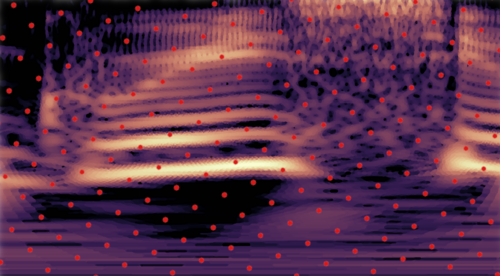
We focus on integrating concepts from probability theory and Bayesian signal processing into time–frequency analysis and acoustic signal processing. One goal is to develop a fundamental understanding of time–frequency representations of random processes, with a current emphasis on Gaussian processes and the zero sets of their short-time Fourier transform. In a second line of research, the group develops methods that combine data-driven and model-based inference to harness the practical success of deep-learning approaches—whose internal mechanisms often remain poorly understood—within a strictly Bayesian framework.
Head: Nicki Holighaus
Our central goal is to develop mathematical theory that enables the construction of novel, universal discretization schemes for frames, in particular for continuous frames. Like (discrete) frames, continuous frames are function dictionaries that allow complex data to be decomposed into simple building blocks, or atoms. However, continuous frames often consist of uncountably many atoms and are therefore highly redundant. Reducing the size of such dictionaries is thus essential for their practical use.
We investigate reduction schemes that can be applied under mild and general assumptions on the dictionary—in other words, schemes that are universal. This step is crucial for enabling the use of more flexible and general dictionaries and for supporting their efficient implementation across a variety of applications.
Our work at ARI focuses on mathematical concepts related to acoustics and on demonstrating their relevance for real-world applications. The most convenient mathematical abstraction of sound (i.e., an acoustic signal) is as a function in time, i.e., for each and every point in time, we assign a sound pressure to that time point. This results in several challenges if we want to use this concept in the real world: The first challenge is that we cannot measure sound pressure continuously; we have to sample the signal at specific time points (discretization). The second challenge is that we cannot consider the signal over all time, but only over a small time period (localization). Finally, the third challenge is that we can never measure with arbitrary precision, and our measurements are constantly subjected to some type of noise (randomization). These are the three challenges that are central to our mathematical research at ARI: discretization, localization, and randomization.
Discretization of a signal is classically done by taking samples at regular intervals, and the underlying sampling theory is well developed, with many fundamental theorems known. Our focus is on a different type of discretization that corresponds to integrating windowed versions of the signal. In mathematical terms, we take inner products with a system of functions. The system of functions is designed here to build a robust representation of arbitrary functions in a given class. Such systems are known as "frames," and their theory is a central pillar of our research.
Localization, in its simplest form, is to consider a signal only on a finite time interval and ignore the rest. However, it is difficult to argue what interval is best to choose given certain properties of our signal (usually described by the signal belonging to a certain function space), and what the tradeoff is between the accuracy of our signal representation and the interval length. We want to identify optimal ways to focus on a specific time and frequency range of interest and to generalize these concepts to operators as well.
Randomization is finally the link that enables the transition of a signal not only to a finite number of (real-valued) sampling values, but to a finite number of bits. Indeed, information theory tells us that a signal in noise contains only a finite number of bits of information. In other words, if we consider signals not to be deterministic but inherently random, it does not make sense to represent them more accurately than with a certain finite number of bits, as is commonly done in any form of digital storage of audio data. We consider fundamental questions about random signals in time-frequency space, seek to understand their properties, and identify how we can exploit them in applications.
Youtube Talks:
Links: