


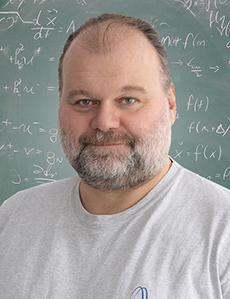
Direktor
Fachbereich Mathematik
Leiter Frame Theory and its Implementation
Maschinelles Lernen
Tel. +43 1 51581-2510
Email: peter.balazs(at)oeaw.ac.at
Wissenschaftliche IDs:
orcid.org/0000-0003-4939-0831
Scopus Author ID: 8211873600
ResearcherID: E-3020-2010
https://scholar.google.at/
https://www.researchgate.net/
Bildung
Peter Balazs studierte Mathematik und Mathematik/Physik Lehramt an der Universität Wien. 2001 schloss er sein Studium mit einer Diplomarbeit zum Thema Polynome über Gruppen (download hier) mit Auszeichnung ab. Im Juni 2005 beendete er sein Dissertationsstudium mit einer Arbeit über Regular and Irregular Gabor Multiplier with Application to Psychoacoustic Masking (download hier) mit Auszeichnung.
Peter Balazs ist Teil des Institutes seit 1999. Seine Dissertation schrieb er an der NuHaG, Fakultät für Mathematik der Universität Wien. Durch diese Kooperation bekam er die Möglichkeit, mittels des HASSIP EU Network am LATP, CMI und LMA, CNRS Marseille von November 2003 - April 2004 zu studieren und im August 2005 an der FYMA, UCL, Louvain-La-Neuve.
Im Jahr 2011 erhielt er den Start-preis – das österreichische Pendant zum ERC Starting Grant – und damit die höchste Auszeichnung für Nachwuchswissenschafter:innen in Österreich. Im selben Jahr schloss er seine Habilitation mit dem Titel "New Concepts in Frame Theory Motivated by Acoustical Applications" ab.
2012 wurde er zum Direktor des Instituts ernannt. Im Jahr 2022 wählte ihn die International Commission for Acoustics zum Kassier. Seit April 2025 ist er Fellow Professor of Acoustics, Analysis, and AI (3AI) an der Interdisciplinary Transformation University Austria (IT:U).
Derzeitige Forschung
Peter Balazs interessiert sich für die Theorie der redundanten Darstellungen ("Frames"), Operatoren und Zeit-Frequenz-Analysen. Diese Konzepte werden verbindet er mit Signalverarbeitung, maschinellem Lernen, Bioakustik, Sprachverarbeitung, mathematische Physik, numerische Akustik, Optimierung und Psychoakustik.
Publikationen
- The Lifting Property for Frame Multipliers and Toeplitz Operators. / Balazs, Peter; Grochenig, Karlheinz.
in: Integral Equations and Operator Theory, Jahrgang 98, Nr. 4, 47, 25.09.2026.Frame multipliers are an abstract version of Toeplitz operators in frame theory and consist of a composition of a multiplication operator with the analysis and synthesis operators. Whereas the boundedness properties of frame multipliers on Banach spaces associated to a frame, so-called coorbit spaces, are well understood, their invertibility is much more difficult. We show that frame multipliers with a positive symbol are Banach space isomorphisms between the corresponding coorbit spaces. The results resemble the lifting theorems in the theory of Besov spaces and modulation spaces. Indeed, the application of the abstract lifting theorem to Gabor frames yields a new lifting theorem between modulation spaces. A second application to Fock spaces yields isomorphisms between weighted Fock spaces. The main techniques are taken from the theory of localized frames and the spectral invariance of matrix algebras.
- Bioacoustic processing and analyses of mouse vocalizations: Current methods and future directions. / Abbasi, Reyhaneh; Nicolakis, Doris; Marconi, Maria Adelaide et al.
in: Behavioural Brain Research, Jahrgang 513, 116337, 13.09.2026.House mice (Mus musculus), like other rodents, communicate using sonic and ultrasonic vocalizations (USVs), but their functions are still poorly understood. One of the main challenges for studying any acoustic communication is processing and analyzing audio files. Our aims here are to provide a critical and comprehensive review of the new bioacoustic tools available for processing and analyzing recordings of mouse vocalizations. We consider each method as used in a serial data processing pipeline and how to minimize errors at each step to prevent error propagation (or error cascades). First, we review methods for processing audio files of recordings of mice. We compare conventional approaches for visualizing vocalizations (time-frequency representations) with an alternative method adapted to the mouse auditory system. We compare machine learning (ML) and signal processing methods for automating USV detection and emphasize the need for better methods for denoising audio files and reliable frequency contour (ridge) tracking and feature extraction. Second, we review methods for analyzing detected USVs, focusing on classification and sequencing approaches. Classifying USVs is a challenging task because, while some calls are discrete, others show graded variation within and between call classes. We compare supervised classifications and unsupervised labeling, and we emphasize the importance of reliable manual (researcher-based) methods as a gold standard for automated ML approaches. We review classifications of mouse vocalizations in the literature, and we propose a new hierarchical framework for the classification of USVs. We examine methods for sequencing USVs and consider their relative advantages. Finally, we address the unresolved technological challenges for these methods to study rodent vocalizations and propose potential solutions for the future.
- Training Set Synthesis for Bioacoustic Denoising: A Case Study With Mice. / Abbasi, R.; Balazs, P.; Lostanlen, Vincent et al.
in: IEEE Transactions on Audio, Speech and Language Processing, Jahrgang 34, 31.07.2026, S. 3802-3816.Bioacoustic recordings are often degraded by ambient noise, which complicates the analysis of weak or noise-overlapped vocalizations. Convolutional neural networks, particularly U-Net architectures, have shown strong denoising performance in speech and music processing. However, their application for denoising bioacoustic signals is limited by the scarcity of clean training data. To address this, we propose a training set synthesis approach and develop a supervised denoising model that predicts a complex ratio mask in the time-frequency domain. The model leverages ridges, or frequency contours, that represent the fundamental frequency together with one or more harmonic partial components of vocalizations. These ridges are used both for the synthesis of training set and for the design of a loss function that assigns higher weights to the ridge regions (ridge-guided loss function). This weighting step helps the network better preserve vocalization details during denoising. As a case study, we evaluate our approach using ultrasonic vocalization (USV) recordings of house mice, which are widely studied in behavioral biology and neuroscience. In field recordings, the proposed method enhances tracking of fundamental and harmonic partial ridges compared to previous signal-processing approaches. In addition, a classifier trained on denoised data improves USV classification on out-of-sample, noisy recordings from wild and domesticated mice compared to classifiers trained on noisy recordings. The proposed method also substantially improves the scale-invariant signal-to-distortion ratio on synthetic testing data across a wide range of input signal-to-noise ratios. While focused on USVs, the proposed approach is broadly applicable to other bioacoustic signals with trackable ridges, and thus enables ridge-based training set synthesis and denoising.
- Courtship vocalizations of male mice do not always attract females. / Peng, Maja; Zani, Martina; Abbasi, Reyhaneh et al.
in: Scientific Reports, Jahrgang 16, Nr. 1, 30398, 02.07.2026.Male house mice (Mus musculus) emit ultrasonic vocalizations (USVs) during courtship and mating, which influence their copulatory success. Several studies have found that playbacks of male USVs attract females, though this response may depend on the presence of male scent, and one study suggested that females are more attracted to complex than simple USV types. We conducted three playback experiments with wild-derived female house mice to test these predictions. None of our results met our expectations: First, females were not more attracted to sequences of complex versus simple USVs. Second, females were also not more attracted to these syllables when compared to silence. Third, females showed no attraction towards more natural sequences containing simple and complex USVs compared to silence, even in the presence of male scent. Thus, we found no evidence that wild-derived female mice show approach behavior towards male USVs, regardless of their complexity or exposure to male olfactory stimuli. These findings raise questions about the repeatability and generalizability of playback studies in house mice and highlight the need for more studies aimed at determining the types of vocalizations and contexts under which mice do and do not show attraction or other responses to USVs.
- Localised frames for tensor product spaces. / Bytchenkoff, Dimitri; Speckbacher, Michael; Balazs, Peter.
in: Monatshefte fur Mathematik, Jahrgang 210, Nr. 3-4, 18.05.2026, S. 427-441.In this paper, we investigate whether the tensor product of two frames, each individually localised with respect to a spectral matrix algebra, is also localised with respect to a suitably chosen tensor product algebra. We provide a partial answer by constructing an involutive Banach algebra of rank-four tensors that is built from two solid spectral matrix algebras. We show that this algebra is inverse-closed, given that the original algebras satisfy a specific property related to operator-valued versions of these algebras. This condition is satisfied by all commonly used solid spectral matrix algebras. We then prove that the tensor product of two self-localised frames remains self-localised with respect to our newly constructed tensor algebra. Additionally, we discuss generalisations to localised frames of Hilbert-Schmidt operators, which may not necessarily consist of rank-one operators.
- Localization of operator-valued frames. / Köhldorfer, L.; Balazs, P.
in: Applied and Computational Harmonic Analysis, Jahrgang 84, 101868, 01.05.2026.We introduce a localization concept for operator-valued frames, where the quality of localization is measured by the associated operator-valued Gram matrix belonging to some suitable Banach algebra. We prove that intrinsic localization of an operator-valued frame is preserved by its canonical dual. Moreover, we show that the series associated to the perfect reconstruction of an operator-valued frame converges not only in the underlying Hilbert space, but also in a whole class of associated (quasi-)Banach spaces which are carefully introduced and analyzed. Finally, we apply our results to irregular Gabor g-frames.
- Weighted Frames, Weighted Lower Semi Frames and Unconditionally Convergent Multipliers. / Balazs, Peter; Corso, Rosario; Stoeva, Diana.
in: Journal of Fourier Analysis and Applications, Jahrgang 32, Nr. 1, 24, 09.02.2026.In this paper, we ask when it is possible to transform a given sequence into a frame or a lower semi frame by multiplying the elements by numbers. In other words, we ask when a given sequence is a weighted frame or a weighted lower semi frame and for each case we formulate a conjecture. We determine several conditions under which these conjectures are true. Finally, we prove an equivalence between two older conjectures. The one being that any unconditionally convergent multiplier can be written as a multiplier of Bessel sequences by shifting weights between the generating sequences of the multiplier. The second one that every unconditionally convergent multiplier which is invertible can be written as a multiplier of frames by a similar shift of weights. We also show that these conjectures are also related to one of the newly posed conjectures.
Weitere Informationen
Wissenschaftliche Mitgliedschaften
Seit 2005 Mitglied bei IEEE, darüber hinaus Mitglied bei AES, ÖMG, EMS, ÖGA und DEGA.
Hobbys
Peter Balazs spielt gerne Musik (Schlagzeug), Baseball, alle Arten von Spiele (besonders Rollen- und Computerspiele). Seine persönliche Homepage ist hier abrufbar.
Forschung in der Vergangenheit
Peter Balazs arbeitete am Start-Projekt 'Frames and Linear Operators for Acoustical Modeling and Parameter Estimation', das darauf abzielt die Frame Theorie als mathematischen Hintergrund für akustische Modellierung zu etablieren. Mehr Detail hier.
Peter Balazs war Leiter des WWTF-Projekts Frame Multiplier: Theory and Application in Acoustics, das im März 2008 begonnen hat. Diese Projekt fand neue Resultate in der mathematischen Theorie der "Frame Multiplier", integrierte diese in effizienten Signalverarbeitungs-Algorithmen und stellte sie damit konkreten akustischen Anwendungen zur Verfügung. Dieses internationale, multi-disziplinäre und teamorientierte Projekt hat P. Balazs erlaubt, eine kleine Gruppe Mathematik und akustische Signalverarbeitung am Institut für Schallforschung zu gründen, in Zusammenarbeit mit NuHaG Wien (Hans G. Feichtinger), Laboratoire PRISM des LMA / CRNS Marseille (Richard Kronland-Martinet) und der Institut de Mathématiques de Marseille (Bruno Torrésani) sowie FYMA, UCL, Louvain-La-Neuve (Jean-Pierre Antoine). Diese Gruppe ist mittlerweile deutlich gewachsen.
P. Balazs beschäftigte sich mit dem Thema Regular and irregular Gabor multiplier with application to psychoacoustic masking. Mit diesem Projekt bewegte er sich im Schnittfeld von harmonischer Analyse und Psychoakustik. 2006 und 2007 hatte das Institut für Schallforschung in Kooperation mit dem Laboratoire PRISM des LMA / CRNS Marseille ein WTZ-Austauschprojekt zum Thema "Time-Frequency Representation and Perception" bewilligt bekommen. Im August 2005 arbeitete P. Balazs an der FYMA, UCL, Louvain-La-Neuve an der Operator Theorie als Grundlagenforschung für das Projekt.
Seit 1999 arbeitete er auch in der Softwareabteilung an Implementierungen für die Software S_TOOLS-STx in Makro und C++, an Dokumentationen, an der Entwicklung einer Benutzeroberfläche und am Konzept einer Datenbankstruktur. Nach Studienabschluss beschäftigte er sich mehr und mehr mit dem mathematischen und theoretischen Hintergrund der Signalverarbeitung, wobei er im Juni 2003 von der Softwareabteilung zur numerischen Abteilung des Instituts wechselte. Neben anderen Projekten (bspw. die Untersuchung der Phase in der Akustik und die Unterstützung anderer Projekte durch sein mathematisches Wissen und einigen Programmierarbeiten) arbeitete er auch bei dem Projekt "Vibrations in soils and liquids - Transform method for layers with random properties" von Dr. Ing. habil. Waubke mit, das vom FWF gefördert wird.
P. Balazs beschäftigte sich auch mit der diskreten Gaboranalyse und der Gabortheorie in finiter diskreter Umgebung, welche von höchstem Interesse bei jeder Anwendung ist. Im Speziellen arbeitete er an der Untersuchung eines numerisch effizienten Weg, um ein duales Fenster zu entwickeln (ein Fenster, das perfekte Rekonstruktion erlaubt). Er nützte dafür die spezielle Struktur der Gaboranalyse und -synthese für das Doppelte Präkonditionieren des Gabor Frame Operators aus.