
Technology development is integral to our research, because many key features of genome organization are difficult to measure with existing methods. We therefore build new tools to capture nuclear structure and dynamics with higher resolution and throughput. On the genomics side, we develop chromosome conformation approaches that can resolve interactions between sister chromatids during replication, mitosis, and DNA repair. In parallel, we create programmable, highly multiplexed fluorescence imaging strategies to map the spatial organization of sister chromatids, RNA molecules, and proteins in single cells. To translate these measurements into mechanistic insight, we establish controlled in-vitro reconstitution systems that allow precise manipulation under defined conditions. Analyzing these complex, multi-dimensional data leads us to develop new computational tools. Together, these complementary approaches allow us to discover new organizational principles in cells, recreate them in simplified settings, and then test models using engineered synthetic chromatin organizers that compact chromatin or bias its positioning. By expanding both what we can measure and what we can control, we aim to open new routes to uncovering the physical rules that govern nuclear organization.

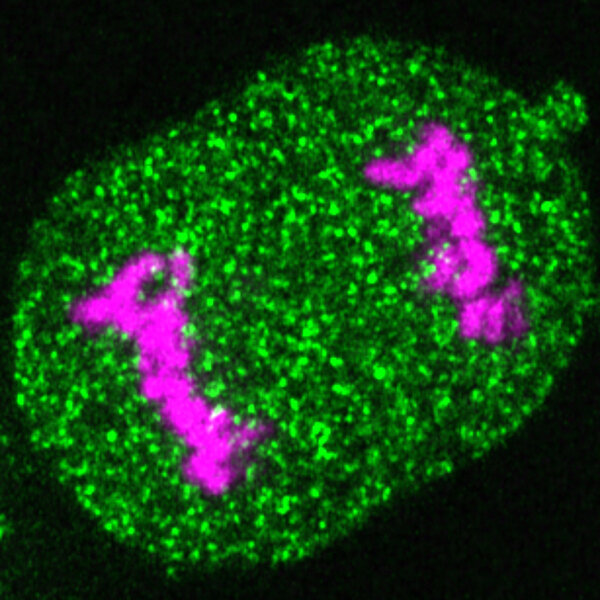
DNA replication must duplicate not only the DNA sequence, but also the 3D organization that supports gene regulation and genome stability. Replication creates two sister chromatids that need to preserve internal folding patterns for long-range gene control while also forming physical connections between sisters so that DNA breaks can be repaired using an intact template. We are interested in how two functionally distinct pools of cohesin coordinate these tasks: one pool that dynamically extrudes DNA into loops and one pool that holds sister chromatids together by cohesion. Building on our sister-chromatid–resolved genomics and imaging, we map how newly replicated chromatin is folded and how sister chromatids are positioned relative to each other. We then ask how this architecture influences transcriptional output, the mechanics of sister chromatid separation, and the efficiency and fidelity of DNA repair.
Homologous recombination faithfully repairs DNA double-strand breaks by finding a matching DNA sequence that serves as a template to restore missing information at the damaged site. This homology search must be fast and precise, yet it takes place in a nucleus where DNA molecules containing billions of nucleotides are densely folded and constantly moving. We ask how genome architecture makes this search possible across two scales. At the chromosome level, we investigate how cohesin-mediated loops and sister-chromatid linkages constrain the space that a break can explore. At the molecular scale, we test how DNA packaging into nucleosomes controls access to the underlying sequence and how the search process locally remodels chromatin during strand exchange. By combining sister-resolved genomics with quantitative imaging and biochemical reconstitution, we aim to reveal how chromatin organization enables fast and accurate homology-directed DNA repair.
RNA molecules are long, flexible polymers that must move through a nucleus densely filled with chromatin to reach the nuclear envelope for export to the cytoplasm. Along the way, RNA must avoid becoming entagled with chromatin or aggregating through unintended base pairing with other RNAs. Cells reduce these risks by packaging RNA into ribonucleoprotein particles (RNPs), yet the physical rules that govern how individual RNAs are folded within RNPs, and how this folding influences nuclear transport, remain poorly understood. Using multiplexed super-resolution RNA imaging, we map the three-dimensional conformations of individual RNA molecules in cells and measure how their mobility changes when key RNP components are perturbed. In parallel, we reconstitute RNA–protein assemblies and chromatin fibers under controlled conditions in vitro to test how packaging modulates RNA–chromatin interactions and diffusion. Together, these approaches aim to define the physical and molecular principles that govern how RNA and chromatin are co-organized within the cell nucleus.