The Institute for Urban and Regional Research is part of the Horizon Europe research project “OppAttune – Countering Oppositional Political Extremism Through Attuned Dialogue: Track, Attune, Limit”, funded by the European Commission (3 years, 04/2023-03/2026).
OppAttune brings together an ambitious multi-disciplinary team of academics and practitioners to examine the evolution of political extremism and its influence on social and political dialogue with the aim to track, attune and limit the spread of oppositional extreme narratives.
The three objectives of the project are defined as follows:
The team at the ISR is responsible for work package 4 “Media, Machines and Mobilisation” together with Tina Askanius and Jullietta Stoencheva from Malmö University. The objective of this work package is to identify and understand contemporary extremist narratives in online and offline spaces and to map their spread across the digital mainstream and into local ecologies. Within the large consortium of the project, work package 4 pursues a transdisciplinary approach, bringing together media and urban scholars. We understand everyday extremism not as a fixed category but as a set of processes operating across scales and continuums, from local to translocal and global, and across physical and digital spaces. In our work, we pay attention to how narratives move and mutate between different public spaces, how they are reinforced by spatial infrastructures (built as well as digital) and how they are mediated through routinised, embodied practices and visual artefacts that circulate in both the digital and physical spaces that citizens inhabit and move through in everyday life.
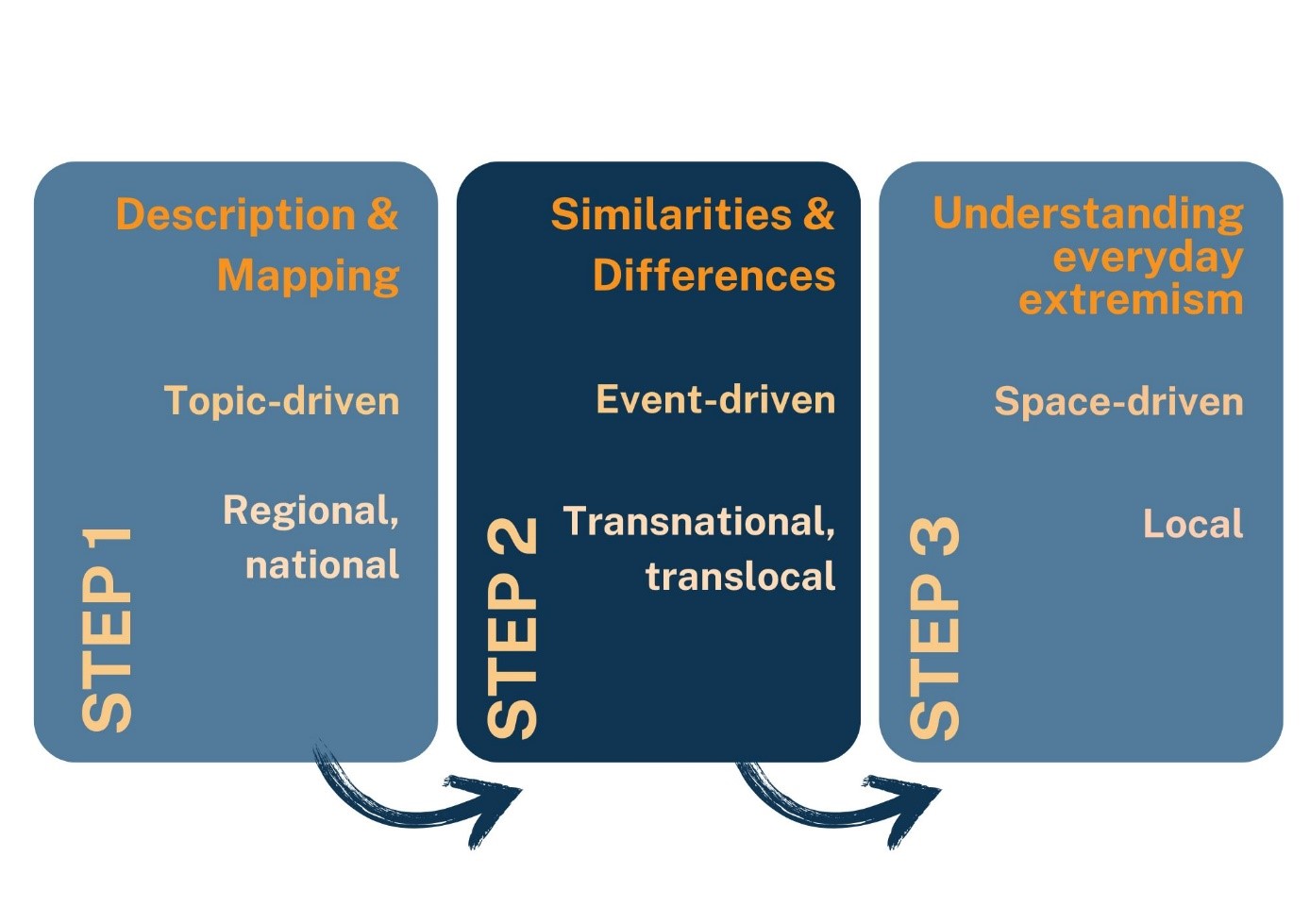
Work package 4 follows a stepwise approach. The first deliverable maps everyday extremist narratives and their online spread (Askanius et al., 2024a). The second deliverable examines the 2024 European Parliament elections to trace how extremist narratives were articulated, disseminated, and contested across online and offline spaces, noting that war and conflict emerged as a crucial topic while vaccination folded into a broader conspiracy frame (Askanius et al., 2024b). The third deliverable summarises the blog post series conducted within work package 4 (Askanius et al., 2025a). The fourth deliverable (Haselbacher et al., 2026) adopts a space-centered approach and presents findings from ethnographic fieldwork conducted in different neighbourhoods in Athens, Malmö and Vienna. The final deliverable, a public engagement practitioners handbook on everyday extremism and artificial intelligence (Askanius et al., 2025b), provides a synthesis of research on AI and online extremism and recommendations for how to engage the wider public in conversations about the polarising and dehumanising ideas.
Deliverables and further reading:
Askanius, T. & Stoencheva, J. (2024). On Memes and Mugs. Everyday Extremism in the (Digital) Mainstream. In The Psychologist, Special Issue ‘Being Political in Divisive Times (Guest Editors Mahendran, K., Obradović, S., Nieland, S., & Weinberg, A.). available online
Askanius, T., Haselbacher, M., Reeger, U., & Stoencheva, J. (2024a). Visualisation report of emerging extremist narratives across Europe. OppAttune D4.1. download here
Askanius, T., Haselbacher, M., Stoencheva, J., & Ursula, R. (2024b). Translocal articulations of extremism in three countries: Visualisation report on Austria, Bulgaria, and Sweden. OppAttune D4.2. download here
Askanius, T., Haselbacher, M., Reeger, U., & Stoencheva, J. (2025a). OppAttune Media, Machines & Mobilisation Blog. OppAttune D4.3. download here
Askanius, T., Filiou, D., Haselbacher, M., Rowell, G., Stoencheva, J. & Reeger, U. (2025b). Everyday Extremism & Artificial Intelligence Public Engagement Practitioners Handbook. OppAttune D4.6. download here
Haselbacher, M., Stoencheva, J., Droumpali, M., Stiegler, J., Reeger, U., Askanius, T., & Ntontis, E. (2026). Three Ethnographic Case Studies Spaces of political contention and everyday extremism in Athens, Malmö and Vienna. OppAttune D.4.4. download here
Reeger, U. & Haselbacher, M. (2024). Divided Cities? In The Psychologist, Special Issue ‘Being Political in Divisive Times (Guest Editors Mahendran, K., Obradović, S., Nieland, S., & Weinberg, A.). available online
Stoencheva, J., Haselbacher, M., Askanius, T., & Reeger, U. (2026). Everyday extremism: memes and the mainstreaming of extremist narratives around the 2024 European Parliament election. Popular Communication, 1–21. https://doi.org/10.1080/15405702.2026.2629792

April 2023-March 2026